Nikhil Prasad Fact checked by:Thailand Medical News Team Apr 21, 2026 5 months, 1 week, 5 days, 22 hours, 11 minutes ago
Medical News: A new follow-up study is raising fresh concerns about the long-term neurological effects of COVID-19, revealing that many patients continue to suffer lingering symptoms months after infection - while also developing unexpected immune responses involving neuronal antibodies.
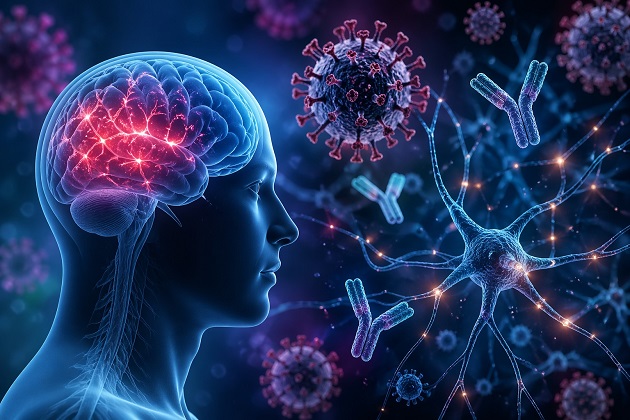 Study reveals lingering neurological symptoms and unexpected immune responses in post-COVID patients
Persistent Symptoms Long After Infection
Study reveals lingering neurological symptoms and unexpected immune responses in post-COVID patients
Persistent Symptoms Long After Infection
Researchers tracked 28 individuals who had experienced neurological symptoms during the acute phase of COVID-19. More than four months later, a striking 82 percent of these patients reported ongoing issues. These included memory problems, fatigue, difficulty concentrating, sensory disturbances, and motor impairments.
Even more concerning, about one-third of patients showed clear abnormalities during neurological examinations, suggesting that these symptoms are not merely subjective complaints but may reflect underlying dysfunction.
Cognitive testing further supported this. Around 35 percent of patients scored below normal thresholds, indicating measurable cognitive decline, while over half showed signs of severe fatigue based on standardized assessments.
Brain Injury Markers Show Recovery
Despite these persistent symptoms, the study found that key biomarkers of brain injury had largely returned to normal levels over time. These biomarkers - such as neurofilament light chain (NfL), glial fibrillary acidic protein (GFAP), and total tau—are typically elevated when there is active damage to brain cells.
At follow-up, almost all patients showed normalized levels of these markers in both blood and cerebrospinal fluid. This suggests that the initial brain injury caused by the virus does not appear to be ongoing.
Interestingly, there was no clear link between how severe the brain injury markers were during the acute illness and the severity of symptoms months later. In simple terms, patients who had more brain damage signals early on were not necessarily the ones suffering the most later.
Emergence of Neuronal Antibodies Raises New Questions
One of the most unexpected findings of the study was the appearance of new neuronal antibodies in nearly 19 percent of patients. These antibodies target components of the nervous system and are often associated with autoimmune neurological conditions.
Detected antibodies included those against NMDA receptors, GAD65, amphiphysin, and other neuronal proteins. In some cases, these antibodies were found in both blood and cerebrospinal fluid, suggesting a deeper immune involvement.
This
Medical News report highlights that these antibodies were not present during the initial infection but appeared later, raising the possibility that COVID-19 may trigger delayed autoimmune responses.
However, the presence of these antibodies did not consistently match specific symptoms or clinical fin
dings. This makes it difficult to determine their exact role, though researchers believe they may signal a broader immune dysregulation rather than direct damage.
Possible Mechanisms Behind Lingering Effects
Scientists believe that the long-term neurological symptoms may not be caused by ongoing brain damage but rather by other mechanisms. One leading theory is that the immune system, once activated by the virus, continues to behave abnormally even after the infection has cleared.
Another possibility is molecular mimicry, where the immune system mistakenly attacks the body’s own tissues because they resemble viral components. This could explain the development of neuronal antibodies.
Inflammation during the acute phase may also play a role, potentially altering brain function in subtle but lasting ways without causing permanent structural damage.
Study Limitations and Need for Further Research
While the findings are significant, the study had limitations. The sample size was relatively small, and many patients declined follow-up participation. There was also no control group for comparison, which makes it harder to draw definitive conclusions.
Nevertheless, the discovery of post-COVID neuronal antibodies is considered novel and warrants further investigation, especially in larger and more diverse populations.
Conclusion
This study provides important insights into the complex and often puzzling neurological aftermath of COVID-19. While the brain appears to recover from initial injury based on biomarker normalization, many patients continue to struggle with persistent symptoms that impact daily life.
The emergence of neuronal antibodies introduces a new layer of complexity, suggesting that immune-related mechanisms may be driving these long-term effects rather than direct viral damage. Understanding this distinction is crucial, as it may influence future treatment approaches, including the potential use of immunotherapies.
Ultimately, these findings underscore the need for ongoing monitoring and research into long COVID, particularly its neurological aspects, as millions worldwide continue to deal with its lasting consequences.
The study findings were published in the peer reviewed journal: Acta Neurologica Scandinavica.
https://onlinelibrary.wiley.com/doi/10.1155/ane/6656280
For the latest COVID-19 news, keep on logging to Thailand
Medical News.
Read Also:
https://www.thailandmedical.news/articles/coronavirus
https://www.thailandmedical.news/articles/long-covid




 Share
Share
 Tweet
Tweet
 Share
Share

































