Researchers Warn That Chronic Neuroinflammation Caused by COVID-19 Can Lead to Retinal Damage
Nikhil Prasad Fact checked by:Thailand Medical News Team Jun 25, 2026 3 months, 1 week, 2 days, 7 hours, 5 minutes ago
Medical News: Scientists are raising new concerns that COVID-19 may leave behind lasting damage that extends far beyond the lungs. New research suggests that even after the virus has been cleared from the body, persistent inflammation in the nervous system may continue damaging the retina, the light-sensitive tissue at the back of the eye that is essential for vision. The findings provide fresh evidence that some long-term complications of COVID-19 could include progressive eye disease and visual impairment.
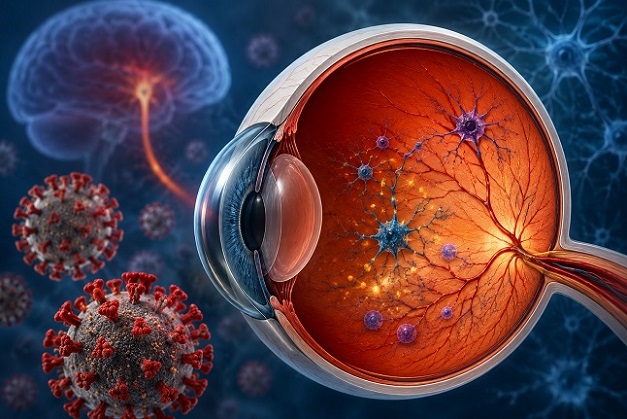 New research shows that lingering inflammation after COVID-19 may silently damage the retina and increase the risk
of long-term vision problems
The research was conducted by scientists from Gyeongsang National University, Republic of Korea, with experiments performed at the Korea Zoonosis Research Institute in certified Animal Biosafety Level-3 laboratories. This
Medical News report highlights growing evidence that lingering inflammation after SARS-CoV-2 infection may continue harming delicate nerve tissues long after the acute illness has ended.
Looking Beyond the Initial Infection
SARS-CoV-2 enters cells by attaching to the angiotensin-converting enzyme 2 (ACE2) receptor, which is found in many parts of the human body, including the brain and the retina. Although COVID-19 is widely recognized as a respiratory disease, previous research has already linked acute infection to numerous eye disorders such as conjunctivitis, retinal inflammation, optic neuritis, retinal blood vessel inflammation, and damage to the optic nerve.
However, very little has been known about whether the virus leaves behind long-term damage after recovery. To answer this question, the Korean researchers infected genetically engineered hACE2 transgenic mice with SARS-CoV-2 and monitored changes in their eyes and nervous system over a period of 60 days.
Persistent Retinal Damage Despite Viral Clearance
The researchers discovered that although viral proteins were abundant in the brain during the early stage of infection, they had largely disappeared by 60 days. Despite the virus no longer being detectable, significant damage continued to develop inside the retina.
One of the most striking findings was a measurable thinning of the inner retinal layers. These layers contain specialized nerve cells responsible for processing visual information before it is transmitted to the brain. The scientists also observed a significant increase in the death of retinal ganglion cells, which form the optic nerve and play a critical role in carrying visual signals. Loss of these cells is commonly associated with irreversible vision loss in diseases such as glaucoma.
Chronic Inflammation Continues to Attack Eye Tissue
The study revealed that the damage was driven not by the continued presence of the virus but by ongoing neuroinflammation. Two major immune cells within the nervous system—microglia and astrocytes—remained activated in the retina long after in
fection had resolved.
These activated immune cells produced inflammatory molecules that can gradually injure nearby nerve tissue. In the optic nerve, the researchers found increased levels of inflammatory cytokines, particularly interleukin-1 beta (IL-1β) and tumor necrosis factor-alpha (TNF-α), both of which are well known for promoting chronic inflammation and tissue injury. Interestingly, while inflammatory signals increased in the optic nerve, the expression of microglia and astrocyte markers decreased there, suggesting that different inflammatory mechanisms may occur in the retina and optic nerve during long COVID.
Why These Findings Matter
The study provides one of the first demonstrations that chronic neuroinflammation can persist even after SARS-CoV-2 has been eliminated from the brain. This ongoing inflammatory response appears capable of gradually damaging retinal nerve tissue, potentially increasing the risk of long-term visual disturbances and progressive retinal degeneration.
Although the research was performed in a mouse model, the findings offer an important explanation for why some people recovering from COVID-19 continue reporting blurred vision, visual discomfort, or other unexplained eye problems months after their initial infection. The results also suggest that therapies aimed at reducing chronic inflammation rather than simply eliminating the virus may eventually help protect vision in patients experiencing long COVID.
Conclusions
The researchers concluded that SARS-CoV-2 infection may trigger a prolonged inflammatory response that continues damaging the retina long after the virus itself has disappeared. Their findings suggest that persistent neuroinflammation, activation of immune cells, and elevated inflammatory cytokines collectively contribute to retinal degeneration and retinal ganglion cell loss. They also emphasized that longer-term studies extending beyond two months are needed to determine how long this inflammation persists and whether similar mechanisms contribute to chronic vision problems in people recovering from COVID-19.
The study findings were published in the peer reviewed Journal of Neuroimmunology.
https://www.sciencedirect.com/science/article/abs/pii/S0165572826001517
For the latest COVID-19 news, keep on logging to Thailand
Medical News.
Read Also:
https://www.thailandmedical.news/articles/coronavirus
https://www.thailandmedical.news/articles/long-covid




 Share
Share
 Tweet
Tweet
 Share
Share

































