Nikhil Prasad Fact checked by:Thailand Medical News Team Jun 29, 2026 2 months, 3 days, 18 hours ago
Medical News: A growing body of scientific evidence is shedding light on an unexpected culprit behind worsening kidney disease: the gut. Researchers have found that an imbalance of bacteria in the digestive system—known as gut dysbiosis—plays a major role in accelerating chronic inflammation and aging-like damage in people with chronic kidney disease (CKD).
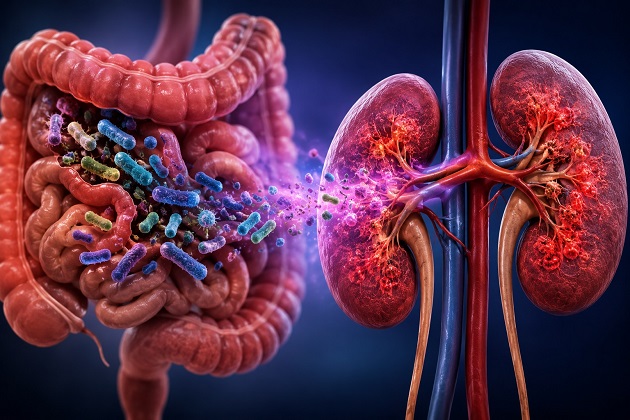 Gut imbalance may silently fuel kidney disease progression and deadly complications
Researchers and Institutions Behind the Study
Gut imbalance may silently fuel kidney disease progression and deadly complications
Researchers and Institutions Behind the Study
This research was conducted by a team from multiple respected institutions, including the Nephrology and Dialysis Unit, Internal Medicine Unit, Microbiology Unit, and Gastroenterology Unit at SS. Antonio e Biagio e Cesare Arrigo University Hospital in Alessandria, Italy, along with the Department of Translational Medicine at Università del Piemonte Orientale (UPO) in Novara, and the Nephrology and Transplant Unit at Maggiore della Carità University Hospital.
What Is Happening Inside the Body?
Chronic kidney disease affects around 10–15% of adults worldwide. One of its most dangerous features is a constant, low-level inflammation known as “inflammaging,” which speeds up aging and raises the risk of heart disease, bone loss, and even cognitive decline.
The study reveals that the gut microbiome—the trillions of bacteria living in our intestines—plays a key role in this process. When these bacteria become imbalanced, harmful changes occur.
Toxic Buildup and “Leaky Gut”
In CKD patients, harmful bacteria increase while beneficial ones decrease. This leads to the production of toxic substances such as indoxyl sulfate and p-cresyl sulfate. Normally, healthy kidneys filter these toxins out. But in CKD, they accumulate in the body, damaging blood vessels, the heart, and the kidneys themselves.
At the same time, the intestinal lining becomes weaker, often referred to as a “leaky gut.” This allows bacteria and toxins to pass into the bloodstream, triggering widespread inflammation and immune system disruption.
Loss of Protective Compounds
Healthy gut bacteria produce helpful substances called short-chain fatty acids (SCFAs), which reduce inflammation, support immune balance, and protect organs. However, in CKD, these beneficial compounds are significantly reduced.
This imbalance creates a vicious cycle: kidney disease worsens gut health, and poor gut health further accelerates kidney damage.
Wider Impact on the Body
The effects go far beyond the kidneys. The study highlights strong links between gut imbalance and:
-Cardiovascular disease, including heart attacks and stroke
-High blood pressure
-Muscle wasting (sarcopenia)
-Malnutrition
-Cognitive decline
These findings suggest that the gut-kidney connection is central to many complications seen in CKD patien
ts.
New Hope Through Gut-Based Therapies
Encouragingly, researchers are exploring ways to restore balance in the gut. Approaches include:
-Dietary changes, especially plant-based and high-fiber diets
-Probiotics and prebiotics, which support healthy bacteria
-Synbiotics, combining both
-Postbiotics, using beneficial bacterial byproducts
-Fecal microbiota transplantation (FMT) in early experimental stages
Some studies have already shown that these strategies can lower toxin levels, reduce inflammation, and potentially slow kidney disease progression.
This
Medical News report highlights that while results are promising, more large-scale human studies are needed to confirm which treatments work best and how they can be personalized.
Conclusions
The findings clearly show that gut microbiota imbalance is not just a side effect of chronic kidney disease but a driving force behind its progression and complications. By producing harmful toxins, weakening the intestinal barrier, and disrupting immune balance, dysbiosis fuels chronic inflammation and accelerates organ damage. At the same time, the loss of beneficial compounds further worsens the situation. Importantly, targeting gut health offers a new and potentially powerful way to manage CKD, reduce cardiovascular risks, and improve overall patient outcomes. However, more research is essential before these therapies become standard treatment.
The study findings were published in the peer reviewed journal: Cells.
https://www.mdpi.com/2073-4409/15/13/1171
For the latest on aging and kidney diseases, keep on logging to Thailand
Medical News.
Read Also:
https://www.thailandmedical.news/articles/nephrology-(kidneys)




 Share
Share
 Tweet
Tweet
 Share
Share