Nikhil Prasad Fact checked by:Thailand Medical News Team Dec 29, 2025 8 months, 4 days, 19 hours, 8 minutes ago
Medical News:
A surprising link between dengue and COVID-19
During the COVID 19 pandemic, scientists noticed an unusual global pattern. Countries where dengue fever is widespread, including India, Brazil, and many parts of Southeast Asia, often reported lower COVID-19 death rates during the early waves. A new study now explains how this may have happened and reveals that dengue could have played a hidden role in shaping how the coronavirus evolved.
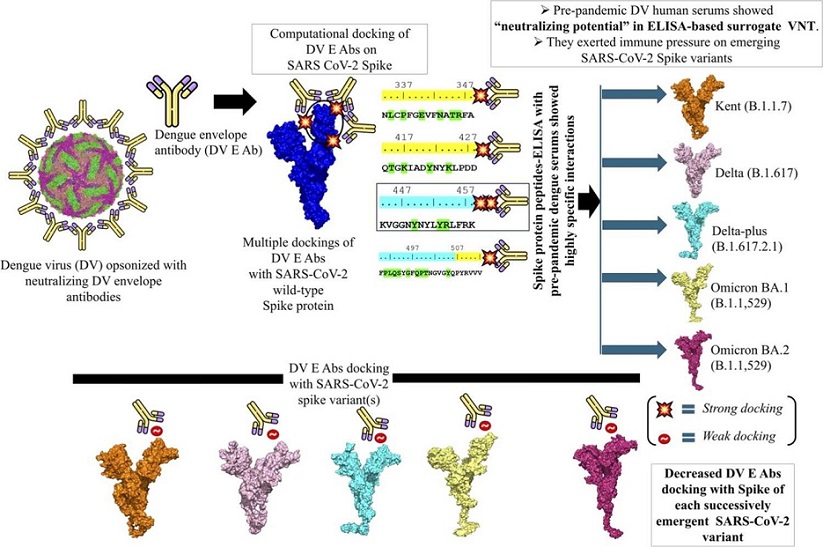 Widespread dengue immunity may have pushed the coronavirus to evolve and mutate faster in certain parts of the world.
The research was carried out by scientists from the Infectious Diseases and Immunology Division at CSIR Indian Institute of Chemical Biology in West Bengal, India, and the Academy of Scientific and Innovative Research AcSIR in Ghaziabad, India. Their work explored how immune responses from past dengue infections interacted with SARS-CoV-2.
How dengue antibodies interact with the coronavirus
When a person recovers from dengue, the body produces antibodies that can last for many years. This study found that these dengue antibodies can recognize and bind to certain parts of the SARS-CoV-2 spike protein. The spike protein is the tool the coronavirus uses to attach to human cells.
According to this
Medical News report, this unexpected cross reaction meant that dengue antibodies could partially block the coronavirus from entering cells, especially during the early stages of the pandemic. This may explain why COVID-19 appeared less severe in many dengue endemic regions during 2020 and early 2021.
Virus mutations under immune pressure
Viruses constantly change in order to survive. Using computer based structural analysis and laboratory testing, the researchers showed that SARS-CoV-2 gradually accumulated mutations in its spike protein. These changes reduced its ability to bind with dengue antibodies.
The study closely examined major variants including Alpha, Delta, Delta Plus, and Omicron. It was found that newer variants had progressively fewer interaction points with dengue antibodies. Omicron variants, in particular, showed a dramatic reduction in cross reactivity. In simple terms, the virus learned how to avoid immune pressure created by widespread dengue immunity.
Laboratory evidence strengthens the findings
To support their conclusions, the scientists tested blood samples collected before the COVID-19 pandemic from people who had dengue. These samples were able to interfere with the binding between the coronavirus spike protein and the ACE2 receptor, which is how the virus enters human cells.
However, this protective effect weakened as new variants emerged. Compared to early strains, Omicron variants showed nearly fifty percent lower cross reactivity with dengue antibodies. This provided strong evidence that SARS-CoV-2 had evolved specifically to escape this form of immune pressure.
Why the findings matter<
;/strong>
This research helps explain why COVID-19 followed different patterns around the world. In dengue endemic regions, the coronavirus faced an additional immune challenge beyond vaccines or previous COVID-19 infections. This pressure may have accelerated the selection of variants with many mutations.
The study also highlights how different infectious diseases can influence one another. Immunity developed from one virus can unintentionally shape the evolution of another virus spreading at the same time.
Study conclusions
The researchers concluded that long lasting dengue antibodies likely contributed to shaping the evolution of SARS-CoV-2 in dengue endemic regions. By repeatedly pressuring the virus to escape immune recognition, these antibodies may have played a role in the emergence of highly mutated variants such as Omicron. While dengue immunity is not the only factor involved, the evidence suggests it was a significant and previously overlooked influence.
The study findings were published in the peer reviewed journal: Computational and Structural Biotechnology Journal.
https://www.csbj.org/article/S2001-0370(25)00525-2/fulltext
For the latest COVID-19 News, keep on logging to Thailand Medical News.
Read Also:
https://www.thailandmedical.news/articles/coronavirus




 Share
Share
 Tweet
Tweet
 Share
Share