Nikhil Prasad Fact checked by:Thailand Medical News Team May 22, 2026 3 months, 1 week, 4 days, 21 hours, 28 minutes ago
Medical News: Scientists from Nagasaki University, Boston University, The University of Tokyo, Kyoto Institute of Technology, and other collaborating institutions in Japan and the United States have identified two powerful experimental compounds that may help fight the deadly Ebola virus. The research focused on special chemical derivatives known as ascofuranone and naphthoquinone compounds, which showed remarkable ability to block Ebola virus replication in laboratory testing.
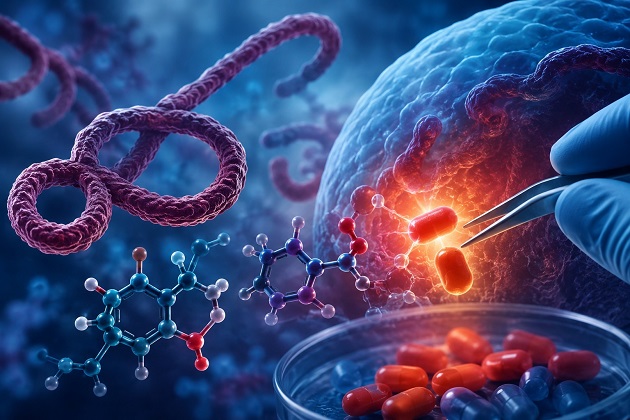 Newly discovered experimental compounds show powerful ability to stop Ebola virus replication in laboratory studies
A New Search for Better Ebola Treatments
Newly discovered experimental compounds show powerful ability to stop Ebola virus replication in laboratory studies
A New Search for Better Ebola Treatments
Ebola virus disease remains one of the world’s most feared infectious illnesses because of its extremely high death rate. Some outbreaks have killed up to 90 percent of infected patients. Although two antibody-based drugs are currently approved for Ebola treatment, experts say they still have important limitations, especially in patients carrying very high viral loads.
Researchers involved in the new study wanted to discover additional treatment options that could work in different ways from existing therapies. To do this, they screened 87 compounds that target a human enzyme called DHODH, which is essential for the production of pyrimidines, the building blocks needed for viral replication.
Two Compounds Stood Out
Among the 87 tested compounds, two experimental molecules named 280-12 and 511-12 showed especially strong antiviral effects. The researchers found that both compounds could dramatically reduce Ebola virus activity in infected cells.
The compound called 511-12 appeared particularly impressive. It blocked Ebola virus replication at extremely low concentrations, making it even more potent than some previously known DHODH inhibitors.
Laboratory testing showed that the compounds worked by interfering with the virus after it entered human cells. Instead of attacking the virus directly, the compounds targeted the host cell’s internal machinery that Ebola depends on for survival and replication.
Scientists discovered that the compounds depleted pyrimidines inside cells. Since Ebola virus requires large amounts of these molecules to copy its genetic material, the virus became unable to reproduce efficiently.
How The Compounds Work
The researchers used advanced structural analysis techniques to understand exactly how the compounds interact with the DHODH enzyme. They found that the molecules bind tightly to a specific hydrophobic pocket within the enzyme, effectively shutting down its activity.
This
Medical News report highlights that the compounds appear to disrupt the virus by starving it of critical cellular resources rather than directly attacking viral proteins. This strategy is important because viruses often mutate rapidly and develop resistance to drugs that target the virus itself.
Interestingly, when scientists added uridine and orotate,
substances involved in pyrimidine production, the antiviral effect was reversed. This confirmed that the compounds were specifically blocking the pyrimidine synthesis pathway.
The researchers also tested the compounds against live Ebola virus under high-security biosafety level-4 laboratory conditions. The results confirmed that both compounds strongly suppressed authentic Ebola virus infections without causing major toxicity to the cells.
Potential For Broader Antiviral Use
Another exciting aspect of the discovery is that DHODH inhibitors may potentially work against multiple dangerous viruses, not just Ebola. Previous studies have shown that similar compounds can interfere with other RNA viruses as well.
Researchers believe this raises the possibility of developing broad-spectrum antiviral drugs capable of fighting several deadly viral diseases at once. Since many viruses rely on the same cellular pyrimidine production pathways, targeting the host process may provide a wider antiviral shield.
The study also revealed that slight chemical modifications made the compounds significantly more powerful. For example, the 280-12 derivative was found to be about eight times stronger than the original ascofuranone compound.
Conclusions
The findings provide strong evidence that targeting human pyrimidine biosynthesis could become a promising new strategy against Ebola virus disease. The experimental compounds 280-12 and especially 511-12 demonstrated potent antiviral activity at very low doses while showing limited toxicity in laboratory studies. Although additional animal and human studies are still required, the research opens the door to a new generation of Ebola treatments that may be cheaper, more stable, and potentially effective against a broader range of deadly viruses in the future.
The study findings were published in the peer reviewed journal: Antiviral Research.
https://www.sciencedirect.com/science/article/pii/S0166354226000598
For the latest on Ebola, keep on logging to Thailand
Medical News.
Read Also:
https://www.thailandmedical.news/news/scientists-discover-potential-ebola-blocking-effects-of-lumateperone
https://www.thailandmedical.news/news/pink-rockrose-compounds-show-promise-against-ebola
https://www.thailandmedical.news/news/old-gout-drug-shows-promise-against-ebola
https://www.thailandmedical.news/news/study-finds-that-berberine-hydrochloride-could-be-used-to-inhibit-ebola-virus
https://www.thailandmedical.news/news/the-phytochemical-kolaviron-from-garcinia-kola-bitter-kola-shows-potential-against-the-ebola-virus-further-studies-needed
https://www.thailandmedical.news/news/u-s-nih-study-finds-that-algal-lectin-griffithsin-shows-promise-in-preventing-ebola-virus-infection




 Share
Share
 Tweet
Tweet
 Share
Share