Nikhil Prasad Fact checked by:Thailand Medical News Team Jul 05, 2026 1 month, 4 weeks, 15 hours, 59 minutes ago
Medical News: A new international study has uncovered striking differences in the immune response of people who develop Guillain-Barré syndrome (GBS) after COVID-19, revealing that the condition follows a different inflammatory pathway than traditional cases of the rare neurological disorder. The findings could eventually help doctors identify patients earlier, predict disease severity, and develop more targeted treatments.
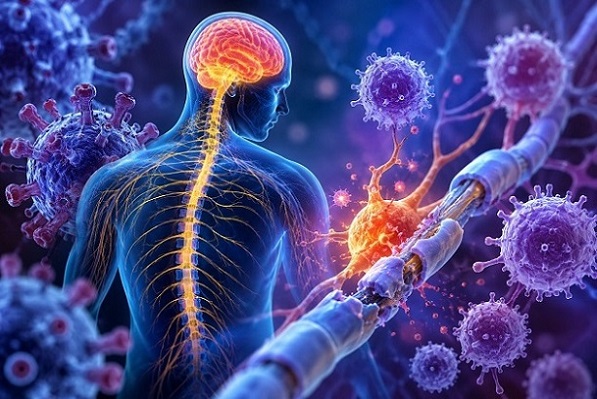 Researchers discover that COVID-associated Guillain-Barré syndrome has a distinct immune profile that could
improve future diagnosis and treatment
The research was led by scientists from the University of Zurich, University Hospital Zurich, University of Bern, the Swiss Institute of Allergy and Asthma Research (SIAF), Hospital de la Santa Creu i Sant Pau in Barcelona, Vall d'Hebron University Hospital, the University of Barcelona, and the IRCCS San Raffaele Scientific Institute in Italy.
Looking Beyond Traditional Guillain-Barré Syndrome
GBS is an autoimmune disorder in which the body's immune system mistakenly attacks peripheral nerves, often causing weakness, numbness, and, in severe cases, paralysis. It frequently develops after bacterial or viral infections, but scientists have remained uncertain whether COVID-19 triggers the disease through the same biological mechanisms.
To answer that question, researchers analyzed spinal fluid and blood samples from 57 participants, including patients with COVID-19-associated GBS, people with conventional GBS diagnosed before the pandemic, COVID-19 patients without neurological complications, and patients with non-inflammatory nerve disorders. They measured 92 different inflammatory proteins to determine how immune responses differed between the groups.
Two Important Molecules Stand Out
The investigators confirmed that the inflammatory molecule IL-8 is consistently elevated in the spinal fluid of GBS patients. IL-8 attracts immune cells to damaged tissue and promotes inflammation, making it a likely contributor to nerve injury.
More surprisingly, they identified leukemia inhibitory factor (LIF) as a previously unrecognized marker of GBS. Unlike IL-8, LIF may actually represent the body's attempt to protect injured nerves and stimulate repair. The researchers found increased LIF only in spinal fluid, suggesting that these protective responses occur directly around affected nerves rather than throughout the entire body.
Analysis of publicly available nerve-cell gene data further suggested that immune cells called myeloid cells are probably producing IL-8, while blood vessel cells and supporting tissue cells appear to be the main targets of LIF signaling.
These findings covered in this
Medical News report emerge as one of the study's most important discoveries because they identify both harmful inflammatory activity and possible natural repair mechanisms occurring simultaneously within damaged nerves.
COVID-19 Cases Dis
play Their Own Immune Fingerprint
The study revealed that COVID-19-associated GBS is not simply a copy of conventional GBS.
Patients who developed GBS after COVID-19 showed a distinctive blood protein profile involving altered natural killer cell activity, cytotoxic T-cell responses, and abnormal myeloid cell activation. Several immune proteins, including IL-7 and EN-RAGE, clearly distinguished COVID-19-related cases from traditional GBS. Another protein, TWEAK, was significantly lower in COVID-19-associated GBS than in COVID-19 patients who never developed neurological complications.
The researchers also found higher levels of signaling proteins including IL-15RA, IL-18R1, and CDCP1, suggesting that SARS-CoV-2 may trigger a different pattern of immune regulation rather than the classic autoimmune attack seen after other infections. These findings support the growing theory that excessive inflammation following COVID-19 may damage nerves through bystander immune activation instead of direct targeting of nerve tissue.
Biomarkers May Predict Disease Severity
The team also discovered that several blood proteins tracked closely with how severely COVID-19-associated GBS patients were affected.
Higher concentrations of osteoprotegerin (OPG) and MMP-10 were linked to greater disability, poorer muscle strength, and slower recovery. In contrast, another immune regulator known as IL-10RA appeared protective in conventional GBS but not in COVID-19-associated disease, suggesting that SARS-CoV-2 alters important anti-inflammatory pathways.
These differences indicate that COVID-related GBS may require different diagnostic approaches and, eventually, different therapeutic strategies than conventional forms of the disorder.
Conclusion
The findings provide compelling evidence that COVID-19-associated Guillain-Barré syndrome represents a biologically distinct form of the disease with its own inflammatory fingerprint. By identifying new biomarkers such as LIF, IL-7, EN-RAGE, OPG, and MMP-10 while confirming the importance of IL-8, the study significantly advances understanding of how immune responses differ after SARS-CoV-2 infection. Although larger studies are still needed to validate these discoveries, the results offer promising leads for improved diagnosis, monitoring of disease severity, and the future development of more personalized treatments for patients affected by this potentially life-threatening neurological disorder.
The study findings were published in the peer reviewed Journal of Molecular Medicine.
https://link.springer.com/article/10.1007/s00109-026-02698-2
For the latest COVID-19 news, keep on logging to Thailand
Medical News.
Read Also:
https://www.thailandmedical.news/articles/coronavirus
https://www.thailandmedical.news/articles/long-covid




 Share
Share
 Tweet
Tweet
 Share
Share

































