Brain Scans Reveal Two Distinct Long COVID Types with Different Cognitive Changes
Nikhil Prasad Fact checked by:Thailand Medical News Team Aug 02, 2026 2 months, 1 day, 20 hours, 27 minutes ago
Long COVID may not affect every brain in the same way
Long COVID has puzzled doctors for years because people with similar symptoms often show very different patterns of recovery. Now, researchers have found evidence that persistent cognitive problems after COVID-19 may actually fall into two separate brain-related subtypes, offering a possible explanation for why some patients experience more severe "brain fog" than others.
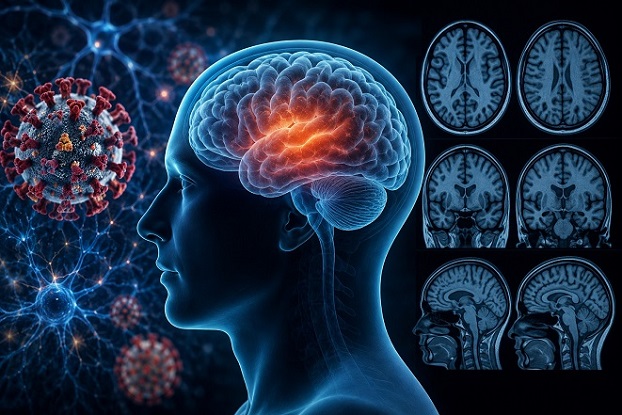 Brain imaging identifies two distinct Long COVID subtypes, helping explain why persistent cognitive symptoms
vary so widely among patients.
The research was conducted by scientists from the Faculty of Medicine at the National Autonomous University of Mexico, the Faculty of Computer Science at Dalhousie University in Canada, and the Departments of Physiology and Pharmacology and Psychology at Western University in Canada.
Advanced brain imaging uncovered two distinct patient groups
The team examined 42 people with Long COVID who continued to experience cognitive symptoms and compared them with 14 healthy volunteers. Every participant underwent detailed cognitive testing and high-resolution MRI brain scans. Researchers also followed many of the patients for six months to see how their brains changed over time.
Instead of assuming every patient had the same condition, the scientists used sophisticated brain-network analysis to classify individuals according to similarities in their brain structure. This revealed two clearly different neuroanatomical groups.
One subgroup showed noticeable reductions in gray matter density in the putamen, a brain region involved in movement and learning, and in parts of the cerebellum, which is increasingly recognized for its role in thinking, attention, memory, and planning. The second subgroup showed no significant structural brain abnormalities despite having persistent cognitive complaints.
Cognitive problems varied between the two groups
The study found that both patient groups displayed cognitive difficulties, although the patterns differed.
People in one subgroup performed more poorly on tasks involving response control, spatial memory, and logical reasoning. Those in the other subgroup showed greater problems with language fluency, visual attention, object recognition, and certain memory-related tasks. While several of these differences did not remain statistically significant after strict corrections for multiple testing, many demonstrated moderate-to-large effect sizes, suggesting that the differences could become clearer in larger studies.
The researchers also found that both groups reported major reductions in quality of life. Fatigue, physical limitations, reduced general health, pain, and emotional wellbeing were all substantially affected, highlighting that Long COVID continues to interfere with everyday life long after the initial infection.
Brain changes may continue months after infection
Interestingly, follow-up MRI scans performed about six months later revealed increased gray matter density in the medial frontal cortex, an area important for decision-making, planning, attention, and executiv
e function.
This
Medical News report highlights an encouraging observation from the study. Rather than showing ongoing widespread brain deterioration, the findings suggest that certain brain regions may undergo structural reorganization during recovery.
Researchers also observed links between improvements in frontal brain structure and better performance on some visuospatial and executive-function tasks.
Although these relationships did not remain significant after correction for multiple comparisons, they point toward possible recovery mechanisms that deserve further investigation.
A step toward more personalized Long COVID care
The findings suggest that Long COVID should not be viewed as a single neurological condition. Instead, different patients may develop distinct brain changes that produce similar symptoms. Recognizing these biological subtypes could eventually help physicians identify patients more accurately, predict recovery patterns, and develop more personalized rehabilitation strategies rather than relying on a one-size-fits-all approach.
The researchers emphasized that the study was exploratory and involved a relatively small number of participants. They recommend larger investigations to confirm these findings and determine whether these brain-based subtypes can guide future diagnosis and treatment.
The study findings were published on a preprint server and have yet to be peer reviewed.
https://www.biorxiv.org/content/10.64898/2026.07.30.741878v1
For the latest on Long COVID, keep on logging to Thailand
Medical News.
Read Also:
https://www.thailandmedical.news/articles/long-covid




 Share
Share
 Tweet
Tweet
 Share
Share

































