Ultrafine Particles Released by Cruise Ship Fuel Combustion Can Trigger Harmful Inflammation and Increase Risk of Viral Infections
Nikhil Prasad Fact checked by:Thailand Medical News Team Jun 23, 2026 3 months, 1 week, 4 days, 3 hours, 35 minutes ago
Medical News: Air pollution from cruise ships may be doing far more than irritating the lungs. A new study has found that ultrafine particles released by cruise ship fuel combustion can trigger harmful inflammation while also weakening the body's natural defenses against respiratory viruses, potentially making infections such as COVID-19 and the common cold more severe.
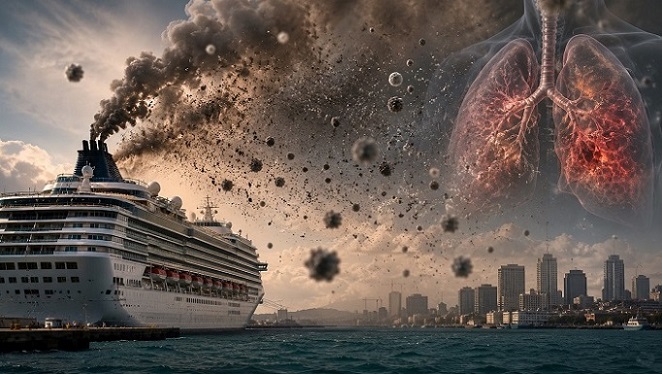 Study finds ultrafine pollution from cruise ships can fuel inflammation and make respiratory viruses spread more easily in lung cells
Researchers from the University of Southampton, Southampton Marine and Maritime Institute, NIHR Southampton Biomedical Research Centre, University Hospital Southampton, Durham University, the UK Health Security Agency, the University of Liverpool, Colorado State University, the National Institute for Public Health and the Environment (RIVM) in the Netherlands, Utrecht University, and Università Cattolica del Sacro Cuore in Italy investigated pollution collected from different areas of the Port of Southampton in the United Kingdom.
Tiny Particles with Big Health Risks
The study focused on ultrafine particulate matter, particles so small that they measure less than 100 nanometers in diameter. These particles can travel deep into the lungs and even enter the bloodstream.
Scientists discovered that ultrafine particles collected near cruise ship terminals contained unusually high levels of the metals vanadium, nickel, and cobalt. These metals are associated with the combustion of heavy fuel oil, a thick petroleum-based fuel commonly used by large ships.
The cruise ship particles stood out from pollution collected from other port activities. They contained much higher concentrations of these metals, particularly vanadium, which emerged as a key driver of harmful biological effects.
Strong Inflammatory Response Detected
Laboratory experiments using human airway and lung cells revealed that exposure to cruise ship ultrafine particles triggered a powerful inflammatory reaction.
The particles caused sharp increases in several inflammatory molecules, including IL-8, IL-6, TNF-alpha, GM-CSF, and IL-1 beta. These substances are known to play important roles in respiratory inflammation and have been linked to severe outcomes during viral illnesses.
This
Medical News report highlights that the inflammatory response caused by cruise ship particles was significantly stronger than responses produced by pollution collected from other areas of the port.
Pollution Also Weakens Antiviral Defenses
Perhaps the most concerning finding was that the same particles that caused inflammation also suppressed genes involved in the body's antiviral defense system.
Researchers found that exposure to cruise ship pollution reduced activity in interferon-related pathways. Interferons are crucial signaling molec
ules that help cells detect and fight viruses.
Further testing revealed that vanadium alone could reproduce many of the harmful effects seen with the cruise ship particles. The metal reduced antiviral signaling, interfered with protective immune responses, and made cells more vulnerable to viral infection.
Increased Replication of COVID-19 and Cold Viruses
The team then examined what happened when cells exposed to vanadium encountered viruses.
The results were striking. Vanadium exposure increased replication of Rhinovirus-16, one of the major causes of the common cold. It also significantly boosted replication of SARS-CoV-2, the virus responsible for COVID-19. In some experiments, viral growth increased nearly five-fold.
Researchers believe this combination of excessive inflammation and weakened antiviral protection may create conditions associated with poorer infection outcomes.
Implications for Public Health
The findings suggest that current air-quality regulations may not adequately address the dangers posed by ultrafine particles from shipping emissions. While regulations focus largely on overall particle mass, ultrafine particles and their chemical composition are often overlooked.
The researchers concluded that cruise ship emissions rich in vanadium-containing ultrafine particles may pose a disproportionate threat to human health compared to many other pollution sources. Their results raise concerns for people living, working, or spending time near busy ports and coastal regions. The study also highlights the need for stronger monitoring of ultrafine particles and cleaner maritime fuel technologies to reduce potential risks linked to respiratory infections and long-term lung health.
The study findings were published in the peer reviewed journal: Environment International.
https://www.sciencedirect.com/science/article/pii/S0160412026003399
For the latest on air pollutants from cruise ships and their effects on human health, keep on logging to Thailand
Medical News.
Read Also:
https://www.thailandmedical.news/news/french-study-shows-that-long-term-exposure-to-air-pollution-raises-covid-19-infection-risk
https://www.thailandmedical.news/news/south-korean-researchers-find-that-thyme-extract-shields-lungs-from-air-pollution-damage




 Share
Share
 Tweet
Tweet
 Share
Share

































