Nikhil Prasad Fact checked by:Thailand Medical News Team Mar 12, 2026 6 months, 3 weeks, 1 day, 21 hours, 12 minutes ago
Medical News: A surprising discovery by scientists in South Korea suggests that a simple plant extract may help tackle one of the most common health problems affecting aging men—an enlarged prostate. Researchers have found that an extract from the grass Calamagrostis arundinacea significantly reduced prostate enlargement in laboratory animals, raising hopes that natural therapies could one day complement existing treatments.
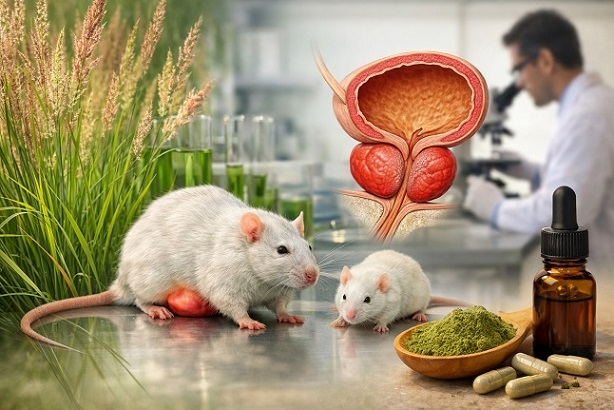 Scientists discover that a natural grass extract can shrink enlarged prostate tissue and reduce hormone-driven growth
in laboratory studies.
A Common Condition Affecting Millions of Men
Benign prostatic hyperplasia (BPH), commonly known as an enlarged prostate, is a condition where the prostate gland gradually grows bigger with age. Although it is not cancer, the swelling can press against the urethra and interfere with normal urination.
Many men with BPH experience frequent urination, difficulty starting or stopping urine flow, weak urinary stream, and a constant feeling that the bladder is not completely empty. The condition becomes more common with age, affecting a large proportion of men in their sixties and becoming even more prevalent among men over eighty.
Because the global population is aging, doctors expect the number of men affected by BPH to continue increasing. This growing health burden has pushed scientists to search for safer and more effective treatments.
Scientists Explore a Traditional Medicinal Plant
The study was conducted by researchers from the Department of Veterinary Pathology at Chungnam National University in Daejeon, Republic of Korea, the Department of Physiology at Jeju National University in Jeju-si, Republic of Korea, and the Laboratory Animal Resource Center at the Korea Research Institute of Bioscience and Biotechnology in Cheongju-si, Republic of Korea.
Their investigation focused on Calamagrostis arundinacea, a perennial grass that grows widely across parts of Europe and Asia. In certain rural communities, the plant has long been used in traditional remedies for its anti-inflammatory properties.
However, until now, there had been little scientific evidence examining whether the plant might also help treat prostate disorders.
This
Medical News report highlights how the researchers examined the potential of this plant extract to reduce prostate enlargement triggered by male hormones.
How the Researchers Tested the Plant Extract
To simulate prostate enlargement, the scientists used male laboratory rats and injected them daily with testosterone for four weeks. This hormone treatment caused the animals’ prostates to grow significantly larger, mimicking the biological processes that occur in human BPH.
At the same time, another group of rats received a daily oral dose of the Calamagrostis arundinacea extract. A separate group received finasteride, a commonly prescribed drug for BPH, allowing researche
rs to compare the plant extract’s effects with a known medical treatment.
After the treatment period, the scientists carefully examined prostate size, hormone levels, tissue structure, and several molecular signals linked to abnormal cell growth.
Significant Shrinkage of Enlarged Prostates
The results were encouraging. Rats that received testosterone alone developed large prostates, confirming the success of the BPH model. However, animals treated with the plant extract showed noticeably smaller prostates.
The extract significantly reduced levels of testosterone and dihydrotestosterone (DHT), two hormones that play major roles in stimulating prostate growth. Lowering these hormones is one of the key strategies used in modern medications for BPH.
Microscopic examination of prostate tissue also revealed major improvements. The thickened epithelial layers seen in untreated animals were reduced in the extract-treated group, suggesting that abnormal tissue growth had been suppressed.
The Extract Slows Cell Growth and Activates Natural Cell Death
Further laboratory tests showed that the plant extract reduced markers associated with rapid cell proliferation while increasing the number of cells undergoing apoptosis, a natural process where damaged or unnecessary cells are removed from the body.
This balance between cell growth and cell death is crucial for maintaining healthy tissue. In BPH, excessive cell growth combined with reduced cell death leads to prostate enlargement. By restoring this balance, the extract appeared to slow the progression of the disease.
Blocking Key Biological Growth Pathways
The research also revealed that the extract lowered the activity of several important growth factors linked to prostate enlargement, including VEGF, IGF-2, and TGF-beta. These molecules normally promote tissue growth, blood vessel formation, and structural changes within the prostate.
Additionally, the extract suppressed activation of a major cellular signaling system known as the Akt/mTOR pathway. This pathway controls cell survival and proliferation, and excessive activation has been associated with prostate hyperplasia.
A Promising Natural Candidate for Prostate Health
Overall, the findings suggest that Calamagrostis arundinacea extract may work through multiple mechanisms to slow prostate enlargement. It reduces hormone levels, blocks abnormal cell growth signals, and encourages the body to remove excess prostate cells.
While the results are promising, the scientists emphasize that the research was conducted in animals. More studies, including human clinical trials, will be required before the extract can be considered a potential treatment for men with BPH.
In conclusion, the study provides strong early evidence that this plant extract may represent a valuable natural approach to managing prostate enlargement. By targeting hormone levels, cellular growth signals, and tissue remodeling processes simultaneously, the extract demonstrates a multi-layered protective effect that could inspire future plant-based therapies for benign prostatic hyperplasia.
The study findings were published in the peer reviewed journal: Pharmaceuticals.
https://www.mdpi.com/1424-8247/19/3/453
For the latest on treating benign prostatic hyperplasia, keep on logging to Thailand
Medical News.
Read Also:
https://www.thailandmedical.news/articles/herbs-and-phytochemicals
Medical Disclaimer: All content published by Thailand Medical News is based on scientific research and is intended for informational and educational purposes only. It is not medical advice, diagnosis, or treatment. Readers must not attempt to use, apply, or experiment with any protocols, compounds, or therapies mentioned without first consulting a qualified and licensed medical doctor. Many findings discussed are experimental or preliminary, and only a licensed healthcare professional can determine what is safe and appropriate for an individual’s specific medical condition




 Share
Share
 Tweet
Tweet
 Share
Share

































