Nikhil Prasad Fact checked by:Thailand Medical News Team Apr 28, 2026 5 months, 6 days, 8 hours, 20 minutes ago
Medical News: Lung cancer continues to be one of the leading causes of cancer-related deaths worldwide, but new scientific insights are revealing a far more complex story behind how the disease develops and spreads. Researchers have uncovered that a specific group of immune cells, known as regulatory T cells or Tregs, play a surprising dual role—helping protect the lungs under normal conditions while also aiding tumor growth in cancer.
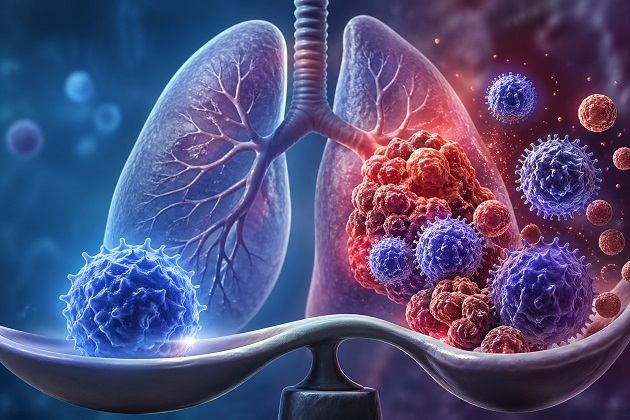 Study reveals how regulatory T cells can both defend the lungs and unintentionally support lung cancer growth
The Lung’s Natural Defense System
The lungs are constantly exposed to harmful particles such as dust, pollutants, bacteria, and viruses. To defend against these threats, the body relies on a sophisticated system called the pulmonary mucosal barrier. This barrier includes tightly connected cells lining the airways, a mucus layer that traps harmful substances, and tiny hair-like structures that help clear debris.
Within this protective environment, Treg cells act as regulators of the immune system. Their primary job is to prevent excessive inflammation that could damage healthy lung tissue. By releasing calming signals, these cells help maintain balance and ensure that the immune response does not become overly aggressive.
When Protection Becomes a Problem
The study reveals that in the presence of lung cancer, Treg cells can switch roles. Instead of protecting the body, they begin to suppress the immune system’s ability to attack cancer cells. This shift creates a favorable environment for tumors to grow and spread.
Tregs achieve this by releasing substances such as IL-10 and TGF-beta, which weaken the activity of immune cells responsible for killing cancer. They also interfere with key immune signals, effectively disabling the body’s natural defenses. As a result, cancer cells are able to evade detection and continue multiplying.
Tumors Actively Recruit Treg Cells
One of the most striking findings is that lung tumors are not passive. They actively attract Treg cells by releasing specific chemical signals. This recruitment strengthens the tumor’s ability to suppress the immune system.
As more Tregs gather within the tumor environment, they form a protective shield that blocks immune attacks. This not only accelerates tumor growth but is also associated with poorer outcomes in patients.
Damage to Lung Barriers Plays a Key Role
The research also highlights the importance of the lung’s protective barrier in preventing cancer. When this barrier is damaged—due to smoking, air pollution, or infections—it becomes easier for harmful substances to enter lung tissue.
This damage often leads to chronic inflammation, which can trigger changes in the immune system. Over time, these changes create conditions that support cancer development. The weakened barrier also allows cancer-promoting factors to interact more easily with lung cells, increasing the risk of tumor formation.
A Delicate Immune
Balance
This
Medical News report emphasizes that Treg cells are not inherently harmful. Under normal conditions, they are essential for maintaining immune balance and preventing autoimmune diseases.
However, their behavior depends heavily on the surrounding environment. In healthy lungs, they act as protectors. In cancerous conditions, they are manipulated into becoming suppressors that aid tumor survival. This dual nature is now understood as part of a broader system described by researchers as the “mucosal-Treg-tumor immune axis.”
Implications for Future Treatments
The discovery of this dual function opens new possibilities for lung cancer treatment. Scientists are now exploring ways to selectively target the harmful actions of Treg cells without disrupting their protective roles.
Potential strategies include blocking the signals that attract Tregs to tumors, interfering with the substances they release, and modifying the tumor environment so it no longer supports immune suppression. These approaches could improve the effectiveness of existing treatments, including immunotherapy.
However, researchers caution that completely eliminating Treg cells is not a viable solution. Doing so could lead to severe immune reactions and damage healthy tissues. The goal is to restore balance rather than remove these cells entirely.
Conclusion
The findings provide a deeper understanding of how lung cancer interacts with the immune system. Treg cells, once thought to play a purely protective role, are now recognized as key contributors to cancer progression under certain conditions. Their ability to switch between beneficial and harmful functions highlights the complexity of the disease. Moving forward, therapies that carefully adjust this balance may offer more precise and effective ways to treat lung cancer while preserving the body’s natural defenses.
The study findings were published in the peer reviewed journal: Immunology.
https://onlinelibrary.wiley.com/doi/10.1111/imm.70140
For the latest cancer research, keep on logging to Thailand
Medical News.
Read Also:
https://www.thailandmedical.news/articles/cancer
https://www.thailandmedical.news/articles/immunology




 Share
Share
 Tweet
Tweet
 Share
Share

































