Thailand Public Hospitals Face Cash Crisis and Risk of Collapse, Threatening Universal Care
Nikhil Prasad Fact checked by:Thailand Medical News Team Feb 16, 2026 6 months, 2 weeks, 11 hours, 4 minutes ago
Thailand Hospital News: Thailand’s public healthcare system is facing one of its most serious financial challenges in decades, as state hospitals across the country report rapidly declining liquidity levels that threaten their ability to deliver essential services. Health officials, hospital directors, and medical associations are now urging urgent reforms to safeguard the long-term survival of the universal healthcare system, commonly known as the Gold Card scheme.
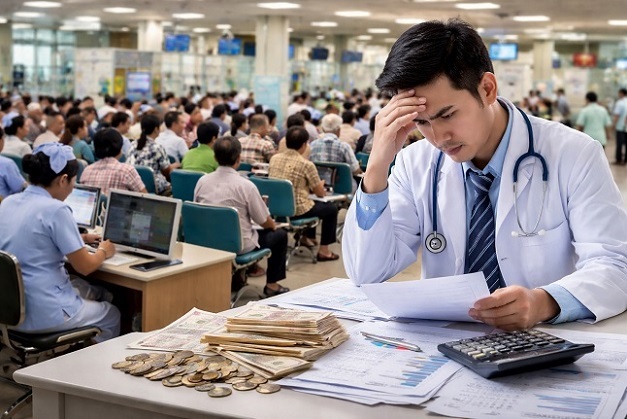 Public hospitals across Thailand are facing a growing financial crisis that could impact the future stability of the
universal healthcare system
The crisis has intensified pressure on the Ministry of Public Health and policymakers to reevaluate how hospitals are funded, reimbursed, and managed under the national universal healthcare framework. The Gold Card program, which is administered by the National Health Security Office, currently provides medical coverage to the majority of Thailand’s population. However, mounting evidence suggests that the financial structure supporting hospitals is increasingly unsustainable.
Liquidity Levels Collapse at Alarming Speed
Recent fiscal data has revealed a sharp and deeply concerning decline in hospital working capital. During the first quarter of fiscal year 2026, working capital among public hospital service units dropped to just 22.6 billion baht. This represents a dramatic fall compared to previous years, when working capital stood at 82 billion baht in early 2023, declined to 69 billion baht in 2024, and fell further to just above 50 billion baht in 2025.
This rapid deterioration has shocked many healthcare administrators, particularly because it is occurring at the very beginning of the fiscal year. Historically, hospitals tend to experience financial strain toward the end of the fiscal cycle, not the start. The current early-year collapse suggests a far more severe structural imbalance.
Even more concerning, the combined net working capital across 402 state hospitals has already fallen into negative territory, reaching minus 11.4 billion baht. This means that collectively, hospitals owe more in short-term obligations than they have available funds to cover.
This
Thailand Hospital News report highlights that without urgent intervention, hospitals may face severe cash flow shortages that could affect procurement of medicines, payment of staff, maintenance of equipment, and delivery of patient services.
Structural Funding Problems Behind the Crisis
At the heart of the financial strain lies the reimbursement system under the universal healthcare program. Hospitals receive payments for inpatient care based on an Adjusted Relative Weight formula, currently set at 8,350 baht per unit. However, approximately 3,505 baht of this amount is effectively allocated toward personnel costs, leaving a much smaller portion to cover treatment expenses, medical supplies, and operational overhead.
Hospital admin
istrators argue that this bundled payment structure masks the true cost of providing care. Internal financial assessments suggest that the actual reimbursement rate should be closer to 12,000 baht per unit or more to reflect real treatment costs accurately.
The current system also imposes national caps on service volumes. Hospitals must operate within a national Relative Weight cap to receive full compensation. When hospitals exceed this cap due to high patient demand, reimbursement rates are reduced, resulting in financial losses.
This mismatch between actual treatment costs and reimbursement levels has gradually eroded hospital financial reserves year after year.
Patient Demographics and Rising Treatment Costs
Thailand’s ageing population is another major driver of the crisis. Older patients typically require more complex, long-term treatment, including management of chronic diseases such as cardiovascular conditions, diabetes, kidney disease, and cancer.
Medical technology advancements have improved patient survival rates, but they have also significantly increased treatment costs. Advanced diagnostic tools, specialized medications, surgical procedures, and intensive care support all add to hospital expenses.
Currently, approximately 62 to 68 percent of patients treated in public hospitals are covered under the universal healthcare scheme. Another 12 to 17 percent fall under civil servant healthcare programs, while the remainder are covered by the social security system.
Hospital financial data shows that reimbursement from civil servant and social security schemes more closely matches actual treatment costs. In contrast, universal healthcare reimbursements are based on averaged costs within a fixed national budget, often leaving hospitals underfunded.
Calls for Urgent Structural Reform
Medical associations and healthcare organizations are now calling for amendments to healthcare financing policies to stabilize hospital finances. One key proposal is to separate personnel salaries from treatment reimbursement calculations. This would allow clearer cost accounting and ensure hospitals receive adequate compensation for medical services.
Healthcare groups are also calling for reforms to governance structures overseeing the universal healthcare system. They argue that frontline hospital representatives should have greater influence in policy decisions, as they are directly responsible for delivering care and managing financial realities.
Concerns have also been raised about financial transparency and administrative complexity within healthcare funding systems. Hospital administrators say clearer reporting and simplified funding allocation processes would improve financial stability and operational efficiency.
Balancing Universal Access with Financial Sustainability
Thailand’s universal healthcare system has long been praised internationally for providing affordable care to millions of citizens. It has significantly improved healthcare access, reduced medical poverty, and enhanced national health outcomes.
However, healthcare officials warn that without urgent financial restructuring, the system itself could face serious operational strain. Declining liquidity could eventually lead to delayed treatments, reduced services, or compromised quality of care.
Health authorities emphasize that the universal healthcare principle remains essential and must be preserved. However, ensuring sustainability will require careful financial planning, increased budget allocation, and reforms to reimbursement systems that more accurately reflect modern medical costs.
The current crisis serves as a critical warning. Without timely action, Thailand risks undermining one of its most important public health achievements. Ensuring that hospitals remain financially stable is not only essential for healthcare providers but also vital for protecting the health and wellbeing of millions of citizens who depend on the system every day.
Maintaining universal healthcare requires constant adaptation to evolving medical, demographic, and economic realities. Structural adjustments, improved financial transparency, and adequate reimbursement will be necessary to preserve both access and quality of care. Failure to act decisively could weaken hospital infrastructure and ultimately jeopardize national healthcare security.
References:
https://www.nhso.go.th/th/agency-th/report-finance-2
https://ucapps1.nhso.go.th/budgetreport/
For the latest
Thailand Hospital News, keep on logging to Thailand Medical News.
Read Also:
https://www.thailandmedical.news/articles/hospital-news




 Share
Share
 Tweet
Tweet
 Share
Share

































