Nikhil Prasad Fact checked by:Thailand Medical News Team Apr 22, 2026 5 months, 1 week, 5 days, 4 hours, 43 minutes ago
Medical News: A phytochemical compound found in hops - the plant widely used in food and beverage production - is gaining significant scientific attention after new research revealed its complex and sometimes surprising effects on the human body. Known as isoxanthohumol, this plant-based phytochemical molecule may influence metabolism, inflammation, and hormone activity, depending largely on the composition of an individual’s gut microbiota.
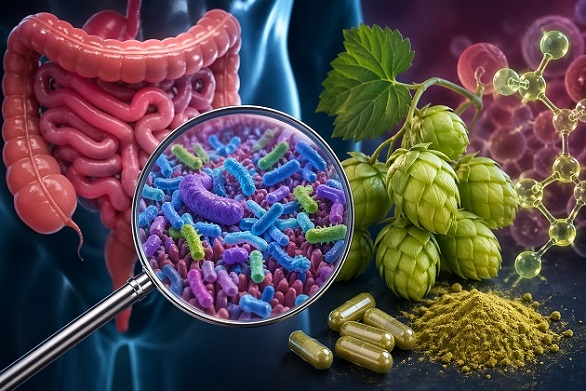 A natural hop compound may reshape metabolism and hormone activity through gut microbiota interactions
What Is Isoxanthohumol and Why It Matters
A natural hop compound may reshape metabolism and hormone activity through gut microbiota interactions
What Is Isoxanthohumol and Why It Matters
Isoxanthohumol is a naturally occurring flavonoid derived from hops. It is formed from another compound, xanthohumol, during processing and exposure to heat. While earlier studies have linked it to antioxidant, anti-inflammatory, and anticancer properties, recent findings highlight that its true biological impact depends on how it is processed inside the body.
Once ingested, isoxanthohumol undergoes enzymatic processing in the liver through cytochrome P450 systems such as CYP1A2, CYP2C9, and CYP3A4, followed by conjugation reactions involving glucuronidation and sulfation. However, the most critical transformation occurs in the gut, where intestinal microbiota convert it into a much more potent compound known as 8-prenylnaringenin, a strong phytoestrogen capable of interacting with hormone receptors.
The Crucial Role of Gut Microbiota
A key discovery from recent research is the central role played by gut bacteria in determining the effects of isoxanthohumol. Certain intestinal microbes, especially Eubacterium limosum, can efficiently convert isoxanthohumol into its more active estrogen-like form. Under optimal conditions, this conversion can be highly efficient.
However, not everyone has the same microbial composition. Studies indicate that only a portion of the population can effectively carry out this conversion. This means that individuals consuming the same compound may experience very different biological effects.
Adding further complexity, other gut bacteria such as Eubacterium ramulus can break down the active metabolite, reducing its hormonal influence. This dynamic interaction highlights how the balance of gut microbes ultimately determines the compound’s final impact.
Metabolic and Anti-Inflammatory Benefits
Beyond its hormone-related effects, isoxanthohumol has demonstrated promising benefits in metabolic health. Preclinical studies show that it can improve blood sugar regulation, enhance insulin sensitivity, and reduce markers of chronic inflammation.
These benefits appear to be closely linked to changes in the gut microbiota. Notably, isoxanthohumol has been shown to increase levels of Akkermansia muciniphila, a beneficial bacterium associated with improved gut health and metabolic balance. At the same time, it reduces populations of harmful bacteria linked to inflammation.
This
Medical News
report highlights that these positive effects can occur independently of significant weight loss, suggesting that the compound acts directly through microbiota-driven pathways rather than solely through changes in body fat.
Hormonal Implications and Potential Risks
Despite its benefits, the transformation of isoxanthohumol into a strong estrogen-like compound introduces important safety considerations. The metabolite 8-prenylnaringenin is among the most potent plant-based estrogens identified to date, capable of interacting with hormone receptors in the body.
In some contexts, such as menopause, this activity may be beneficial by helping to alleviate symptoms or support bone health. However, it may pose risks for individuals with hormone-sensitive conditions, including certain cancers or reproductive disorders.
It is important to note that isoxanthohumol itself has relatively weak hormonal activity. The level of risk largely depends on how efficiently an individual’s gut microbiota converts it into the more active form.
Challenges in Absorption and Future Research
One limitation of isoxanthohumol is its low bioavailability, meaning it is not easily absorbed by the body. Researchers are currently exploring advanced delivery methods, including nano-formulations and protein-based carriers, to enhance its effectiveness.
Scientists are also investigating how slight changes in its chemical structure can influence its biological activity, with the goal of developing safer and more targeted applications.
Conclusion
Isoxanthohumol represents a compelling example of how plant compounds and gut microbiota interact to influence human health. Its potential to improve metabolic function and reduce inflammation is supported by growing evidence, yet its conversion into a potent estrogen-like compound introduces significant complexity. Individual differences in gut bacteria play a decisive role in determining both benefits and risks, making personalized responses highly variable. While the compound shows promise for future therapeutic applications, particularly in metabolic and inflammatory conditions, careful evaluation of long-term safety is essential, especially for populations vulnerable to hormonal effects.
The study findings were published in the peer reviewed journal: Molecules.
https://www.mdpi.com/1420-3049/31/8/1311
for the latest on herbs and phytochemicals, keep on logging to Thailand
Medical News.
Read Also:
https://www.thailandmedical.news/articles/herbs-and-phytochemicals




 Share
Share
 Tweet
Tweet
 Share
Share