Nikhil Prasad Fact checked by:Thailand Medical News Team Jun 09, 2026 3 months, 3 weeks, 4 days, 4 hours, 33 minutes ago
Medical News: A newly published study has identified a human protein called CD9 as a crucial factor that helps Ebola and Marburg viruses spread from infected cells. The discovery sheds new light on how these deadly pathogens exploit the body's own cellular machinery and could pave the way for innovative antiviral treatments that target human proteins rather than the viruses themselves.
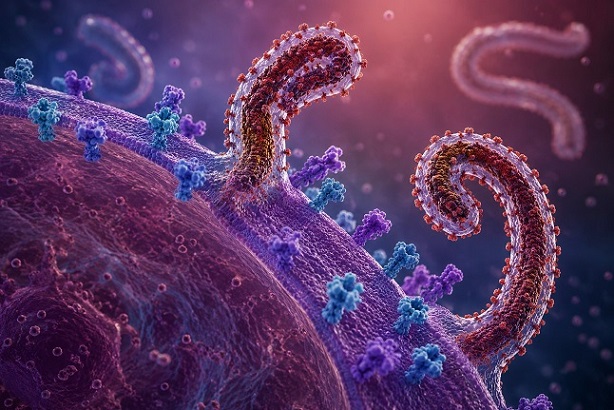 Scientists discover that the human protein CD9 plays a crucial role in helping Ebola and Marburg viruses escape
infected cells and spread throughout the body
The research was conducted by scientists from the Department of Pathobiology at the School of Veterinary Medicine, University of Pennsylvania in Philadelphia; the Integrated Biomedical Science Program at the University of Texas San Antonio; and the Host-Pathogen Interactions Program at the Texas Biomedical Research Institute in San Antonio.
Scientists Search for Hidden Weaknesses in Deadly Viruses
Ebola and Marburg viruses belong to a family of pathogens known as filoviruses. These viruses are notorious for causing severe hemorrhagic fever, a disease characterized by internal bleeding, organ failure, and high mortality rates. In some outbreaks, death rates have reached as high as 90 percent.
Although vaccines and experimental treatments have improved the outlook for some patients, researchers continue searching for new ways to stop these viruses. One promising strategy involves identifying host proteins that viruses depend on during infection.
Instead of targeting the virus directly, scientists hope to interfere with the human cellular factors that viruses need to survive and spread.
CD9 Emerges as a Key Player
The researchers initially conducted genetic analyses to identify human genes that might influence Ebola and Marburg virus infections. Among several candidates, a protein called CD9 stood out.
CD9 is part of a family of proteins known as tetraspanins. These proteins are found on the surface of cells and help organize clusters of molecules within the cell membrane. They are involved in numerous biological processes, including cell communication, movement, adhesion, and signaling.
Previous studies had already linked CD9 to the life cycles of several viruses, including HIV, influenza, coronaviruses, and Zika virus. This led the researchers to investigate whether Ebola and Marburg viruses also rely on CD9.
Removing CD9 Dramatically Reduces Viral Escape
To test the role of CD9, the scientists used advanced gene-editing techniques and RNA interference methods to reduce CD9 levels in human cells.
The results were striking. When CD9 expression was suppressed, the release of Ebola virus-like particles dropped dramatically. In some experiments, viral particle production fell to only about 30 percent of the levels seen in normal cells.
A similar pattern was observed with Marburg virus-like particles. Cells lacking sufficient CD9 struggled to release viral particles efficiently, suggesting that the protein plays a major role in helping viruses
exit infected cells.
The researchers then restored CD9 levels in the modified cells. Once CD9 was reintroduced, viral release recovered to nearly normal levels. This finding provided strong evidence that CD9 itself was responsible for the observed effects.
Real Ebola and Marburg Viruses Show the Same Dependence
To determine whether the findings applied to actual viral infections, the team performed experiments using live Ebola and Marburg viruses.
The results closely mirrored those seen in laboratory-generated viral particles.
Cells with reduced CD9 levels showed significantly lower rates of Ebola infection and viral spread. More importantly, the amount of virus released from infected cells decreased by approximately 75 to 80 percent compared to normal cells.
Marburg virus displayed a similar dependence on CD9. Viral spread was substantially reduced, and virus release dropped dramatically in cells where CD9 expression had been suppressed.
These findings indicate that CD9 is not merely involved in artificial laboratory systems but is also essential during authentic infections with these dangerous pathogens.
Why This Protein Matters
Viruses lack the ability to reproduce on their own and must exploit the machinery of the cells they infect. According to the researchers, CD9 appears to help create the membrane environment needed for Ebola and Marburg viruses to assemble and bud from infected cells.
The protein is believed to organize specialized regions of the cell membrane and coordinate interactions with structural components inside the cell. These functions may provide the support necessary for newly formed viruses to successfully escape and infect additional cells.
This
Medical News report highlights the growing realization that many viruses depend heavily on host proteins for critical stages of their life cycle. Identifying these host factors could provide entirely new avenues for therapeutic intervention.
Potential Implications for Future Treatments
One of the most important aspects of the discovery is that both Ebola and Marburg viruses appear to rely on the same human protein. This raises the possibility of developing therapies that target CD9-related pathways and potentially work against multiple filoviruses.
Unlike drugs aimed directly at viral proteins, treatments targeting host factors may be less vulnerable to viral mutations that often lead to drug resistance.
Researchers believe that understanding exactly how CD9 supports viral release could eventually lead to broad-spectrum antiviral strategies capable of limiting the spread of some of the world's most lethal viruses.
Conclusion
The identification of CD9 as a critical regulator of Ebola and Marburg virus spread represents a significant advance in filovirus research. By demonstrating that suppression of CD9 can reduce viral infectivity and decrease virus release by up to 80 percent, the study uncovers an important vulnerability that had previously gone unrecognized. The findings suggest that Ebola and Marburg viruses are highly dependent on specific host-cell mechanisms to complete their life cycle. While further studies are needed to fully understand the molecular interactions involved and to determine whether CD9 can be safely targeted in humans, the research opens an exciting new avenue for antiviral drug development. If future therapies can successfully disrupt this pathway, they may offer a powerful new tool for combating some of the deadliest viral diseases known to humanity.
The study findings were published in the peer reviewed journal: Viruses.
https://www.mdpi.com/1999-4915/18/1/104
For the latest on Ebola research, keep on logging to Thailand
Medical News.
Read Also:
https://www.thailandmedical.news/articles/ebola




 Share
Share
 Tweet
Tweet
 Share
Share

































