CVA6 Virus Surge Sparks Global Concern as Severe Hand Foot and Mouth Disease Cases Rise
Nikhil Prasad Fact checked by:Thailand Medical News Team Jun 19, 2026 3 months, 2 weeks, 1 day, 2 hours, 42 minutes ago
Medical News: Hand, foot, and mouth disease (HFMD) has long been regarded as a common childhood illness that usually resolves on its own within a week or two. Traditionally, the disease has been linked mainly to Coxsackievirus A16 and Enterovirus A71 (EV-A71). However, a growing body of research is showing that another virus, Coxsackievirus A6 (CVA6), is rapidly emerging as a dominant global threat, causing larger outbreaks, more severe symptoms, and a broader range of complications than previously recognized.
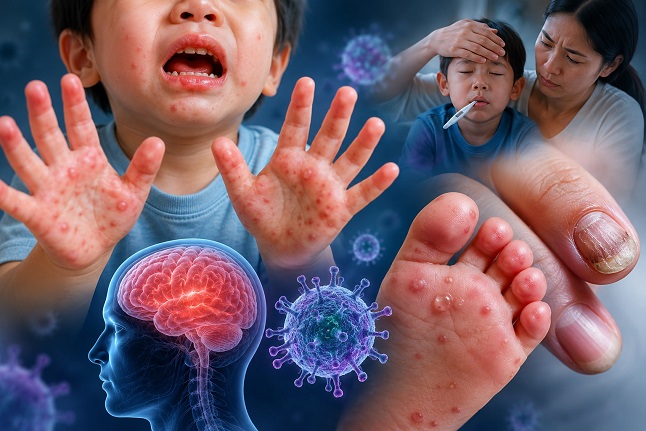 Emerging Coxsackievirus A6 infections are driving more severe and widespread hand, foot, and mouth disease outbreaks
worldwide
Researchers from the Jiangxi University of Chinese Medicine, Nanchang, China, and collaborating institutions conducted an extensive review examining the epidemiology, pathogenicity, evolution, diagnosis, and antiviral strategies related to CVA6. Their findings highlight why health authorities are increasingly concerned about the virus's growing impact worldwide.
A New Dominant Cause of HFMD
Over the last decade, CVA6 has steadily overtaken many traditional HFMD-causing viruses in numerous countries. Unlike the classic form of HFMD, which mainly affects children under five years of age, CVA6 infections are increasingly being reported in older children, teenagers, and adults.
This broader susceptibility means the virus can spread rapidly through households, schools, and workplaces. Because many adults have little or no immunity against CVA6, outbreaks can affect entire families rather than just young children.
More Aggressive and Painful Symptoms
One of the most alarming features of CVA6 is its tendency to produce far more severe skin manifestations than those seen with traditional HFMD strains.
Patients frequently develop extensive rashes that spread beyond the hands, feet, and mouth to involve the arms, legs, torso, face, and buttocks. Large fluid-filled blisters, known as bullae, can form and may resemble chickenpox, eczema, or other skin disorders, often making diagnosis difficult.
In addition to the rash, infected individuals often experience prolonged high fevers, severe mouth ulcers, intense pain, and difficulty eating or drinking. In young children, dehydration can become serious enough to require hospitalization.
The Unusual Nail-Shedding Phenomenon
A particularly distinctive feature of CVA6 infection is a condition known as onychomadesis, or delayed nail shedding. Several weeks after apparent recovery, fingernails and toenails may begin to loosen and fall off.
This complication typically occurs four to eight weeks after the initial illness and can be alarming for patients and parents. Although the nails usually regrow naturally, the phenomenon remains one of the most recognizable hallmarks of CVA6 infection.
Neurological Complications Raise Concerns
While Enterovirus A71 remains notorious for causing severe neurological disease, researchers warn that CVA6 is also capable of triggering dangerous compl
ications involving the central nervous system.
Documented neurological conditions linked to CVA6 include aseptic meningitis, encephalitis, acute limb weakness, paralysis, and, in rare cases, life-threatening cerebral edema or brain swelling.
This
Medical News report highlights that although such complications remain uncommon, their occurrence underscores the importance of close monitoring during infection.
Doctors urge immediate medical evaluation if patients develop warning signs such as persistent high fever, repeated vomiting, severe headache, unusual drowsiness, muscle jerks, balance problems, weakness in the arms or legs, or seizures.
A Rapidly Evolving Virus
Researchers also found that CVA6 continues to evolve through genetic mutations and frequent recombination events with other enteroviruses. This constant evolution has resulted in the emergence of multiple viral lineages and recombinant strains.
Such genetic changes can potentially alter disease severity, transmission patterns, and immune responses, making outbreak prediction increasingly difficult. The virus's rapid evolution also presents significant obstacles for vaccine development and antiviral drug design.
Challenges for Treatment and Prevention
Currently, no specific antiviral therapy has been approved for CVA6 infections. Treatment remains largely supportive, focusing on hydration, fever management, and symptom relief.
Scientists are investigating both viral structural proteins and non-structural proteins as potential therapeutic targets. However, the virus's ability to mutate and recombine continues to complicate efforts to develop broadly effective treatments and vaccines.
Enhanced molecular surveillance, improved diagnostic testing, and expanded international monitoring programs are therefore considered essential for controlling future outbreaks.
Conclusion
The rise of Coxsackievirus A6 represents a significant shift in the global landscape of hand, foot, and mouth disease. Unlike traditional HFMD viruses, CVA6 causes more widespread skin disease, affects a broader age range, and has demonstrated the potential to cause serious neurological complications. Its ongoing genetic evolution and increasing dominance in outbreaks worldwide make it an important emerging public health challenge. Researchers emphasize that continued surveillance, accelerated antiviral research, and vaccine development efforts will be crucial to limiting the impact of future CVA6-driven epidemics.
The study findings were published in the peer reviewed journal: Clinical Microbiology Reviews:
https://journals.asm.org/doi/10.1128/cmr.00015-26
For the latest on Coxsackievirus A6, keep on logging to Thailand
Medical News.
Read Also:
https://www.thailandmedical.news/articles/infectious-diseases




 Share
Share
 Tweet
Tweet
 Share
Share

































