COVID-19 Spike Protein Study Reveals Vaccines and Infection Train T-Cells in Different Ways
Nikhil Prasad Fact checked by:Thailand Medical News Team Jul 21, 2026 2 months, 1 week, 6 days, 19 hours, 40 minutes ago
Medical News: A new study has uncovered an important difference in how the human immune system responds to COVID-19 infection compared to vaccination. Researchers found that the body's CD4+ T cells—immune cells that help coordinate long-term protection—focus on different parts of the SARS-CoV-2 spike protein depending on whether a person was infected with the virus or received an mRNA vaccine. The findings suggest that the way the spike protein is first encountered can shape future immune responses and may even influence protection against severe disease.
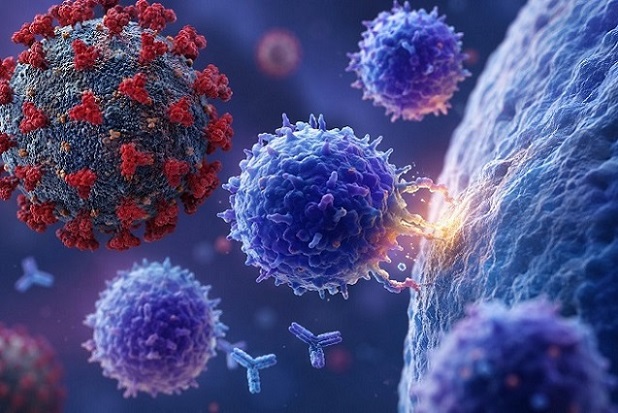 New research shows COVID-19 infection and vaccination program CD4+ T cells to recognize different regions
of the coronavirus spike protein, potentially influencing long-term immunity and disease outcomes.
Scientists Investigated How the Immune System Chooses Its Targets
The research was led by scientists from Tulane University School of Medicine, Tulane University Department of Computer Science, Medical University of Vienna, Washington State University, and Ochsner Health Center.
Rather than examining antibodies alone, the researchers focused on CD4+ T cells, which play a vital role in helping other immune cells produce better antibodies, activating killer T cells, and coordinating the body's defense against viral infections.
The team wanted to understand why certain portions of the coronavirus spike protein consistently attract stronger T-cell responses than others. They suspected that the three-dimensional shape of the spike protein determines which regions are cut apart and presented to immune cells.
Protein Shape Dictates Which Immune Targets Are Seen
The researchers first analyzed the physical structure of the spike protein using laboratory protease digestion experiments. They discovered that enzymes naturally cut the spike protein at flexible and unstable regions while leaving more stable regions largely intact.
These cleavage sites closely matched the structural boundaries of the spike protein, confirming that its shape strongly influences how it is processed before immune cells recognize it.
Interestingly, the study found that the stabilized spike protein used in mRNA vaccines behaves differently from the spike protein produced during natural infection, leading immune cells to encounter different fragments.
Infection and Vaccination Produce Distinct T-Cell Fingerprints
This
Medical News report highlights one of the study's most striking discoveries. The researchers divided dominant spike protein peptides into two groups: peptides from structurally stable regions and peptides from structurally unstable regions.
Blood samples collected from multiple human cohorts showed clear differences. Individuals who had recovered from COVID-19 alone generated relatively stronger responses against peptides located within unstable regions of the spike protein.
By contrast,
people who were vaccinated—especially those vaccinated without prior infection—showed much stronger responses toward peptides found in stable regions of the spike protein.
Instead of simply increasing the overall number of T cells, vaccination appeared to redirect which spike regions those T cells recognized.
When previously infected individuals later received vaccination, their immune responses gradually shifted toward the stable-region pattern seen in vaccinated individuals.
More Infections May Continue to Reshape Immunity
The researchers also studied a separate group of recently infected patients treated through Ochsner Health Center.
They observed that as the number of previous COVID-19 infections increased, the ratio between stable-region and unstable-region T-cell responses steadily declined. This indicates that repeated encounters with the virus continue modifying immune memory rather than simply strengthening existing responses.
The study further identified individual spike protein peptide pairs that largely drove these changes, suggesting that only a small number of dominant immune targets may influence broader T-cell behavior.
Possible Link to Disease Severity
Perhaps the most intriguing finding involved disease severity. Among unvaccinated infected participants, those who experienced milder COVID-19 symptoms displayed stronger T-cell responses toward the stable regions of the spike protein. Participants with more pronounced inflammatory immune profiles showed comparatively weaker responses to these stable targets.
Although the researchers emphasize that additional studies are needed, the findings raise the possibility that recognizing certain stable portions of the spike protein may contribute to better immune protection while reducing harmful inflammation.
The researchers believe these differences are likely driven by variations in antigen processing, the types of immune cells involved, local inflammatory signals, and the structural form of the spike protein during the initial exposure.
Conclusion
The study demonstrates that natural SARS-CoV-2 infection and mRNA vaccination leave distinctly different immune fingerprints by directing CD4+ T cells toward different regions of the spike protein. These differences may influence immune memory, repeated infection responses, vaccine effectiveness, and possibly even disease severity. The findings provide important new insights into how the body's adaptive immune system is programmed and may help guide the design of future vaccines that generate broader and more protective T-cell immunity.
The study findings were published in the peer reviewed journal: Frontiers in Immunology.
https://www.frontiersin.org/journals/immunology/articles/10.3389/fimmu.2026.1857103/full
For the latest COVID-19 news, keep on logging to Thailand
Medical News.
Read Also:
https://www.thailandmedical.news/articles/coronavirus
https://www.thailandmedical.news/articles/vaccine-news
https://www.thailandmedical.news/articles/immunology




 Share
Share
 Tweet
Tweet
 Share
Share

































