Bee Propolis Shows Powerful Action Against Shingles Virus and Drug-Resistant Strains
Nikhil Prasad Fact checked by:Thailand Medical News Team Jun 24, 2026 3 months, 1 week, 3 days, 3 hours, 40 minutes ago
Medical News: A natural substance made by honeybees may offer a promising new way to fight the virus responsible for chickenpox and shingles, according to a new study. Researchers have found that propolis, often called “bee glue,” demonstrated strong antiviral activity against varicella-zoster virus (VZV), including strains that no longer respond to the commonly used antiviral drug acyclovir.
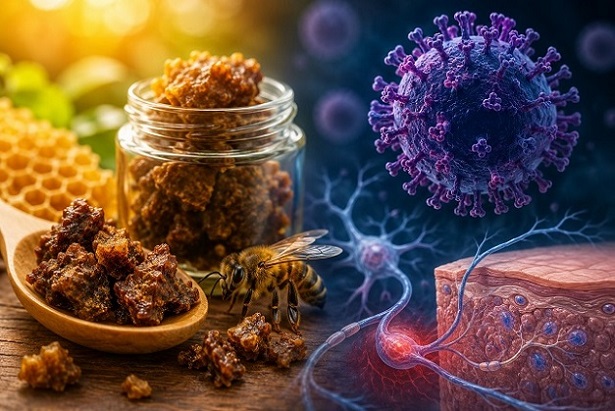 Natural bee-derived propolis demonstrated strong activity against the shingles virus, including strains resistant to
standard antiviral drugs
The study provides fresh hope for the development of alternative treatments for shingles, a painful condition that affects millions of people worldwide, particularly older adults and those with weakened immune systems.
Why New Treatments Are Needed
Varicella-zoster virus, also known as human herpesvirus-3, causes chickenpox during the initial infection, usually in childhood. After recovery, however, the virus does not completely disappear. Instead, it remains dormant inside nerve cells for life and can reactivate years or even decades later, causing shingles.
While vaccination has greatly reduced chickenpox cases, shingles continues to be a major health concern. The condition is often accompanied by severe nerve pain that can persist for months or even years. In some cases, complications can include neurological disorders, strokes, vision problems, and secondary bacterial infections.
Current treatments rely heavily on antiviral drugs such as acyclovir, valacyclovir, famciclovir, and brivudine. Unfortunately, increasing numbers of VZV strains are becoming resistant to acyclovir due to mutations in a viral gene known as thymidine kinase. This growing resistance has created an urgent need for new antiviral approaches.
Bee-Derived Propolis Under Investigation
Propolis is a sticky, resin-like material produced by honeybees using plant resins mixed with their own secretions. Bees use it to strengthen and protect their hives from microbial contamination.
For centuries, propolis has been used in traditional medicine for a wide variety of ailments. Modern scientific studies have already shown that it possesses antibacterial, antifungal, anti-inflammatory, antiviral, and wound-healing properties.
In this latest research, scientists investigated whether Brazilian green propolis could combat VZV. The research was conducted using cultured human cells, human fetal skin tissue, and human dorsal root ganglia tissue, which contains the nerve cells where VZV typically hides during its dormant phase.
The researchers were from the Department of Microbiology and Immunology, University of British Columbia, Vancouver, Canada, together with collaborating institutions involved in virology, molecular biology, and infectious disease research.
Strong Antiviral Effects Observed
The team first evaluated whether propolis was toxic to human cells. Laboratory tests showed that concentrations of up to 0.125 percent caused very little cellular damage.
&nb
sp;
They then measured viral growth using a specially engineered VZV strain that produces detectable light signals. Results revealed that propolis suppressed viral replication in a clear dose-dependent manner, meaning higher concentrations produced stronger antiviral effects.
Importantly, the antiviral activity was not limited to laboratory-grown cells. Similar results were seen in human skin tissue and nerve tissue samples. At a concentration of 0.1 percent, propolis produced antiviral effects approaching those achieved with acyclovir.
This
Medical News report highlights that one of the most remarkable findings was propolis’ ability to inhibit a genetically engineered acyclovir-resistant VZV strain lacking the viral thymidine kinase gene. While acyclovir was essentially ineffective against this resistant virus, propolis continued to suppress viral replication.
How Propolis Appears to Work
To better understand the mechanism involved, researchers performed extensive RNA sequencing analyses.
The study found that propolis altered the activity of hundreds of host genes. Depending on the concentration used, between 207 and 1,035 genes showed significant changes in expression.
Several important biological pathways were affected, including glycolysis and gluconeogenesis, calcium signaling, ferroptosis, cytokine signaling, extracellular matrix organization, and cellular adhesion pathways.
The researchers also discovered that propolis reduced viral RNA production and interfered with viral RNA splicing, a critical process required for generating functional viral proteins. This suggests that propolis disrupts the virus at multiple stages of its life cycle.
Interestingly, infected cells treated with propolis displayed gene-expression patterns that more closely resembled healthy uninfected cells, indicating that the substance may help reverse some of the cellular disruptions caused by VZV infection.
Natural Compounds May Hold the Key
Scientists believe the antiviral effects may arise from the combined action of numerous compounds found in propolis. Brazilian green propolis is particularly rich in phenolic acids, cinnamic acid derivatives, Artepillin-C, and baccharin, all of which may contribute to its biological activity.
However, the researchers caution that propolis composition can vary depending on geography, plant sources, and seasonal factors. Future research will be needed to identify the exact antiviral compounds responsible for the observed effects.
Conclusion
The findings suggest that propolis possesses significant antiviral activity against varicella-zoster virus and may be especially valuable against drug-resistant strains that no longer respond to standard therapies. Unlike acyclovir, propolis appears to work through entirely different biological mechanisms, affecting both viral gene expression and multiple host cellular pathways. Although the research remains at an early stage and has only been conducted in laboratory and tissue models, the results are highly encouraging. Further studies involving animal models and eventually human clinical trials will be necessary to determine safety, effectiveness, optimal dosing, and the specific active compounds involved. If future investigations confirm these findings, propolis could emerge as an important new weapon in the fight against shingles and other VZV-related diseases.
The study findings were published in the peer reviewed journal: Zoonoses.
https://www.scienceopen.com/hosted-document?doi=10.15212/ZOONOSES-2025-0081
For the latest on Shingles, keep on logging to Thailand
Medical News.
Read Also:
https://www.thailandmedical.news/news/incidences-of-herpes-zoster-ophthalmicus-as-a-result-of-shingles-are-rising-globally
https://www.thailandmedical.news/news/shingles-cases-rising-among-young-adults-worldwide
https://www.thailandmedical.news/news/herpes-zoster-after-covid-19-linked-to-higher-blood-cancer-risk




 Share
Share
 Tweet
Tweet
 Share
Share

































