Singapore Scientists Discover Key Human Protein That Fuels Hepatitis B Replication
Nikhil Prasad Fact checked by:Thailand Medical News Team May 13, 2026 3 months, 6 days, 19 hours, 10 minutes ago
Medical News: A major scientific breakthrough has revealed how the hepatitis B virus hijacks a human protein to help it survive and multiply inside the liver. The discovery could eventually lead to new treatments capable of delivering a more effective and lasting cure for millions of people living with chronic hepatitis B infection worldwide.
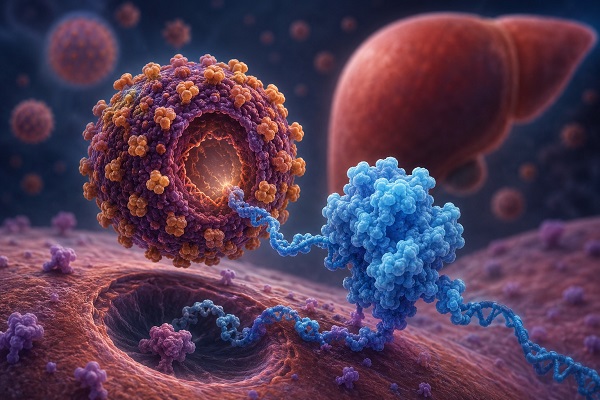 Researchers identify the human protein CCNL1 as a crucial factor that helps hepatitis B virus survive and
multiply inside liver cells
Researchers from the Genome Institute of Singapore under ASTAR, the National University of Singapore, the Experimental Drug Development Centre at ASTAR, the Cancer Research Center of Lyon in France, the University of Glasgow, Nanyang Technological University, the University of Nairobi, the National University Hospital Singapore, and the Institute of Molecular and Cell Biology have identified a human protein called Cyclin L1, also known as CCNL1, as a critical factor that hepatitis B virus depends on to replicate efficiently.
Hepatitis B Still Remains a Global Threat
Hepatitis B is one of the world’s most dangerous viral infections and affects more than 250 million people globally. Chronic infection can silently damage the liver over many years and eventually lead to liver failure, cirrhosis, or liver cancer. Although current antiviral medications can suppress the virus, they rarely eliminate it completely. Many patients need lifelong treatment because the virus can continue hiding inside liver cells in a stable DNA form known as cccDNA.
Scientists have long been trying to understand exactly which human proteins the virus depends on for survival. Identifying these host factors could allow researchers to develop therapies that indirectly stop the virus by targeting the human machinery it exploits.
Researchers Identify a Crucial Human Helper Protein
Using advanced whole-transcriptome sequencing technology, the scientists analyzed liver cells infected with hepatitis B virus and compared them with healthy cells. They discovered that the virus dramatically altered the activity of numerous human genes after infection.
Among 69 significantly altered genes, CCNL1 emerged as one of the most important.
The team then used RNA interference technology to reduce CCNL1 levels inside infected liver cells. The results were striking. When CCNL1 was suppressed, the virus lost much of its ability to reproduce.
Levels of hepatitis B surface antigen, a major viral protein used to track infection activity, dropped significantly. Researchers also observed sharp reductions in viral DNA, viral RNA, HBe antigen, and core viral proteins.
Importantly, the reduction of CCNL1 did not significantly harm healthy liver cells, suggesting that therapies targeting this protein might be safer than expected.
How The Virus Exploits CCNL1
The study revealed that CCNL1 helps regulate an important cellular enzyme called RNA polymerase II. This enzyme acts like a molecular machine that reads genetic instructions and helps produce RNA needed f
or protein production.
Hepatitis B virus relies heavily on this system because it stores its viral blueprint inside infected liver cells as cccDNA, a tiny viral mini-chromosome that continuously produces new viral material.
Researchers discovered that CCNL1 helps RNA polymerase II attach to the viral cccDNA and activate viral gene production. Without sufficient CCNL1, the viral transcription process becomes severely weakened.
This
Medical News report notes that the scientists also found reduced activity of important epigenetic markers linked to active viral replication after CCNL1 was blocked. In simple terms, shutting down CCNL1 appeared to partially silence the virus inside infected liver cells.
Findings Confirmed in Multiple Models
The researchers validated their findings using several laboratory models, including primary human hepatocytes, which closely mimic real human liver tissue.
In every model tested, reducing CCNL1 consistently lowered viral activity. Interestingly, the amount of viral cccDNA itself did not significantly decrease, suggesting that CCNL1 mainly controls the virus after the viral DNA reservoir has already formed.
The scientists also discovered that CCNL1 physically interacts with hepatitis B viral RNA and may influence how stable or active these viral genetic messages remain inside cells.
Additional experiments showed that CCNL1 may affect important cellular structures such as the endoplasmic reticulum, Golgi apparatus, and actin networks, all of which are known to play roles in viral replication and transport.
Higher CCNL1 Levels Seen in Chronic Hepatitis B Patients
To determine whether the findings were clinically relevant, the scientists examined liver samples from patients with chronic hepatitis B infection.
They found that CCNL1 levels were significantly higher in patients with ongoing chronic infection compared to individuals who had successfully achieved functional cure marked by the loss of hepatitis B surface antigen.
This suggests that CCNL1 may potentially serve not only as a therapeutic target but also as a biomarker for disease activity and viral persistence.
Conclusions
The identification of CCNL1 as a key host protein that supports hepatitis B replication represents a major advance in hepatitis B research. Rather than directly attacking the virus itself, future treatments may target human proteins like CCNL1 that the virus depends on for survival. Such an approach could help reduce drug resistance and improve long-term treatment outcomes for chronic hepatitis B patients.
Although additional studies are still needed before clinical therapies can be developed, the findings provide strong new evidence that disrupting host-virus interactions may become one of the most promising strategies for finally controlling or functionally curing hepatitis B infection.
The study findings were published in the peer reviewed journal: Viruses.
https://www.mdpi.com/1999-4915/18/5/545
For the latest on Hepatitis B research, keep on logging to Thailand
Medical News.
Read Also:
https://www.thailandmedical.news/articles/stds




 Share
Share
 Tweet
Tweet
 Share
Share