Nikhil Prasad Fact checked by:Thailand Medical News Team Jun 25, 2026 3 months, 1 week, 1 day, 22 hours, 36 minutes ago
Medical News:
Researchers Find Naturally Produced Compound That Alters Brain Activity Without Causing Brain Damage
Scientists have discovered that a naturally occurring steroid made by the body can dramatically increase activity levels and reduce anxiety-like behavior without causing the brain damage or movement problems commonly associated with similar compounds. The findings challenge long-held assumptions about an important family of naturally produced steroids and may help researchers better understand brain disorders involving dopamine, serotonin, and other chemical messengers.
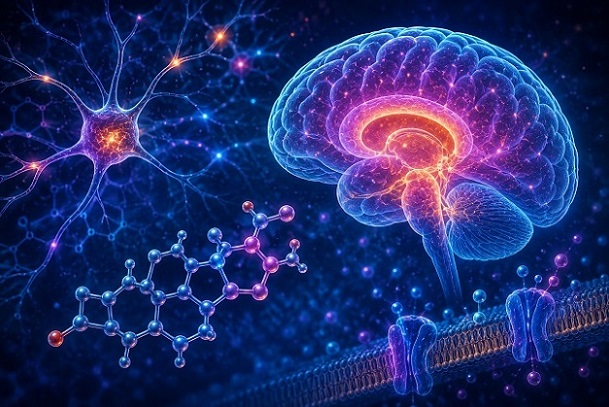 Researchers discovered that the natural steroid marinobufagenin increases activity and reshapes brain chemistry
in mice without causing movement problems or oxidative brain damage
The study was carried out by researchers from the Institute of Translational Biomedicine at St. Petersburg State University, the Biological Department of St. Petersburg State University, the Russian Center of Neurology and Neurosciences in Moscow, and Johns Hopkins University in Baltimore, Maryland, USA.
A Brain-Active Steroid That Behaves Differently
Marinobufagenin, or MBG, belongs to a group of naturally occurring compounds known as cardiotonic steroids. Although these compounds were first recognized for their effects on the heart and blood pressure, scientists now know they also influence the brain by interacting with the sodium-potassium pump, a protein found on nerve cells that is essential for normal brain signaling.
Another naturally occurring steroid in the same family, ouabain, has previously been shown to trigger mania-like behavior, movement abnormalities, and oxidative stress in laboratory animals. However, whether MBG produces similar effects has remained largely unknown.
To answer this question, researchers administered small amounts of MBG directly into the brains of healthy mice every day for 14 days. They then examined changes in behavior, walking ability, brain chemistry, and biochemical markers associated with oxidative stress. The goal was to determine whether MBG affects the brain in the same way as ouabain or follows a completely different biological pathway.
Hyperactivity Appeared Without Movement Problems
The results surprised the researchers. Unlike mice exposed to ouabain in previous studies, animals treated with MBG did not become immediately hyperactive. Instead, noticeable behavioral changes gradually appeared after two weeks of treatment.
By the end of the study, MBG-treated mice were traveling significantly longer distances during open-field testing than untreated animals. They also spent considerably more time exploring the center of the testing arena. Since mice naturally avoid open spaces because they feel exposed to predators, this behavior is widely regarded as an indicator of reduced anxiety-like behavior.
Importantly, detailed gait analysis showed that the mice maintained normal stride length, balance, posture, coordination, and walking patterns. Although they moved faster and were more active, they did not develop the motor impairments or gait abnormalities previously observed
with ouabain treatment.
Brain Chemistry Was Significantly Altered
This
Medical News report highlights that the behavioral changes were accompanied by widespread alterations in several major neurotransmitter systems that regulate movement, motivation, mood, and emotional responses.
The researchers found significant changes in dopamine metabolism within the striatum and thalamus, two brain regions involved in controlling movement and processing information. Dopamine levels also increased in the brainstem, while norepinephrine concentrations rose in both the striatum and hippocampus.
The prefrontal cortex, the brain region responsible for planning, decision-making, and emotional regulation, showed increased serotonin turnover. According to the researchers, these region-specific changes suggest that MBG carefully reshapes communication between multiple brain networks rather than simply overstimulating the entire brain.
The findings indicate that the increased activity observed in the animals was driven by complex changes involving dopamine, serotonin, and norepinephrine signaling instead of damage to brain tissue.
No Signs of Oxidative Stress
One of the most important discoveries was what the researchers did not find.
Previous studies involving ouabain frequently reported oxidative stress, a harmful process in which unstable molecules damage cells and contribute to aging and neurological disease. In contrast, MBG produced no evidence of widespread oxidative injury.
Levels of important antioxidant enzymes, including superoxide dismutase and catalase, remained unchanged. Even more surprising, levels of malondialdehyde, a well-established marker of oxidative damage, were actually reduced in the prefrontal cortex. Although activity of the enzyme monoamine oxidase-B increased within the striatum, the overall biochemical evidence showed that MBG altered neurotransmitter metabolism without triggering destructive oxidative processes.
These findings clearly distinguish MBG from ouabain and demonstrate that members of the same family of natural steroids can have remarkably different effects on the brain.
A New Direction for Brain Research
The researchers conclude that naturally occurring cardiotonic steroids should no longer be viewed as acting through identical biological mechanisms. Instead, MBG appears capable of increasing activity and reducing anxiety-like behavior by selectively modifying dopamine, serotonin, and norepinephrine signaling while preserving normal motor function and avoiding oxidative brain injury. Although these findings come from experiments in mice and cannot yet be directly applied to humans, they provide valuable new insights into how naturally produced brain steroids influence neural function and may eventually contribute to research on bipolar disorder, anxiety disorders, neurodegenerative diseases, and other neurological conditions involving disrupted neurotransmitter signaling.
The study findings were published in the peer reviewed International Journal of Molecular Sciences.
https://www.mdpi.com/1422-0067/27/13/5713
For the latest on natural brain steroids, keep on logging to Thailand
Medical News.
Read Also:
https://www.thailandmedical.news/news/propolis-shows-promise-in-protecting-the-brain-from-inflammation
https://www.thailandmedical.news/news/parkinson-s-disease-breakthrough-reveals-how-a-natural-brain-toxin-called-aminochrome-triggers-dangerous-protein-build-up
https://www.thailandmedical.news/news/olive-oil-phenolics-shield-brain-cells-from-cyclopiazonic-acid,-a-common-foodborne-toxin-many-people-overlook




 Share
Share
 Tweet
Tweet
 Share
Share

































