Nikhil Prasad Fact checked by:Thailand Medical News Team Sep 03, 2026 16 minutes ago
Scientists have identified a group of antiviral proteins produced during acute respiratory infections that may influence whether patients later develop persistent neurocognitive problems associated with Long COVID.
 Strong antiviral protein responses during acute COVID-19 may reduce the risk of persistent neurocognitive symptoms
including brain fog
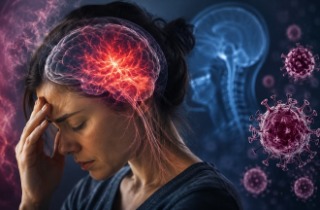
The findings suggest that the strength of the body's early antiviral response could play an important role in determining who experiences brain fog, headaches, anxiety and other lasting symptoms after SARS-CoV-2 infection.
Researchers Track Hundreds of Persistent Symptoms
Researchers conducted a prospective observational study involving patients treated for acute respiratory viral syndromes at the University of Utah Emergency Department. Of 236 initially recruited patients, 173 were included in the final analysis.
During follow-up, 90 patients experienced 389 persistent post-viral symptoms. Researchers classified these as 78 neurocognitive, 187 general and 124 respiratory sequelae.
For this
Thailand Medical News report, researchers used saliva samples collected during acute illness to investigate whether early protein responses could help explain why some people subsequently develop persistent post-infection problems.
29 Antiviral Proteins Stand Out
Mass spectrometry identified thousands of human proteins. Statistical analysis ultimately highlighted 44 clinically relevant proteins that changed significantly during acute illness, with all 44 reaching peak measurements approximately 10 days after initial symptoms.
Among these, 23 proteins showed significant beneficial associations specifically with neurocognitive symptoms following SARS-CoV-2 infection. Lower expression was associated with persistent problems including brain fog, anxiety and headaches.
Another overlapping group of 19 proteins was associated with fewer general post-viral symptoms, including fatigue, disturbed sleep and musculoskeletal complaints, regardless of whether SARS-CoV-2 was responsible for the acute infection.
Altogether, 29 proteins demonstrated significant beneficial associations with neurocognitive or general sequelae. Thirteen were associated with both categories, suggesting some antiviral defenses could potentially protect against multiple forms of persistent illness.
Interferon Defenses Could Provide Important Clues
All 29 proteins were derived from interferon-stimulated genes, which form an important part of innate antiviral immunity. Researchers found that these proteins participate in defenses ranging from detecting viral invasion and amplifying interferon responses to directly interfering with viral replication.
The protein ADAR was particularly notable, showing the strongest protective association against neurocognitive sequelae among SARS-CoV-2-positive patients.
Researchers and Institutions
Researchers were affiliated with the University
of Utah and Spencer Eccles Fox School of Medicine, Imperial College London, Utah State University, University of Oxford, Indiana University, Cincinnati Children's Hospital, University of Cincinnati, Department of Veterans Affairs Medical Center in Salt Lake City and associated University of Utah research core facilities.
Conclusions
The findings indicate that strong acute antiviral protein responses may influence recovery from COVID-19 and other viral infections, potentially providing future biomarkers and therapeutic targets. However, larger studies are required to confirm whether these proteins directly protect patients from developing persistent post-viral symptoms.
The study findings were published on the medRxiv preprint server and have not yet been peer reviewed.
https://www.medrxiv.org/content/10.64898/2026.08.27.26361488v1
Read Also:
https://www.thailandmedical.news/articles/long-covid




 Share
Share
 Tweet
Tweet
 Share
Share