Nikhil Prasad Fact checked by:Thailand Medical News Team Jan 12, 2026 8 months, 3 weeks, 2 days, 8 hours, 38 minutes ago
Medical News: Scientists uncover a quiet viral power play
Italian researchers have discovered that SARS-CoV-2 strengthens itself by forming a direct alliance with a key human enzyme inside infected cells. Rather than acting alone, the viral nucleocapsid protein — known simply as the N protein — locks onto a human RNA-handling enzyme called DDX3X. The result is a far more efficient virus capable of gripping its genetic material, multiplying rapidly and assembling new viral particles with surprising speed.
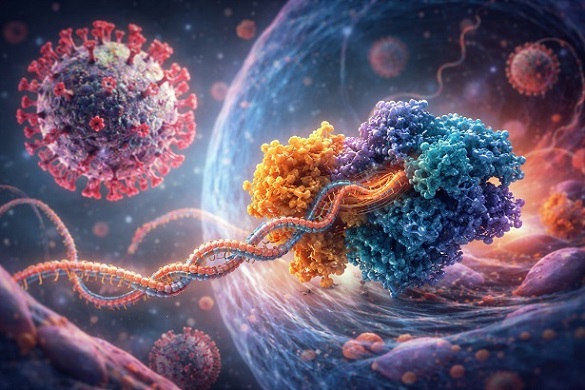 New research exposes how the coronavirus recruits a human enzyme to strengthen its replication engine
The work was carried out by Italian teams at the Institute of Molecular Genetics IGM CNR in Pavia, investigators from the Department of Biotechnology Chemistry and Pharmacy at the University of Siena, and collaborators at the University of Parma’s Department of Food and Drug. Together, the three groups pieced together a molecular mechanism that had remained hidden through four years of global research.
N protein reveals a second job
For most of the pandemic, scientific and public attention targeted the spike protein — the structure the virus uses to enter our cells. The internal N protein, on the other hand, was treated mainly as a structural component that wrapped and protected the viral genome. This
Medical News report highlights that this “internal” viral component is far more strategic than originally understood. Once inside a host’s cell, it physically binds DDX3X, a human enzyme normally involved in moving, folding and translating RNA strands. By co-opting it, the N protein becomes significantly better at holding onto viral RNA, a critical step in copying the virus’s genetic material.
A decisive point of contact
Researchers dissected the human enzyme into smaller portions to find the exact grip point. One region — known as the RecA2 domain — emerged as the anchor. When this domain was present, the N protein attached firmly and held on. When it was removed, the connection weakened dramatically.
This tightly defined interaction gives scientists a clear window into how the virus exploits human machinery and where that process might be interrupted.
Testing early antiviral ideas
With the interaction mapped, the teams turned to potential treatments. They sifted through large libraries of known chemical structures, digitally modeling how each might wedge into the viral protein and disrupt RNA binding.
Ten promising candidates were taken into the lab, and two stood out. Both molecules reduced the N protein’s ability to hold viral RNA, cutting its strength by almost half. Although these compounds are still in the early research phase, they demonstrate that the N protein — long overshadowed by spike — is a vulnerable point that can be targeted.
Why this matters now
The N pro
tein mutates far less than the spike protein, making it a stable target even as new variants emerge. If drugs are developed that prevent the N protein from engaging DDX3X or gripping RNA, they could slow replication across multiple coronavirus strains, potentially including future pandemic threats.
Conclusion
This study reveals a hidden advantage SARS-CoV-2 gains by recruiting the human DDX3X enzyme to reinforce its nucleocapsid protein. By boosting the virus’s ability to hold and organize RNA, the interaction enables faster copying, quicker assembly of new particles and greater survival during the earliest hours of infection. With the docking point identified and early chemical blockers already in hand, researchers now have a realistic pathway toward antiviral medicines that attack the virus at its core rather than its constantly changing exterior.
The study findings were published in the peer reviewed International Journal of Molecular Sciences.
https://www.mdpi.com/1422-0067/27/2/672
For the latest COVID-19 News keep on logging to Thailand
Medical News.
Read Also:
https://www.thailandmedical.news/articles/coronavirus




 Share
Share
 Tweet
Tweet
 Share
Share

































