Nikhil Prasad Fact checked by:Thailand Medical News Team Feb 06, 2026 6 months, 3 weeks, 3 days, 13 hours, 11 minutes ago
Medical News: Scientists Look Beyond Basil Aroma and Taste
Basil is best known worldwide as a fragrant kitchen herb, but new scientific findings now show that its health value goes far beyond aroma and flavor. While earlier research mainly focused on basil’s essential oils and flavonoids, scientists have now turned their attention to its overlooked primary metabolites such as amino acids, vitamins, sugars, and small peptides that play critical roles in human biology.
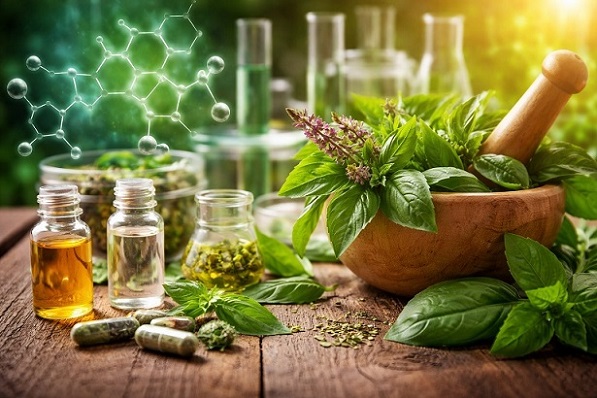 New research reveals that basil contains hidden natural compounds that may help regulate immunity
inflammation and cellular health
This
Medical News report highlights a comprehensive study examining three basil species, Ocimum × africanum, Ocimum tenuiflorum, and Ocimum gratissimum, using advanced laboratory and computer-based techniques to uncover how these common plant compounds may influence disease-related biological pathways.
Advanced Analysis Reveals Rich Metabolic Diversity
Using high-precision UPLC-MS/MS metabolomic profiling, researchers identified an impressive 291 primary metabolites across six basil accessions. These included 185 amino acid-related compounds, 82 carbohydrates, 13 vitamins, and 11 steroid-like molecules. Significant differences were observed between basil species, with Ocimum × africanum and Ocimum tenuiflorum showing higher overall metabolite abundance compared to Ocimum gratissimum.
Further analysis revealed 273 metabolites that differed significantly between samples, suggesting that each basil variety carries a unique chemical fingerprint that may influence its health benefits.
Key Peptides Target Important Human Pathways
By applying network pharmacology and molecular docking simulations, scientists predicted how selected basil metabolites may interact with human proteins. A total of 61 high-impact compounds were examined, revealing 28 core biological targets, many of which belong to the integrin family. Integrins are essential proteins involved in cell adhesion, immune responses, blood clotting, inflammation, and cancer spread.
Notably, small tripeptides such as Met-Ser-Tyr and Phe-Cys-Gln demonstrated strong binding affinity to several integrin subunits, suggesting possible roles in regulating immune balance, cardiovascular health, and tissue repair.
Strong Antioxidant Activity Confirmed
Laboratory antioxidant tests further supported basil’s health potential. Using DPPH, ABTS, and FRAP assays, researchers confirmed that all basil accessions exhibited antioxidant activity, with some varieties performing significantly better. These effects were largely attributed to water-soluble antioxidants linked to primary metabolites rather than essential oils alone.
Why These Findings Matter
This study challenges the long-standing belief that only secondary plant compounds drive medicinal benefits. Instead, it shows that basil’s primary metabolites may
actively influence biological processes linked to inflammation, immunity, thrombosis, and disease prevention. The findings open new possibilities for basil-based nutraceuticals, functional foods, and even drug discovery.
Research Institutions Involved
The study was conducted by researchers from Mianyang Normal University, Southwest Jiaotong University, Southwest Minzu University, and Tibet University in China.
Conclusion
The findings clearly demonstrate that basil’s primary metabolites are not merely nutritional background compounds but may play direct and meaningful roles in human health. By interacting with integrin-related pathways and contributing strong antioxidant effects, these molecules expand basil’s therapeutic potential far beyond traditional expectations. Future biological and clinical studies are needed, but this research provides a solid scientific foundation for developing next-generation basil-based health products.
The study findings were published in the peer reviewed journal: Life.
https://www.mdpi.com/2075-1729/16/2/273
For the latest on Herbs and Phytochemicals, keep on logging to Thailand
Medical News.
Read Also:
https://www.thailandmedical.news/articles/herbs-and-phytochemicals




 Share
Share
 Tweet
Tweet
 Share
Share

































