Nikhil Prasad Fact checked by:Thailand Medical News Team Apr 24, 2026 5 months, 1 week, 3 days, 3 hours, 1 minute ago
Medical News: The global COVID-19 pandemic may have left a lasting impact beyond the lungs, with new research now revealing a surprising connection to thyroid health. Scientists have found that certain thyroid disorders increased significantly during the pandemic, while others unexpectedly declined, highlighting a complex and still evolving medical picture.
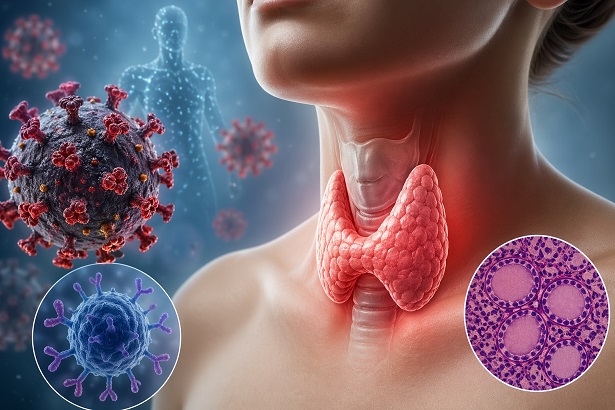 Study reveals COVID-19’s surprising impact on thyroid disease trends worldwide.
Large Population Study Reveals Shifting Trends
Study reveals COVID-19’s surprising impact on thyroid disease trends worldwide.
Large Population Study Reveals Shifting Trends
Researchers from the Faculty of Health Sciences at Ben-Gurion University of the Negev, Soroka University Medical Center, the Clinical Research Center at Soroka University Medical Center, the Endocrinology Unit at Soroka University Medical Center, and the Pediatrics Department and Pediatric Endocrinology Unit at Soroka University Medical Center in Beer-Sheva, Israel conducted a large-scale population study to better understand how COVID-19 has influenced thyroid diseases.
The study analyzed health data from over 4,700 individuals between 2018 and 2022, comparing rates of thyroid disorders before and during the pandemic. These conditions included Hashimoto’s thyroiditis, Graves’ disease, and subacute thyroiditis—three distinct disorders affecting how the thyroid gland functions.
Sharp Rise in Hashimoto’s Cases
One of the most striking findings was a 30 percent increase in cases of Hashimoto’s thyroiditis during the pandemic period. This condition, which occurs when the immune system attacks the thyroid gland, can lead to fatigue, weight gain, and other symptoms linked to low hormone levels.
Data showed that cases nearly doubled from 2018 to 2022. Importantly, this rise began even before COVID-19 vaccines were introduced, suggesting that the virus itself—or the broader stress and immune disruption caused by the pandemic—may have played a key role.
Graves’ Disease Shows Upward Trend
Graves’ disease, another autoimmune thyroid condition that causes excessive hormone production, also showed an upward trend. Although the increase was not statistically conclusive, researchers noted a noticeable pattern that may point to a real effect.
Both Hashimoto’s and Graves’ disease are driven by immune system dysfunction, strengthening the theory that COVID-19 may trigger or worsen autoimmune responses in certain individuals.
Unexpected Drop in Subacute Thyroiditis
In contrast, subacute thyroiditis—a condition often linked to viral infections—showed a surprising 54 percent decrease during the pandemic. This puzzled researchers, as viral illnesses typically trigger this type of thyroid inflammation. Several explanations have been proposed. Public health measures such as masking, social distancing, and lockdowns likely reduced the spread of common viruses that usually lead to this condition. Additionally, many people avoided hospitals during the pandemic, which may have led to underdiagnosis of milder cases.
Understanding the Bigger
Picture
In the middle of these findings, this Medical News report highlights how COVID-19 appears to influence the body far beyond initial infection. The thyroid gland, which plays a crucial role in regulating metabolism and energy, may be particularly sensitive to immune system disruptions caused by the virus.
The study also found that most patients diagnosed with thyroid disorders were women, making up about 77 percent of cases, and the average age of diagnosis remained consistent at around 43 to 45 years.
Why COVID-19 May Affect the Thyroid
Researchers believe several mechanisms could explain these changes. COVID-19 may directly affect thyroid cells, which contain receptors that allow the virus to enter. It may also trigger immune responses that mistakenly attack healthy thyroid tissue, especially in people who are genetically predisposed. Another possibility is that inflammation caused by the virus disrupts normal hormone regulation, leading to long-term effects even after recovery.
Conclusion
The findings reveal a complex and uneven impact of the COVID-19 pandemic on thyroid health, with some conditions rising sharply while others declined. While the study does not prove direct cause and effect, it strongly suggests that the pandemic has altered patterns of thyroid disease in meaningful ways. Continued monitoring and research are essential to understand long-term consequences and to ensure early diagnosis and proper care for affected individuals in the years ahead.
The study findings were published in the peer reviewed journal: Frontiers in Endocrinology.
https://www.frontiersin.org/journals/endocrinology/articles/10.3389/fendo.2026.1784314/full
For the latest COVID-19 news, keep on logging to Thailand
Medical News.
Read Also:
https://www.thailandmedical.news/articles/coronavirus
https://www.thailandmedical.news/articles/long-covid




 Share
Share
 Tweet
Tweet
 Share
Share

































