



BREAKING NEWS
For the latest on Thailand Medical Industry, Thailand Doctors, Thailand Medical Research, Thailand Hospitals, Thailand Wellness Initiatives and the latest Medical News
 Share
Share
 Tweet
Tweet
 Share
Share
Medical News: A naturally occurring compound that helps cancer cells glow under specialized light is attracting growing attention among scientists and clinicians worldwide. Known as 5-aminolevulinic acid (5-ALA), this unique molecule is increasingly being recognized as a valuable tool for both cancer diagnosis and treatment. A new comprehensive review has highlighted how 5-ALA is already improving outcomes in certain cancers while showing expanding promise across a wide range of tumors.
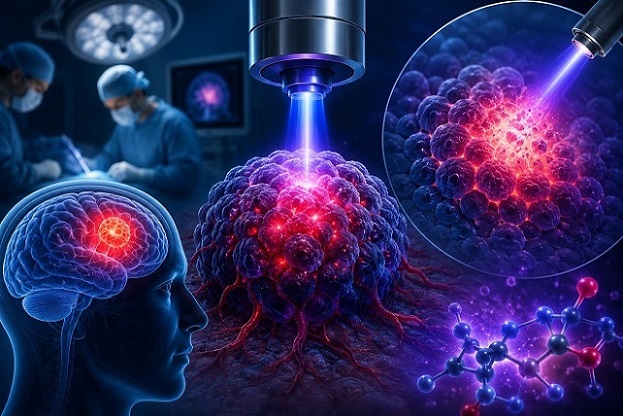
New research shows that 5-ALA can help doctors visualize tumors more accurately while also enabling targeted
light-based destruction of cancer cells
The study was conducted by researchers from the English Division Science Club, Faculty of Medicine, Collegium Medicum, University of Rzeszów, Poland; the Department of Biochemistry and General Chemistry, Faculty of Medicine, Collegium Medicum, University of Rzeszów, Poland; the Department of Photomedicine and Physical Chemistry, Medical College, University of Rzeszów, Poland; and the Department of Biomedical Engineering, Tufts University, Medford, Massachusetts, USA.
A Different Approach to Finding and Treating Cancer
Traditional cancer treatments such as surgery, chemotherapy, and radiotherapy have saved countless lives but often come with serious side effects. Scientists have therefore been searching for more targeted approaches that can identify and destroy cancer cells while minimizing damage to healthy tissues.
5-ALA offers a unique solution. After being administered to patients, it is converted inside cells into a compound known as protoporphyrin IX (PpIX). While healthy cells rapidly process this substance, cancer cells often accumulate large amounts of it.
This accumulation creates a major advantage. When exposed to blue-violet light, PpIX emits a bright red fluorescence that allows doctors to clearly visualize tumors. This technique, called photodynamic diagnosis (PDD), helps surgeons identify cancerous tissue more accurately during procedures.
The same compound can also be used therapeutically. When exposed to specific wavelengths of light, PpIX produces highly reactive oxygen molecules that damage cancer cells and trigger their destruction. This treatment method is known as photodynamic therapy (PDT).
Why Tumors Glow While Healthy Cells Do Not
One of the most fascinating findings discussed in the review is why tumors accumulate PpIX far more readily than normal tissues.
Researchers explain that many cancers have abnormalities in their heme production pathways. An important enzyme called ferrochelatase, which normally converts PpIX into heme, often functions poorly in cancer cells. As a result, PpIX builds up inside tumors.
Cancer cells also frequently express higher levels of transport proteins known as PEPT1 and PEPT2, allowing them to absorb larger amounts of 5-ALA. Combined with altered iron metabolism and other metabolic changes, these factors create ideal conditions for selective tumor fluorescence.
Recent research has further revealed that cells surrounding tu
mors, known as cancer-associated fibroblasts, may actively contribute to excess porphyrin production, creating what scientists call a "porphyrin overload" environment that further boosts PpIX accumulation.
Remarkable Success in Brain Cancer
The most established clinical application of 5-ALA is in the treatment of glioblastoma, one of the deadliest forms of brain cancer.
Glioblastoma is notorious for infiltrating surrounding brain tissue, making complete surgical removal extremely difficult. Studies have shown that administering 5-ALA before surgery causes tumor tissue to fluoresce, enabling surgeons to distinguish cancerous tissue from healthy brain tissue with much greater precision.
Clinical trials have demonstrated significantly higher rates of complete tumor removal when 5-ALA-guided surgery is used. Researchers also found that patients experienced improved progression-free survival compared to conventional surgery.
This Medical News report notes that laboratory studies have further shown that glioma cells exposed to 5-ALA followed by light treatment undergo extensive cell death while healthy cells experience minimal damage.
Expanding Applications Across Multiple Cancer Types
The review highlights promising results in numerous other cancers and precancerous conditions.
In head and neck lesions, including oral precancerous conditions, treatment success rates exceeded 90 percent in some studies. Many patients achieved complete or partial remission after therapy.
Gynecological diseases have also shown encouraging results. Patients with high-grade cervical precancerous lesions associated with human papillomavirus (HPV) demonstrated high rates of lesion regression and HPV clearance following 5-ALA-based treatment.
In bladder cancer, clinical studies reported complete remission in a substantial proportion of patients treated with 5-ALA-guided photodynamic therapy. Positive outcomes were also observed in upper urinary tract cancers.
Laboratory studies involving breast cancer, ovarian cancer, prostate cancer, gastrointestinal tumors, medulloblastoma, and meningioma have likewise demonstrated significant sensitivity to 5-ALA-based therapies, although many of these applications remain in the experimental stage.
New Technologies Could Unlock Greater Potential
Despite its promise, several limitations remain. Some tumors accumulate lower amounts of PpIX than others, reducing treatment effectiveness. Additionally, low oxygen levels inside tumors can limit the ability of photodynamic therapy to generate cancer-killing reactive oxygen species.
To overcome these challenges, scientists are developing advanced formulations and delivery systems. These include nanoparticles, liposomes, hydrogels, and specialized drug carriers designed to improve delivery directly into tumors.
Researchers are also exploring combinations of 5-ALA with immunotherapy, sonodynamic therapy that uses ultrasound, radiodynamic therapy that uses radiation, and other innovative treatment strategies. Early findings suggest these approaches may significantly enhance therapeutic effectiveness while maintaining safety.
Conclusion
The growing body of evidence reviewed by the researchers suggests that 5-ALA is rapidly evolving from a specialized diagnostic tool into a versatile platform for both cancer detection and treatment. Its ability to selectively accumulate in tumors, illuminate cancerous tissue during surgery, and trigger targeted destruction of malignant cells gives it significant advantages over many conventional approaches. While its most established role remains in brain tumor surgery and selected clinical applications, advances in drug delivery technologies, nanomedicine, and combination therapies are expanding its potential across multiple cancer types. Although additional large-scale clinical studies are still needed, the future of 5-ALA-based oncology appears increasingly promising and may ultimately provide safer, more precise, and more effective treatment options for cancer patients worldwide.
The study findings were published in the peer reviewed journal: Biomedicines.
https://www.mdpi.com/2227-9059/14/6/1314
For the latest cancer research, keep on logging to Thailand Medical News.
Read Also:
https://www.thailandmedical.news/articles/cancer

































