Nikhil Prasad Fact checked by:Thailand Medical News Team Jul 19, 2026 2 months, 2 weeks, 3 days, 2 hours, 19 minutes ago
Medical News: New Study Uncovers Genetic Clues Behind Long COVID Cognitive Problems
Scientists have uncovered new evidence suggesting that lingering brain fog after COVID-19 may be linked to age-related changes in genes that help brain cells communicate. The findings point to a possible biological explanation for the memory, concentration and thinking problems experienced by many people with long COVID, while also highlighting new directions for future research.
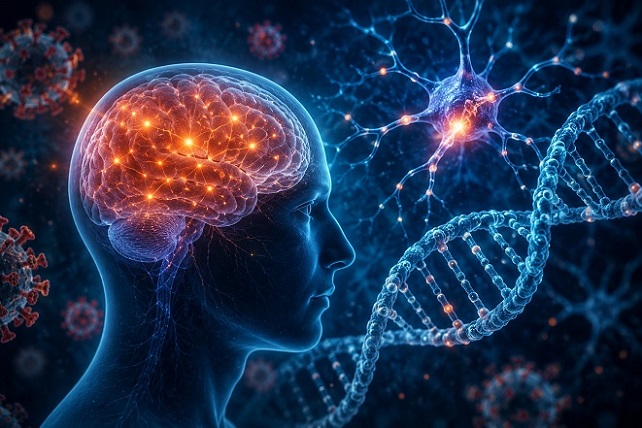 Researchers have identified age-related DNA methylation changes affecting key NMDA receptor genes that may help
explain persistent brain fog after COVID-19.
The study was conducted by researcher Dr. Ngo Cheung from Cheung Ngo Medical Limited, Hong Kong, who re-analyzed publicly available DNA methylation data collected from people six months after recovering from COVID-19.
Looking Beyond Symptoms
Many people recovering from COVID-19 continue to suffer from "brain fog," a term describing problems such as forgetfulness, slower thinking, difficulty focusing and mental fatigue. Although these symptoms are common, doctors still lack reliable biological markers that can explain why they occur or predict who is most likely to develop them.
To investigate, the researcher examined blood samples from 94 individuals aged between 35 and 92 years. Instead of looking for genetic mutations, the study focused on DNA methylation, a natural process that switches genes on or off without changing the DNA sequence itself. These chemical changes often increase with age and can influence how cells function.
Thousands of Age-Related Changes Identified
The analysis revealed 3,467 significant age-related DNA methylation changes across the genome. Most involved a gradual loss of methylation with aging, while a smaller number showed increased methylation at important regulatory genes.
Importantly, the research successfully identified many well-established aging markers, including ELOVL2, FHL2, TRIM59, EDARADD, ASPA and PDE4C, confirming that the analytical approach accurately detected genuine biological aging signals.
Brain Communication Genes Emerged as the Biggest Surprise
The most intriguing finding involved genes responsible for glutamate signaling, the brain's primary communication system. Several important genes belonging to the NMDA receptor pathway, including GRIN1, GRIN2C, GRIN2D, GRM1, GRM5 and SLC17A7, showed consistent age-related methylation changes.
NMDA receptors play a critical role in learning, memory formation, attention and the strengthening of connections between brain cells. Changes affecting these receptors have previously been associated with Alzheimer's disease, depression and other neurological disorders.
Among them, GRIN1 and GRIN2C ranked among the strongest signals detected in the entire study. Their consistent methylation patterns suggest that aging within people who have recovered from COVID-19 may particularly affect biological pathways involved in cognitive performance.
Why Blood Can Reveal Brain Cl
ues
Although the study analyzed blood rather than brain tissue, the researchers noted that immune cells also contain glutamate receptors and communicate using similar signaling pathways. This means blood-based methylation patterns could reflect broader neuroimmune processes linked to cognitive symptoms.
This
Medical News report highlights that the findings do not prove these methylation changes directly cause brain fog or that they are unique to COVID-19. The analysis did not include healthy individuals for comparison, nor did it measure each participant's cognitive performance. Instead, the work identifies promising biological targets that deserve further investigation.
The research also showed that glutamatergic genes were significantly enriched compared with what would normally be expected, strengthening the possibility that this pathway plays an important role in the long-term biological effects seen after COVID-19.
More Research Needed Before Clinical Use
The findings should be viewed as an important starting point rather than definitive proof. Larger studies comparing COVID-19 survivors with healthy individuals and tracking patients over time will be needed to determine whether these methylation changes contribute directly to long COVID or simply reflect normal aging. Future research combining blood biomarkers, detailed cognitive testing and inflammatory measurements may eventually help identify patients most likely to develop persistent neurological complications and guide more personalized treatment strategies.
The study findings were published in the peer reviewed journal: Cureus.
https://www.cureus.com/articles/513868-dna-methylation-at-core-n-methyl-d-aspartate-nmda-receptor-genes-reveals-a-glutamatergic-signature-of-aging-in-post-covid-whole-blood-with-implications-for-long-covid-neuropsychiatric-sequelae#!/
For the latest COVID-19 news, keep on logging to Thailand
Medical News.
Read Also:
https://www.thailandmedical.news/articles/long-covid




 Share
Share
 Tweet
Tweet
 Share
Share