Nikhil Prasad Fact checked by:Thailand Medical News Team Aug 03, 2026 2 months, 1 day, 3 hours, 16 minutes ago
Glioblastoma is the most aggressive form of brain cancer and remains one of the hardest cancers to treat. Even after surgery, radiation, and chemotherapy, the tumor often returns because its cells constantly change into more aggressive forms that are better able to invade healthy brain tissue and resist treatment. Now, researchers from The Second Clinical Medical College, Southern Medical University, Guangzhou, China, and The First Clinical Medical College, Southern Medical University, Guangzhou, China, have identified a major metabolic process that appears to drive this dangerous transformation. Their findings suggest that abnormal arachidonic acid metabolism could become an important target for future therapies.
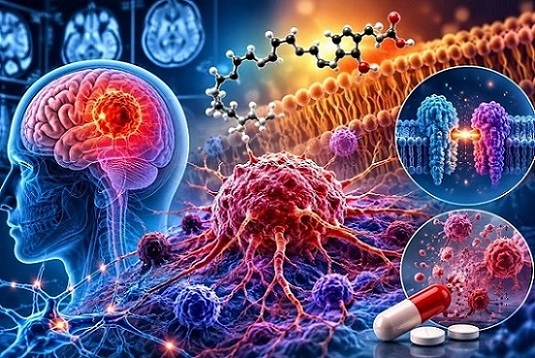 Researchers uncover how abnormal fat metabolism helps glioblastoma evolve into a highly
aggressive, treatment-resistant brain cancer.
Scientists Reveal How Tumor Cells Become More Aggressive
The research team combined several advanced technologies, including single-cell RNA sequencing, spatial transcriptomics, machine learning, molecular docking, molecular dynamics simulations, and laboratory experiments to examine how glioblastoma cells evolve.
The scientists analyzed more than 35,000 individual tumor cells collected from multiple public datasets. Their analysis revealed that glioblastoma cells exist in several different states, but the most dangerous were the mesenchymal-like (MES-like) cells. These cells are known for their ability to spread rapidly, invade surrounding brain tissue, resist treatment, and contribute to poor survival.
The study found that these highly aggressive cells consistently showed the highest activity of arachidonic acid metabolism, indicating that changes in fat metabolism are closely linked to the tumor's progression.
Fat Metabolism Changes as the Cancer Evolves
One of the most important discoveries was that glioblastoma cells gradually change from less aggressive forms into highly invasive mesenchymal-like cells. As this transformation occurs, activity in arachidonic acid metabolism rises steadily.
Several genes involved in this metabolic pathway—including PLA2G4A, PTGS1, PTGS2, ALOX5, and CYP2J2—became increasingly active during this transition. The researchers also found increased activity in genes responsible for fatty acid uptake and processing, including CD36, FADS1, FADS2, and ELOVL5.
These metabolic alterations were strongly associated with biological processes that help tumors survive and spread. Cells with elevated arachidonic acid metabolism showed increased abilities for tissue invasion, migration, inflammation, adaptation to low-oxygen environments, stem-cell-like behavior, resistance to therapy, and protection against cell death.
Researchers Identify a Critical Communication System
The investigators also uncovered a previously unrecognized communication pathway involving the PPIA-BSG signaling axis.
This signaling system was found almost exclusively in tumor cells with high arachidonic acid metabolism. It appeared to strengthen communication between cancer cells and surrounding immune cells, blood vessel cells, and other components of the tumor microenvironment.
When researchers virtually switched
off the BSG gene, numerous genes involved in mesenchymal behavior, invasion, and tumor progression became significantly less active. This suggests that BSG may serve as a key regulator helping glioblastoma maintain its aggressive characteristics.
This
Medical News report highlights an important shift in scientists' understanding of glioblastoma by showing that altered fat metabolism is deeply connected to the biological changes that transform relatively less aggressive tumor cells into highly invasive and treatment-resistant cancers.
Mapping the Most Dangerous Tumor Regions
Using spatial transcriptomics, the researchers mapped where these aggressive cells were located inside glioblastoma tissue.
They discovered that regions with the highest arachidonic acid metabolism almost always overlapped with areas containing large numbers of mesenchymal-like tumor cells. These same regions also displayed increased inflammatory activity through the NF-κB pathway and stronger hypoxia-related signaling, indicating that inflammation, oxygen deprivation, and altered fat metabolism work together to create particularly dangerous tumor environments.
The study also produced an 11-gene arachidonic acid metabolism signature that successfully predicted patient survival. Individuals classified as high risk consistently experienced significantly poorer outcomes than those in the low-risk group.
An Existing Drug Shows Early Promise
The researchers also searched for existing medicines that might interfere with this newly identified pathway.
Computer modeling identified the FDA-approved drug Venetoclax as a promising candidate capable of binding to the BSG protein. Follow-up laboratory experiments showed that Venetoclax reduced the survival of multiple glioblastoma cell lines, suggesting that the drug could potentially be repurposed for future brain cancer treatment studies. While these findings remain preliminary, they provide an encouraging direction for further research.
Conclusions
This study provides strong evidence that arachidonic acid metabolic reprogramming is a major driver of glioblastoma progression rather than simply a byproduct of tumor growth. By linking altered fat metabolism to the transformation of tumor cells into their most aggressive state and identifying the PPIA-BSG signaling pathway as a potential therapeutic target, the research opens promising avenues for improved prognostic testing and targeted treatment strategies. Although additional laboratory and clinical studies are still needed, these findings significantly advance the understanding of how glioblastoma becomes resistant to current therapies and may ultimately lead to more effective interventions for patients.
The study findings were published in the peer reviewed journal: Biomedicines.
https://www.mdpi.com/2227-9059/14/8/1738
Read Also:
https://www.thailandmedical.news/articles/cancer




 Share
Share
 Tweet
Tweet
 Share
Share

































