Nikhil Prasad Fact checked by:Thailand Medical News Team Apr 15, 2026 5 months, 2 weeks, 5 days, 6 hours, 11 minutes ago
Medical News: A groundbreaking new study is reshaping how scientists understand the relationship between the gut and the immune system. Researchers have discovered that immune cells do not just respond to substances circulating in the blood - they actually trap and accumulate harmful compounds produced by gut bacteria inside themselves. This hidden process could explain why many chronic diseases worsen over time and why the immune system appears to “age” prematurely in certain conditions.
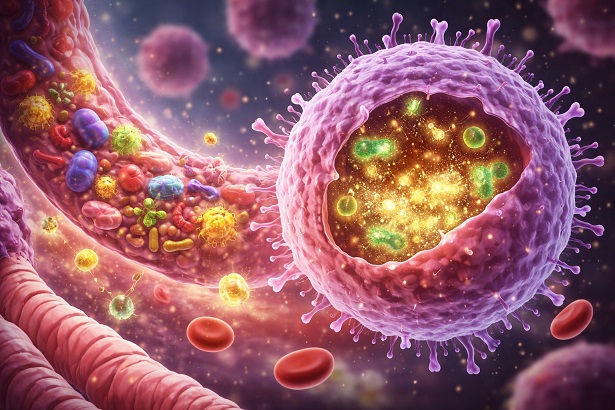 New research reveals immune cells trap gut toxins inside, driving hidden inflammation and accelerated aging
A Hidden World Inside Immune Cells
New research reveals immune cells trap gut toxins inside, driving hidden inflammation and accelerated aging
A Hidden World Inside Immune Cells
For years, scientists believed that gut-derived molecules influenced the body mainly through the bloodstream. However, this new research reveals something far more complex. Immune cells, particularly CD4+ T cells, actively absorb and store microbial metabolites - small chemical byproducts created by gut bacteria.
These compounds, including substances like p-cresol sulfate and indoxyl sulfate, are not just passive passengers. Once inside the cells, they disrupt essential metabolic functions, damage energy production systems, and trigger stress responses that accelerate cellular aging.
The study shows that the amount of these metabolites inside immune cells does not match what is found in the blood. This means traditional blood tests may miss the real extent of damage occurring at the cellular level.
How the Damage Happens
The researchers found that immune cells use specific transport systems to pull these microbial compounds inside. Once absorbed, the cells reduce their ability to expel them, effectively trapping the toxins.
This creates a dangerous cycle. The more these metabolites accumulate, the more they interfere with cellular processes. They activate stress pathways, shut down energy production, and disrupt signaling systems that normally keep immune cells functioning properly.
One of the most striking findings is that these trapped compounds activate a receptor inside the cell that drives inflammation and aging. This leads to reduced immune response, increased fatigue at the cellular level, and a shift toward dysfunctional immune behavior.
Why This Matters for Chronic Diseases
This
Medical News report highlights that these findings could help explain immune dysfunction in conditions such as HIV, chronic kidney disease, and even natural aging. In all these cases, patients often show signs of weakened immunity despite treatment or otherwise stable health.
The study suggests that gut imbalances - known as dysbiosis - cause an overproduction of harmful metabolites. These then accumulate inside immune cells, triggering long-term damage that cannot be detected by measuring blood levels alone.
Importantly, this discovery also explains why some patients do not recover normal immune function even after successful treatment of their primary condition.&
lt;br />
Institutions Behind the Discovery
The research was conducted by scientists from the Pathology Advanced Translational Research Unit at the Department of Pathology and Laboratory Medicine, Emory University School of Medicine, Atlanta, USA; the Division of Infectious Diseases at Emory University School of Medicine; the Department of Global Health at Emory University Rollins School of Public Health; and the Division of Pulmonary, Allergy, Critical Care and Sleep Medicine at Emory University School of Medicine.
New Hope for Future Treatments
The findings open the door to entirely new treatment strategies. Instead of only targeting diseases directly, future therapies may focus on preventing these harmful metabolites from entering immune cells or enhancing the cells’ ability to remove them.
Another promising approach involves targeting the internal signaling pathways triggered by these compounds, potentially reversing or slowing immune aging.
Conclusion
This study provides a powerful new perspective on how the gut microbiome influences immune health. By revealing that immune cells actively accumulate harmful bacterial metabolites, it challenges long-held assumptions and highlights a previously invisible layer of disease development. The discovery that intracellular - not circulating - levels of these compounds drive immune dysfunction suggests that current diagnostic methods may overlook critical factors. Moving forward, therapies aimed at blocking cellular uptake, improving metabolite clearance, or interrupting harmful signaling pathways could transform how chronic diseases and immune aging are treated, offering hope for more effective and targeted interventions.
The study findings were published on a preprint server and are currently being peer reviewed.
https://www.preprints.org/manuscript/202604.0942
For the latest research in immunology, keep on logging to Thailand
Medical News.
Read Also:
https://www.thailandmedical.news/articles/immunology




 Share
Share
 Tweet
Tweet
 Share
Share

































