Nikhil Prasad Fact checked by:Thailand Medical News Team Nov 21, 2026 10 minutes ago
Oregon health authorities have confirmed the state's first human infection with highly pathogenic avian influenza (HPAI) in 2026, raising fresh concerns about the continuing spread of bird flu among American dairy cattle and the occupational risks facing agricultural workers. The infection, detected in a dairy worker in Morrow County, represents Oregon's first known human bird flu case associated with infected cattle, highlighting how the virus continues crossing species barriers.
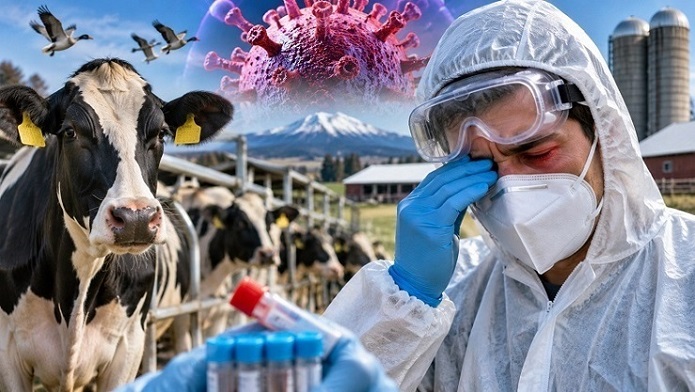 Oregon confirms its first human bird flu infection of 2026 after an H5N1 outbreak at a Morrow County dairy farm, prompting intensified
surveillance and protective measures.
The Oregon State Public Health Laboratory confirmed the infection on November 18, 2026, following the discovery of an outbreak among dairy cows at the same agricultural facility. Although the infected worker experienced relatively mild illness, the incident has triggered coordinated surveillance, antiviral treatment, and infection prevention measures involving multiple state and local agencies.
Infected Worker Developed Eye Inflammation and Respiratory Symptoms
According to the Oregon Health Authority (OHA), the infected individual developed conjunctivitis, commonly known as pink eye, alongside upper respiratory symptoms. These manifestations are consistent with symptoms documented in several previous human H5N1 infections associated with infected dairy cattle.
The worker was promptly tested after reporting symptoms and subsequently received oseltamivir, an antiviral medication commonly marketed as Tamiflu. Early administration of this medication is particularly important because influenza antivirals generally provide their greatest benefits when treatment begins soon after symptoms develop.
Fortunately, the individual did not require hospitalization, and health authorities described the illness as mild.
As an additional precaution, local public health officials offered oseltamivir to members of the infected person's household. This measure was intended to provide protection following potential exposure rather than indicate confirmed household transmission.
Officials emphasized that there is currently no evidence of sustained human-to-human transmission involving the circulating dairy-associated bird flu virus.
Routine Milk Testing Uncovered the Outbreak
One particularly significant aspect of the incident involves how the outbreak was initially discovered.
The Oregon Department of Agriculture (ODA) conducts weekly avian influenza testing of milk collected from dairy operations across the state. Earlier in November, this surveillance program detected the virus in cattle at the Morrow County facility.
The finding represented Oregon's first identified outbreak of avian influenza among dairy cattle.
Following detection, agricultural authorities immediately placed the affected farm under quarantine and began implementing containment measures designed to prevent infected animals, contaminated materials, and potentially infectious equipment from spreading the virus elsewhere.
/>
Public health teams subsequently contacted farm personnel, distributed protective equipment, and explained the importance of reporting even minor symptoms.
The effectiveness of this surveillance system is particularly noteworthy because infected dairy cattle may develop symptoms that are initially mistaken for other agricultural health problems.
Bird Flu Can Attack the Mammary Glands of Dairy Cattle
Although avian influenza has historically been associated with wild birds and poultry, the ongoing American dairy outbreak has demonstrated that certain H5N1 viruses can infect cattle and replicate in mammary tissue.
Infected cows may develop mastitis, an inflammatory condition affecting the mammary glands. Other manifestations can include reduced milk production, abnormal milk consistency, decreased appetite, fever, and changes in normal behavior.
Research has demonstrated that infected mammary tissue can contain substantial concentrations of influenza virus, making contaminated raw milk an important concern for transmission within dairy operations.
Milking equipment, contaminated surfaces, and direct exposure to infectious milk can create opportunities for workers to encounter the virus.
Unlike the frequently devastating outbreaks observed among poultry, H5N1 infections in dairy cattle are generally less lethal, although affected animals can experience considerable illness and reduced productivity.
This
Thailand Medical News report highlights how the virus's adaptation to additional mammalian hosts creates new challenges for occupational safety and agricultural disease control.
Genetic Evidence Connects Oregon Outbreak to Washington
Investigators have identified another potentially important finding concerning the geographical origins of Oregon's dairy outbreak.
According to Oregon state veterinarian Dr. Ryan Scholz, genetic sequencing indicates that the virus detected in Morrow County is connected to the outbreak affecting dairy herds in Washington's Yakima Valley.
Dozens of Washington dairy herds have recently tested positive, making the neighboring state's outbreak a significant regional concern.
However, investigators have found no indication that cattle were transported directly from Yakima Valley to the affected Oregon dairy.
Instead, Scholz suggested that contaminated footwear, vehicles, or agricultural equipment could have transported infectious material between farms.
Such indirect transmission pathways are especially concerning because they allow pathogens to move between agricultural facilities without requiring infected animals to be physically transferred.
Nevertheless, genetic similarity alone cannot establish the precise transmission route.
The relatively isolated location of the Morrow County dairy may help limit further spread.
No Additional Oregon Dairy Herds Have Tested Positive
Despite concerns about possible interstate transmission, Oregon agricultural officials reported that no additional dairy herds had tested positive during the approximately two weeks following the initial Morrow County detection.
This finding offers cautious reassurance that containment measures may be helping restrict the outbreak.
However, continued testing remains essential because infected animals can potentially shed virus before obvious clinical signs become apparent.
Oregon state epidemiologist Dr. Dean Sidelinger indicated that public health personnel expect to continue working with the affected dairy for at least another six weeks.
During this period, workers will receive ongoing access to symptom monitoring, diagnostic testing, and appropriate antiviral treatment.
Officials are particularly encouraging workers to report mild eye irritation, respiratory symptoms, or other unusual illnesses rather than waiting for symptoms to become severe.
More Than 300 Exposed Individuals Previously Monitored
Oregon's latest infection comes against a background of extensive human exposure monitoring.
Since 2022, state public health authorities have monitored more than 300 individuals following potential contact with infected animals.
Before the current incident, Oregon had documented one human avian influenza infection in 2024 associated with a commercial poultry outbreak.
The latest dairy-associated infection therefore represents an important change in the state's exposure profile.
Nationally, the Centers for Disease Control and Prevention has reported 74 confirmed human avian influenza cases in the United States, according to the figures cited in the available reporting, including three fatalities.
Most identified infections have involved individuals with direct exposure to infected poultry or cattle.
These figures underline the importance of distinguishing occupational exposure risks from risks faced by the general population.
Why Scientists Remain Concerned About Viral Evolution
Although the immediate public health risk remains low, influenza specialists continue monitoring H5N1 because influenza viruses possess segmented genomes that can exchange genetic material under certain circumstances.
This process, known as reassortment, can occur when two different influenza viruses infect the same host cell.
Scientists are particularly concerned about scenarios involving simultaneous infection with seasonal human influenza and avian influenza viruses.
Such events could theoretically generate new viral combinations with altered biological properties, although reassortment does not automatically produce a virus capable of efficient human transmission.
Health authorities consequently recommend seasonal influenza vaccination for agricultural workers.
Importantly, conventional seasonal influenza vaccines do not directly protect against H5N1 infection. Their value in this context lies partly in reducing seasonal influenza infections and potentially lowering opportunities for co-infection.
Strong Surveillance Remains Essential
OHA respiratory viral pathogens medical director Dr. Melissa Sutton emphasized that the incident demonstrates the importance of functioning surveillance and rapid response systems rather than signaling an immediate public health emergency.
The swift identification of the infected worker, prompt antiviral treatment, quarantine procedures, and continued monitoring illustrate how coordinated agricultural and medical surveillance can reduce risks associated with emerging zoonotic infections.
Nevertheless, the continuing spread of H5N1 among dairy cattle warrants sustained attention.
Oregon's latest case demonstrates that even relatively mild human infections deserve careful investigation. Protecting agricultural workers, maintaining rigorous dairy surveillance, improving farm biosecurity, and monitoring viral genetic changes remain essential safeguards against further animal-to-human transmission. While current evidence does not indicate sustained human-to-human spread, continued vigilance is necessary to identify emerging threats before they become more difficult to contain.
Reference:
https://www.oregon.gov/oha/erd/pages/oha-confirms-states-first-human-case-of-avian-influenza-of-2026-11.19.2026.aspx
Read Also:
https://www.thailandmedical.news/articles/h5n1-avian-flu




 Share
 Tweet
 Share