Nikhil Prasad Fact checked by:Thailand Medical News Team Mar 07, 2026 6 months, 4 weeks, 6 hours, 10 minutes ago
Medical News: Scientists are beginning to uncover new clues about why some people continue to experience lingering symptoms long after recovering from COVID-19. A new study has found that many individuals suffering from Post-COVID syndrome carry unusual immune antibodies that may influence how blood vessels function throughout the body.
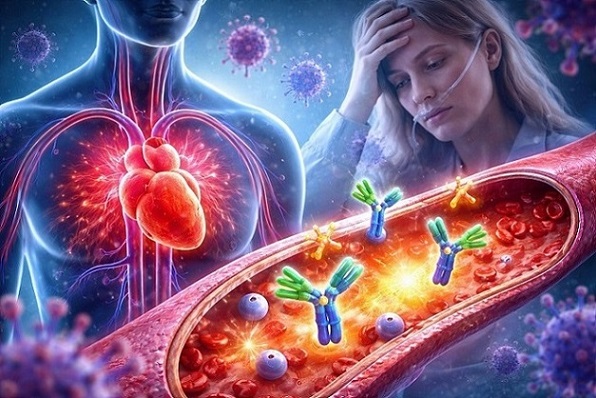 Researchers discover unusual immune antibodies in many Post-COVID patients that may influence blood vessel regulation
Researchers from the Medical Department 1, University Hospital Marien Hospital Herne at Ruhr-University Bochum in Bochum, Germany; the Department and Hiller Research Unit of Rheumatology, Medical Faculty, University Hospital Düsseldorf at Heinrich-Heine-University Düsseldorf in Düsseldorf, Germany; and the Department of Internal Medicine, Gastroenterology and Pneumology at Marien-Hospital Witten in Witten, Germany examined how these antibodies interact with the body’s vascular system.
Why Post-COVID Still Mystifies Scientists
Post-COVID syndrome, often referred to as Long COVID, occurs when symptoms persist for months after the initial infection. People can experience fatigue, breathing problems, muscle pain, and cognitive difficulties. It is estimated that about five percent of individuals infected with SARS-CoV-2 develop this prolonged condition.
Despite increasing research, the exact cause of these persistent symptoms remains unclear. Scientists have proposed several possible mechanisms, including lingering viral damage, immune system abnormalities, chronic inflammation, and problems with the regulation of blood vessels.
This
Medical News report highlights a new study exploring whether specific immune antibodies might play a role in these vascular changes.
Study Examined 134 People After COVID Infection
The research team analyzed 80 patients with Post-COVID syndrome and compared them with 54 individuals who had recovered from COVID-19 without lingering symptoms. Both groups were around the same average age of 45 years.
Scientists specifically measured antibodies targeting a group of receptors called G-protein-coupled receptors (GPCRs). These receptors help regulate many functions in the body, including heart activity, nerve signaling, immune responses, and the widening or narrowing of blood vessels.
The team looked for antibodies targeting several key receptors, including angiotensin receptors, beta-adrenergic receptors, endothelin receptors, and muscarinic receptors. These were measured using laboratory blood tests designed to detect even small amounts of the immune proteins.
Most Post-COVID Patients Had These Antibodies
The findings revealed a striking difference between the two groups.
About 65 percent of Post-COVID patients showed elevated levels of at least one of these GPCR autoantibodies, compared with only 22 percent of individuals who recovered fully from infection. Sever
al antibodies—including those targeting AGTR2, ADRB1, CHRM3, and CHRM4 receptors—were significantly higher among people suffering persistent symptoms.
The researchers then examined how these antibodies might influence blood vessel behavior. They assessed vascular function by measuring flow-mediated dilation, a test that shows how well blood vessels widen in response to increased blood flow. They also evaluated central aortic blood pressure and microscopic blood vessel structure.
Surprising Links to Blood Pressure and Vessel Function
The study uncovered interesting associations. Higher levels of certain GPCR antibodies were linked to lower central systolic and diastolic blood pressure, suggesting these immune molecules may influence how blood vessels relax.
In some patients, antibodies targeting the endothelin receptor were also associated with stronger vessel dilation responses. However, despite these associations, overall vascular function measurements were not dramatically different between Post-COVID patients and the control group.
Researchers believe this could mean the body is activating compensatory mechanisms to maintain normal blood vessel performance even while immune abnormalities are present.
What These Findings Could Mean
The study suggests that Post-COVID syndrome involves complex interactions between the immune system and the body’s vascular regulation systems. These autoantibodies may not directly damage blood vessels but could subtly alter how they function.
Importantly, the researchers emphasize that their findings do not prove these antibodies are the cause of Post-COVID symptoms. Instead, they may serve as markers of immune imbalance that develops after infection.
Further long-term research involving larger patient populations will be needed to determine whether these antibodies contribute to symptoms such as fatigue, brain fog, or circulation problems, or whether they represent the body’s attempt to stabilize vascular function after viral illness.
Understanding this relationship could eventually lead to new diagnostic tools or treatments for individuals struggling with persistent Post-COVID health issues.
The study findings were published in the peer reviewed journal: PLOS One.
https://journals.plos.org/plosone/article?id=10.1371/journal.pone.0343264
For the latest COVID-19 news, keep on logging to Thailand
Medical News.
Read Also:
https://www.thailandmedical.news/articles/coronavirus
https://www.thailandmedical.news/articles/long-covid




 Share
Share
 Tweet
Tweet
 Share
Share

































