As COVID-19 Surges Across America Tulane Professor Says CDC Is Downplaying the Threat
Nikhil Prasad Fact checked by:Thailand Medical News Team Sep 24, 2026 48 minutes ago
COVID-19 is again spreading widely across the United States, with wastewater surveillance pointing to outbreaks from the Northeast and Midwest to the South and West. At the same time, a Tulane University researcher is accusing the U.S. Centers for Disease Control and Prevention of making the national picture appear less alarming by changing how wastewater activity is categorized.
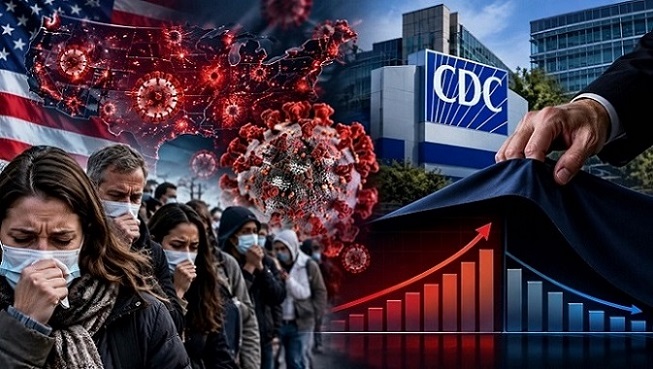 Wastewater surveillance shows COVID-19 rising across much of America as researchers challenge how the CDC
categorizes viral activity
Wastewater reveals a broad national resurgence
The September 21 assessment from the Pandemic Mitigation Collaborative, or PMC, identifies outbreaks in at least 40 states and territories, including California, Florida, Michigan, New York, Texas, Washington, Pennsylvania, Virginia, Ohio, Georgia, North Carolina, Arizona and Hawaii. The group warns the real number may be higher because monitoring is poor in Idaho, Louisiana, Maryland and Tennessee.
Wastewater is especially important because routine case counts no longer capture infections comprehensively. SARS-CoV-2 shed into sewage can reveal transmission even when infected people do not seek testing, and the CDC says rising wastewater activity can indicate higher infection risk.
Texas has stood out with very high statewide wastewater activity, while California, Florida and Washington have registered high activity. PMC also flags outbreaks across the Midwest, Northeast and South, including elevated signals on Hawaii Island and around New York City.
Michigan offers another warning sign. Recent WastewaterSCAN data cited in local reporting showed rising coronavirus concentrations, with Ann Arbor, Warren and Mount Pleasant at high activity and Jackson, Jenison and Traverse City at moderate levels with upward trends.
A dispute over how CDC labels the signal
The controversy centers on how CDC wastewater values are converted into public-facing categories such as low, moderate, high and very high.
Michael Hoerger, an associate professor of psychology and psychiatry at Tulane University and director of PMC, has accused the agency of blue washing its map by changing thresholds so levels previously placed in more serious categories can now receive lower classifications. In this
Thailand Medical News report, the distinction is crucial: the allegation concerns presentation and interpretation, not evidence that underlying wastewater measurements have been erased.
The changes are visible in CDC documentation. Earlier 2026 CDC material classified COVID-19 wastewater activity above 7.8 as very high, while high began above 5.3. Under thresholds published after the August 2026 recalibration, very high begins above 11.6 and high above 7.9. Moderate begins above 4.9, while low extends through 4.9.
Consequently, the same standardized wastewater value can receive a less severe category under the newer scale than under the earlier one.
CDC says recalibration reflects newer data
The CDC offers a
different explanation. It says wastewater thresholds are reviewed annually as surveillance accumulates data, with current categories calculated using the most recent 24 months. The August 2026 update applied Jenks Natural Breaks to COVID-19, influenza A and RSV and evaluated thresholds against clinical surveillance.
The agency describes the changes as routine recalibration intended to keep categories meaningful as viral patterns evolve. It also says historical values are recalculated using the revised methodology, allowing past and current levels to be compared under the same framework.
That explanation does not eliminate Hoerger’s communication concern. A casual user looking mainly at map colors may interpret a lower category as meaning less transmission, even when an identical standardized signal previously carried a more urgent label.
Why the reporting debate matters
Wastewater is now one of the few systems capable of detecting infections among people who never test, use unreported home tests or remain asymptomatic.
Independent dashboards can present a more alarming picture than the CDC map because thresholds, methods, geographic coverage and visualization choices differ.
The available evidence nevertheless shows SARS-CoV-2 transmission elevated across substantial parts of the country. The CDC continues publishing wastewater data and explains its recalibration, while Hoerger argues the revised categories can make current risk look deceptively lower to casual users. With outbreaks identified across dozens of states and monitoring gaps elsewhere, transparent communication of both raw trends and category changes is essential so Americans can understand what is happening and make informed health decisions.
References:
https://pmc19.com/
https://data.wastewaterscan.org/
https://www.cdc.gov/wastewater/about/wval.html
https://www.cdc.gov/wastewater/respiratory-viruses/national.html
https://www.cdc.gov/respiratory-viruses/data/faqs.html 



 Share
Share
 Tweet
Tweet
 Share
Share

































