Nikhil Prasad Fact checked by:Thailand Medical News Team Feb 01, 2026 8 months, 2 days, 19 hours, 30 minutes ago
Medical News: Scientists are increasingly discovering that how our DNA is folded inside cells can be just as important as the genes themselves. A new comprehensive scientific review explains that the three-dimensional organization of DNA plays a powerful role in controlling health, aging, and especially cancer, offering fresh hope for more accurate diagnosis and treatment strategies.
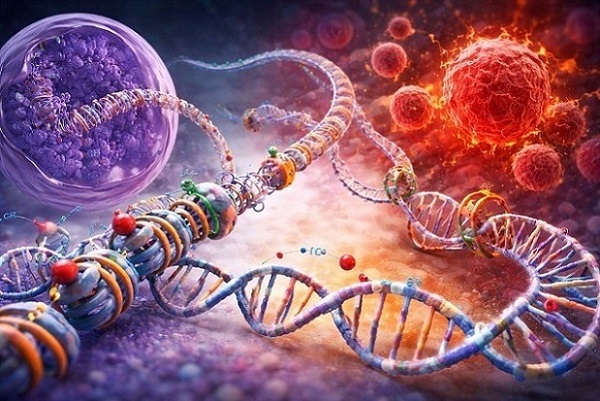 DNA folding errors may unlock new ways to detect and treat cancer earlier and more precisely
How DNA Is Packed Inside Our Cells
DNA folding errors may unlock new ways to detect and treat cancer earlier and more precisely
How DNA Is Packed Inside Our Cells
Inside every human cell, nearly two meters of DNA must fit into a tiny nucleus. This is achieved through a complex folding system known as higher order chromatin structure. DNA wraps around proteins to form compact units, which then loop, fold, and organize into distinct neighborhoods. These structures help ensure that the right genes are turned on or off at the right time. When this organization works well, cells function normally. When it breaks down, disease can follow.
The Epigenetic Control System
The study highlights how epigenetic mechanisms control DNA folding without changing the genetic code itself. These include chemical tags on DNA, modifications to histone proteins, and specialized regulatory RNA molecules. Together, they act like switches and scaffolds, shaping how DNA is folded and which genes can interact. This
Medical News report explains that even small disruptions to this system can cause genes to behave abnormally.
Why Folding Errors Matter in Cancer
Researchers found strong evidence that errors in DNA folding can directly activate cancer causing genes or silence protective ones. Instead of mutations in individual genes, entire chromatin neighborhoods can be rearranged, allowing harmful gene interactions. This mechanism has been observed in cancers such as leukemia, neuroblastoma, and brain tumors. Importantly, these structural changes can drive cancer even when the DNA sequence itself appears normal.
Beyond Cancer Aging and Inherited Disorders
The review also links chromatin folding defects to aging and rare inherited diseases. As cells age, their DNA architecture becomes less stable, leading to increased genomic damage and inflammation. Certain congenital conditions arise when chromatin boundaries fail during early development, causing genes to switch on in the wrong tissues or at the wrong time.
New Paths for Diagnosis and Treatment
One of the most promising findings is that abnormal DNA folding patterns could serve as biomarkers for early disease detection. Therapies are also being developed to target the proteins that maintain chromatin structure, potentially restoring normal gene regulation. Unlike traditional treatments that target single genes, these approaches aim to correct broader genomic organization, opening the door to more precise and personalized medicine.
Institutions Involved in the Research
The researchers involved are from Ya
le School of Medicine, Yale Cancer Center, University of Wisconsin Madison, Mayo Clinic Rochester, UConn Health, BronxCare Health System, Norwalk Hospital, and the William S. Middleton Memorial VA Health System.
Conclusions
This review makes it clear that understanding how DNA folds inside cells is critical to understanding disease. By shifting focus from single genes to large scale chromatin architecture, scientists may unlock new ways to detect cancer earlier, predict disease behavior more accurately, and design therapies that are both more effective and less toxic. The future of precision medicine may depend on decoding these hidden layers of genome organization.
The study findings were published in the peer reviewed journal: Cancers
https://www.mdpi.com/2072-6694/18/3/483
For the latest on cancer research, keep on logging to Thailand
Medical News.
Read Also:
https://www.thailandmedical.news/articles/cancer




 Share
Share
 Tweet
Tweet
 Share
Share