Study Validates That New Omicron Variants Such as BA.2.86 and JN.1 Exhibit Enhanced Tropism for the Human Intestines
Nikhil Prasad Fact checked by:Thailand Medical News Team Jun 23, 2026 3 months, 1 week, 4 days, 4 hours, 29 minutes ago
Medical News: New Research Reveals Why Recent COVID-19 Variants May Spread Differently
A groundbreaking new study has found that newer SARS-CoV-2 Omicron variants, particularly BA.2.86 and JN.1, have developed an enhanced ability to infect the human small intestine. While many earlier studies focused on how COVID-19 variants affect the lungs and airways, this latest research highlights a potentially important shift in viral behavior that could influence how these variants spread among humans.
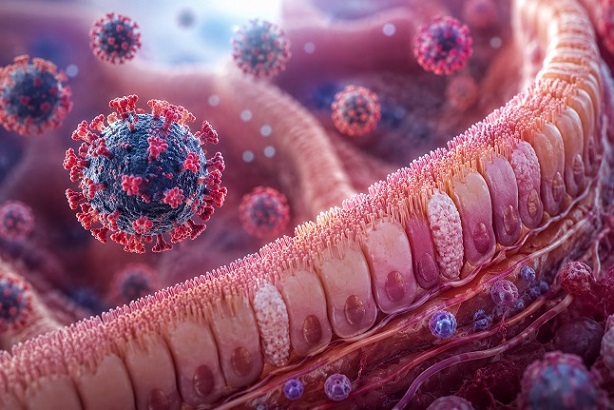 New research shows BA.2.86 and JN.1 have evolved a remarkable ability to infect the human small intestine,
potentially influencing how COVID-19 spreads
The study was conducted by researchers from the School of Public Health, Li Ka Shing Faculty of Medicine, The University of Hong Kong; the Centre for Immunology and Infection (C2i), Hong Kong Science Park; and the Department of Pathology, Li Ka Shing Faculty of Medicine, The University of Hong Kong.
Comparing Multiple Omicron Variants
Researchers examined a wide range of Omicron variants, including BA.1, BA.2, BA.5, XBB.1.5, EG.5.1, BA.2.86, and JN.1. Using human bronchial tissues, lung tissues, airway organoids, colon cells, and laboratory-grown human intestinal tissues known as proximal intestinal enteroids, the team investigated where these variants replicate most effectively.
The findings showed that variants such as XBB.1.5 and EG.5.1 replicated more efficiently in bronchial and lung tissues than BA.2.86 and JN.1. This suggests that XBB.1.5 and EG.5.1 possess stronger respiratory fitness and may be better adapted to infecting the airways and lungs.
However, the picture changed dramatically when the researchers examined tissues from the small intestine.
BA.2.86 and JN.1 Thrive in the Small Intestine
The most striking discovery was that BA.2.86 and JN.1 replicated significantly better than EG.5.1 in tissues that mimic the upper small intestine. In fact, these variants showed a clear preference for infecting intestinal cells, including enterocytes, goblet cells, and Paneth cells.
The researchers found that this enhanced intestinal infection depended heavily on two important host factors known as ACE2 and TMPRSS2. These molecules help the virus gain entry into cells. Interestingly, intestinal tissues contained higher levels of ACE2, helping explain why BA.2.86 and JN.1 were so successful in this environment.
The study also found that JN.1 was especially dependent on ACE2 and demonstrated one of the strongest intestinal infection profiles among the variants tested.
Possible Link to Fecal Transmission
An important implication of the findings is the possibility that BA.2.86 and JN.1 may spread more efficiently through fecal shedding. Previous clinical observations had already suggested that patients infected with these variants shed larger amounts of virus in stool samples.
According to the researchers, stronger replication in the small intestine could increase the amount of virus released through the dig
estive tract. This
Medical News report notes that many gastrointestinal viruses spread through fecal-oral transmission after replicating extensively in the intestine, raising concerns that similar mechanisms could contribute to the spread of these newer SARS-CoV-2 variants.
JN.1 May Spread Quietly
Another intriguing observation involved the body's inflammatory response. Despite replicating efficiently in intestinal tissues, JN.1 triggered relatively low levels of inflammatory cytokines compared to several other variants.
This means infected individuals may experience few or no digestive symptoms even while the virus is actively replicating in their intestines. Such silent intestinal infections could potentially allow infected individuals to unknowingly contribute to viral spread.
The researchers believe this combination of strong intestinal replication and limited inflammation may have helped JN.1 become one of the world's dominant COVID-19 variants.
Respiratory Strength Versus Intestinal Adaptation
The study highlights a major evolutionary difference among recent Omicron variants. Variants such as BA.5, XBB.1.5, and EG.5.1 appear better adapted to the respiratory tract and lungs, while BA.2.86 and JN.1 seem to have developed a stronger preference for the small intestine.
Scientists suggest that this intestinal adaptation may provide an additional transmission advantage even though these variants replicate less efficiently in respiratory tissues than some of their predecessors.
Conclusions
The study provides compelling evidence that BA.2.86 and JN.1 have evolved enhanced tropism for the human small intestine, distinguishing them from many earlier Omicron variants. Their ability to efficiently infect intestinal tissues, combined with reduced inflammatory responses and increased fecal shedding, suggests that the digestive tract may play a more important role in SARS-CoV-2 transmission than previously recognized. These findings underscore the need for continued surveillance of emerging variants and greater attention to gastrointestinal infection pathways.
The study findings were published in the peer reviewed journal: Nature Communications.
https://www.nature.com/articles/s41467-026-74111-y
For the latest COVID-19 news, keep on logging to Thailand
Medical News.
Read Also:
https://www.thailandmedical.news/articles/coronavirus
https://www.thailandmedical.news/articles/long-covid




 Share
Share
 Tweet
Tweet
 Share
Share

































