Nikhil Prasad Fact checked by:Thailand Medical News Team Jun 06, 2026 3 months, 4 weeks, 4 hours, 41 minutes ago
Medical News: A new study from researchers in Poland and the United Kingdom has found that the immune system may remain disrupted for up to nine months after a person recovers from COVID-19, even when most symptoms have started to improve. The findings provide fresh evidence that long COVID is far more complex than many people realize and may involve ongoing biological changes long after the initial infection has passed.
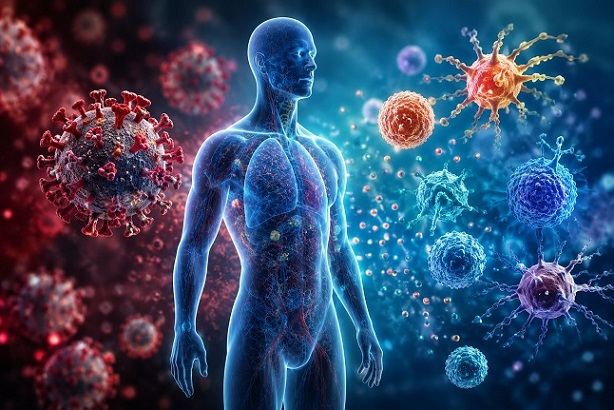 New research shows that immune system abnormalities can persist for up to nine months after COVID-19, even as
symptoms gradually improve.
The research was conducted by scientists from the Military Institute of Medicine–National Research Institute in Warsaw, the University of Lodz, the 7th Polish Navy Hospital in Gdansk, and the University of Oxford’s Wellcome Centre for Human Genetics.
COVID-19 is known to trigger a strong inflammatory response during the acute stage of illness. However, scientists have struggled to understand why many people continue to experience fatigue, breathing problems, and other symptoms months later.
To investigate this issue, researchers followed 139 adults who had been hospitalized with moderate or severe COVID-19. Blood samples and clinical assessments were collected at three, six, and nine months after hospital discharge. The results were compared with healthy individuals who had never developed long COVID symptoms.
The team discovered that several key immune signaling molecules, known as cytokines, remained abnormally elevated throughout the entire nine-month observation period. These included IL-2, IL-6, IL-17A, TNF-alpha, IFN-gamma, and CXCL9. Such molecules normally help coordinate the body's immune response, but persistently high levels can indicate ongoing immune activation and inflammation.
Some Markers Continued Rising Over Time
One of the most surprising findings was that certain inflammatory markers did not gradually return to normal. Instead, some became even higher as time passed.
Levels of IL-2, IL-10, TNF-alpha, and creatinine continued to rise between the third and ninth month after infection. Other markers such as IFN-gamma, CXCL10, CXCL9, CCL2, and lactate dehydrogenase gradually declined, suggesting that different components of the immune system recover at different speeds.
Researchers also observed that long COVID patients lost many of the normal relationships between immune markers that are typically seen in healthy people. This suggests that the immune system may remain poorly coordinated long after recovery from the initial infection.
This
Medical News report highlights that the immune abnormalities observed were not simply a short-term aftereffect of severe illness but represented a prolonged disruption of immune regulation.
Symptoms Improved but Did Not Completely Disappear
The good news is that symptoms generally became less common over time. Fatigue, cough, and shortness of breath all declined significantly during the stud
y period.
At three months, nearly 43 percent of patients reported fatigue. By nine months, that figure had fallen to about 23 percent. Cough dropped from nearly 29 percent to just over 7 percent, while breathing difficulties decreased from almost 23 percent to around 4 percent.
Despite these improvements, a significant number of individuals continued to experience symptoms many months after infection, particularly fatigue, suggesting that complete recovery can be a lengthy process.
IL-6 Emerges as a Key Long COVID Indicator
Among all the immune markers examined, IL-6 stood out as the most reliable indicator of long COVID. Researchers found that it consistently distinguished people recovering from COVID-19 from healthy individuals even after accounting for age differences.
The findings suggest IL-6 could potentially serve as a useful biological marker in future efforts to identify or monitor long COVID patients.
Conclusions
The study provides compelling evidence that COVID-19 can leave behind a long-lasting biological footprint that extends far beyond the initial infection. While many patients gradually improve, important immune abnormalities may persist for at least nine months. The research also shows that lingering symptoms cannot be explained by inflammation alone, indicating that long COVID likely involves a combination of immune, metabolic, neurological, and tissue-repair mechanisms. The authors stress that continued monitoring of recovered patients is essential and that more research is urgently needed to understand why some people fully recover while others continue to experience prolonged health problems long after the virus is gone.
The study findings were published in the peer reviewed International Journal of Molecular Sciences.
https://www.mdpi.com/1422-0067/27/11/5137
For the latest COVID-19 news, keep on logging to Thailand
Medical News.
Read Also:
https://www.thailandmedical.news/articles/coronavirus
https://www.thailandmedical.news/articles/long-covid




 Share
Share
 Tweet
Tweet
 Share
Share

































