Nikhil Prasad Fact checked by:Thailand Medical News Team Apr 16, 2026 5 months, 2 weeks, 5 days, 16 hours ago
Medical News: A new study is shedding light on one of the most puzzling aspects of Long COVID, revealing that fragments of the SARS-CoV-2 virus can persist deep within the gut and actively disturb the body’s immune balance in highly localized ways. Rather than causing widespread inflammation, the research shows that the viral spike protein creates small but significant pockets of immune dysfunction, particularly in the colon, which may help explain lingering symptoms months or even years after infection.
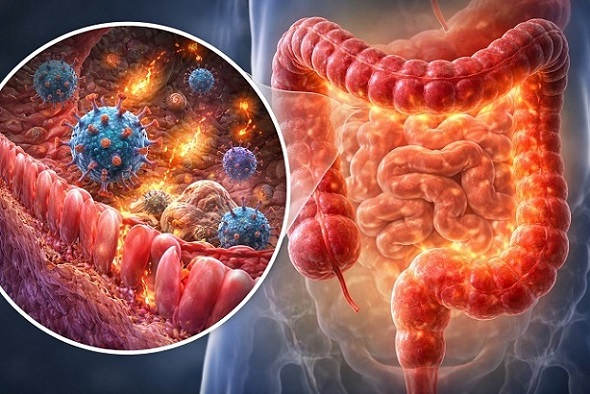 Persistent COVID spike protein in the gut triggers localized immune imbalance linked to Long COVID symptoms
Persistent Viral Remnants Found in Gut Tissue
Persistent COVID spike protein in the gut triggers localized immune imbalance linked to Long COVID symptoms
Persistent Viral Remnants Found in Gut Tissue
Scientists examined intestinal biopsy samples from individuals diagnosed with Long COVID and compared them to healthy controls. Using advanced imaging and gene-mapping techniques, they detected both SARS-CoV-2 spike protein and viral genetic material in the gut tissues of participants across both groups.
However, the presence of viral remnants alone was not the defining factor. What stood out was how the surrounding tissue responded. In Long COVID patients, regions containing the spike protein showed clear signs of altered immune behavior, while similar regions in healthy individuals did not exhibit the same level of disruption.
The research team included experts from the J. Craig Venter Institute, the Icahn School of Medicine at Mount Sinai in New York, the Precision Immunology Institute, and the University of California San Diego.
Localized Immune Dysregulation Emerges as Key Mechanism
Detailed analysis revealed that areas of the colon containing spike protein displayed distinct gene expression changes. A total of 57 genes were found to be significantly altered, with 26 showing increased activity and 31 reduced activity in Long COVID patients. These changes were not random but pointed toward a breakdown in normal immune coordination.
Crucially, important chemokines that guide immune cell movement - such as CXCL13, CCL19, and CCL21 - were suppressed. At the same time, other genes linked to epithelial stress and abnormal cellular behavior were elevated. This combination suggests that while immune activity is present, it is poorly organized and potentially ineffective.
This
Medical News report highlights that such localized immune dysregulation may prevent the body from fully clearing viral remnants, allowing symptoms to persist and fluctuate over time.
Immune Cell Imbalances Within Affected Regions
Further investigation showed that spike-positive regions were enriched with specific immune cells, including macrophages, intermediate monocytes, plasma cells, and regulatory T cells. These cells are typically involved in controlling infections and maintaining immune balance, but their accumulation in these regions points to an ongoing, unresolved immune response.
At the same time, certain protective immune pathways appeared weakened, in
dicating a paradoxical state where the immune system is both activated and impaired. This imbalance may contribute to chronic inflammation, tissue stress, and the wide range of gastrointestinal symptoms reported in Long COVID.
Interestingly, the colon exhibited much stronger immune disruption compared to the ileum, suggesting that different parts of the gut respond differently to persistent viral material.
Signals of Tissue Stress and Potential Long-Term Risks
The study also identified increased activity in genes associated with cellular stress and tissue repair, including those linked to fluid transport and epithelial function. Some of these genes have previously been associated with inflammatory bowel conditions, hinting at overlapping biological mechanisms.
In addition, certain gene patterns observed in spike-positive regions are commonly linked to early tumor-related pathways. While there is no evidence of cancer development in this study, the findings raise important questions about whether prolonged immune dysregulation could increase long-term health risks if left unaddressed.
Conclusions
The findings provide compelling evidence that SARS-CoV-2 spike protein can persist in the gut and actively drive localized immune dysregulation in Long COVID patients. This is not a passive phenomenon but a dynamic process in which retained viral components reshape the immune environment, disrupt normal signaling, and sustain chronic symptoms. By identifying the colon as a key site of this dysfunction, the study opens new avenues for targeted therapies aimed at clearing viral reservoirs or restoring immune balance. Understanding and addressing these localized immune disturbances may be essential for developing effective treatments and improving outcomes for those living with Long COVID.
The study findings were published on a preprint server and are currently being peer reviewed.
https://www.researchsquare.com/article/rs-9284759/v1
For the latest on Long COVID, keep on logging to Thailand
Medical News.
Read Also:
https://www.thailandmedical.news/articles/long-covid
https://www.thailandmedical.news/articles/coronavirus




 Share
Share
 Tweet
Tweet
 Share
Share