Nikhil Prasad Fact checked by:Thailand Medical News Team Aug 16, 2026 1 month, 2 weeks, 5 days, 6 hours, 52 minutes ago
Long COVID may affect more than the lungs, heart, brain and nervous system. A newly published case report suggests that problems involving the salivary glands and their drainage ducts can appear months after repeated SARS-CoV-2 infections, causing severe dry mouth, facial swelling and considerable pain.
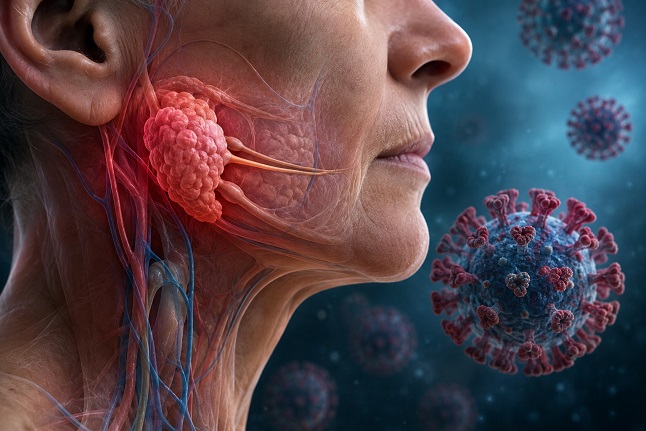 An unusual case suggests long COVID may be linked to severe salivary duct enlargement, dry mouth, facial swelling
and pain months after infection
Researchers described an unusual case involving an 80-year-old woman who developed sudden swelling on the left side of her face and beneath her jaw. She also experienced intense bursting pain affecting her major salivary glands, severe dry mouth, difficulty eating and general fatigue.
Researchers From Multiple International Institutions
The researchers were from Poltava State Medical University and the Palladin Institute of Biochemistry of NAS of Ukraine in Ukraine; Macquarie University and the University of Sydney in Australia; Juntendo University, Juntendo University Graduate School of Medicine, Juntendo University Urayasu Hospital and the University of Tokyo in Japan.
Their departments and research centers included the Australian Institute of Health Innovation, Charles Perkins Centre, Sydney Dental School, Juntendo Biomedical Research Core Facilities, Institute of Medical Science at the University of Tokyo, and Juntendo University's Center for Genome and Regenerative Medicine.
Salivary Duct Became More Than 13 Times Larger
The most striking finding came from ultrasound examination. The duct of the woman's left submandibular salivary gland measured 0.8 centimeters. It was approximately 13.33 times wider than the corresponding duct on the right side.
Importantly, doctors found no salivary stone, tumor or other physical blockage that could explain the dramatic enlargement. The glandular tissue itself also showed no major structural changes, suggesting that the problem was concentrated primarily in the ducts.
The woman had experienced three confirmed COVID-19 infections, occurring approximately 48 months, 12 months and six months before the salivary gland problem developed. She did not experience salivary gland swelling during those infections.
Doctors investigated several alternative explanations. Tests ruled against mumps, salivary stones, active COVID-19 infection and typical bacterial salivary gland infection. A medication the patient had taken for years could contribute to dry mouth, but researchers considered it unlikely to fully explain the new clinical episode.
Inflammation and Severe Duct Spasm Detected
Blood testing revealed raised inflammatory markers. C-reactive protein reached 48 mg/L, while the erythrocyte sedimentation rate was 46 mm/h. The patient also showed increased neutrophils and reduced lymphocytes.
Doctors diagnosed probable post-COVID generalized sialodochitis, meaning inflammation or dysfunction involving the salivary ducts. Attempts to probe the affected duct were unsuccessful because of severe spasm at its opening.
Importantly, this Thailand
">Medical News report highlights that previous research has already shown that salivary gland tissues contain cellular machinery that can make them vulnerable to SARS-CoV-2. Earlier studies have also detected viral material in salivary gland ducts and gland cells and documented persistent gland abnormalities after COVID-19.
Recovery Without Surgery or Antibiotics
Because the patient was elderly and medically frail, doctors pursued conservative treatment. Management included increased water intake, salivary gland massage, medication intended to reduce spasms, infusion therapy and topical treatment.
Pain and swelling gradually decreased. Saliva initially remained scarce during gland massage, but salivary flow subsequently improved. After approximately two months, the symptoms completely resolved. Most importantly, the condition did not progress into bacterial or pus-producing salivary gland infection. Surgery and antibiotics were avoided.
Conclusions
The case suggests that doctors evaluating unexplained facial swelling, severe dry mouth and salivary gland pain should consider a patient's previous COVID-19 infections, even when the infection occurred months earlier. However, this remains a single case and cannot prove that COVID-19 directly caused the condition. Larger studies are needed to determine how frequently delayed salivary duct problems occur and which treatments provide the greatest benefit.
The study findings were published in the peer reviewed journal: Healthcare.
https://www.mdpi.com/2227-9032/14/16/2558
Read Also:
https://www.thailandmedical.news/articles/coronavirus
https://www.thailandmedical.news/articles/long-covid




 Share
Share
 Tweet
Tweet
 Share
Share

































