Nikhil Prasad Fact checked by:Thailand Medical News Team Jun 10, 2026 3 months, 3 weeks, 3 days, 6 hours, 6 minutes ago
Medical News: Vitamin E Deficiency Found to Damage Liver Clock and Trigger Fat Build-Up
A new study has uncovered alarming evidence that even a short-term deficiency of vitamin E can disrupt the liver’s internal biological clock, alter gut bacteria, and trigger harmful fat accumulation in the liver. The findings suggest that inadequate intake of vitamin E may have far-reaching consequences for metabolic health, potentially increasing the risk of fatty liver disease and other metabolic disorders.
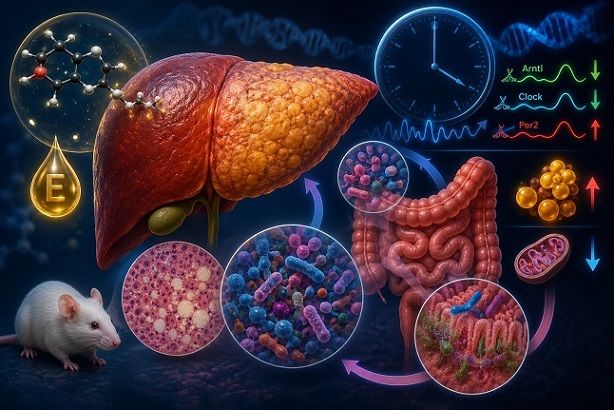 New research shows that low vitamin E levels can disrupt gut bacteria and the liver’s biological clock, leading to
harmful fat accumulation in the liver
Researchers from the Yunnan Key Laboratory of Precision Nutrition and Personalized Food Manufacturing, the Engineering Research Center of Development and Utilization of Food and Drug Homologous Resources of the Ministry of Education, the College of Food Science and Technology, and the Division of Science and Technology at Yunnan Agricultural University in Kunming, China, conducted the study to examine how a deficiency of alpha-tocopherol, the most biologically active form of vitamin E, affects the liver and gut microbiome.
Why Vitamin E Matters More Than Previously Thought
Vitamin E is widely known as an antioxidant that helps protect cells from damage. However, scientists are increasingly discovering that it plays a much larger role in maintaining healthy metabolism. Alpha-tocopherol is the primary form of vitamin E retained and utilized by the human body.
Although severe vitamin E deficiency is uncommon, many people around the world consume less than optimal amounts. Until now, little was known about the metabolic consequences of even a relatively short period of insufficient intake.
Deficiency Quickly Alters Liver Health
In the study, healthy mice were fed either a vitamin E-deficient diet, a normal diet, or a diet containing four times the normal level of vitamin E for five weeks. While body weight and blood sugar levels remained largely unchanged, the vitamin E-deficient mice developed significant signs of liver dysfunction.
Researchers observed enlarged livers, enlarged cecums, shortened intestines, and visible liver cell damage. The animals also showed increased levels of harmful LDL cholesterol and elevated triglyceride accumulation within the liver.
Microscopic examination revealed ballooning degeneration of liver cells, an early warning sign often associated with fatty liver disease and metabolic stress.
The Liver’s Internal Clock Falls Out of Sync
One of the study’s most striking discoveries involved the liver’s circadian clock. Every organ in the body operates according to internal timing mechanisms that regulate thousands of biological processes over a 24-hour cycle.
The researchers found that vitamin E deficiency significantly reduced the activity of two crucial clock genes known as Arntl (also called Bmal1) and Clock. At the same time, it increased levels of another clock-related gene called Per2. Together, these
changes indicate a major disruption of the liver’s natural timing system.
This disruption was not merely cosmetic. The altered clock activity was accompanied by widespread changes in genes that control fat production and fat burning.
Fat Production Increased While Fat Burning Slowed
The team discovered that vitamin E deficiency activated several genes responsible for producing and modifying fats, including Scd1, Elovl6, and Elovl3. At the same time, genes involved in breaking down and burning fatty acids, such as Cyp4a10, Cyp4a14, and Acot1, became less active.
The result was a metabolic imbalance that favored fat accumulation inside liver cells.
According to the researchers, this pattern creates ideal conditions for the development of hepatic steatosis, commonly known as fatty liver.
Gut Bacteria Undergo Major Changes
The investigation also revealed dramatic alterations in the gut microbiome. Mice lacking adequate vitamin E experienced a significant reduction in microbial diversity, a hallmark often associated with poor gut health.
Several beneficial bacterial groups declined sharply, including Alistipes, Odoribacter, Muribaculum, and Dubosiella. At the same time, other bacterial populations increased.
Importantly, many of these bacterial changes closely matched changes seen in liver clock genes and lipid metabolism genes. Among all bacterial groups examined, Alistipes showed the strongest connections to the disrupted liver clock and abnormal fat metabolism.
These findings suggest that vitamin E deficiency may influence liver health indirectly by reshaping gut microbial communities.
A Newly Identified Gut-Liver Connection
This
Medical News report highlights what researchers describe as a previously unrecognized “gut microbiota–liver circadian clock” axis. The evidence suggests that insufficient vitamin E intake may first disturb gut bacteria, which then interfere with the liver’s biological clock, ultimately leading to abnormal fat metabolism and liver injury.
The discovery adds a new layer of understanding to how nutritional deficiencies can influence disease development far beyond traditional vitamin deficiency symptoms.
Conclusions
The study provides compelling evidence that even a relatively short period of alpha-tocopherol deficiency can trigger significant biological changes affecting the liver, gut microbiome, and metabolic regulation. Researchers showed that vitamin E deficiency disrupted the liver’s circadian clock, increased fat-producing pathways, suppressed fat-burning mechanisms, and reduced microbial diversity in the gut. These interconnected effects resulted in early liver damage and excessive fat accumulation. The findings underscore the importance of maintaining adequate vitamin E intake and suggest that preserving healthy vitamin E levels may be crucial not only for antioxidant protection but also for sustaining proper communication between the gut and liver. Future research will be needed to determine whether similar mechanisms occur in humans and whether targeted nutritional interventions can help prevent metabolic diseases linked to vitamin E deficiency.
The study findings were published in the peer reviewed journal: Nutrients.
https://www.mdpi.com/2072-6643/18/12/1853
For the latest research on Vitamin E, keep on logging to Thailand
Medical News.
Read Also:
https://www.thailandmedical.news/articles/supplements
https://www.thailandmedical.news/articles/health-news




 Share
Share
 Tweet
Tweet
 Share
Share

































