Nikhil Prasad Fact checked by:Thailand Medical News Team May 01, 2026 5 months, 3 days, 2 hours, 39 minutes ago
Medical News: A new scientific study has uncovered a surprising and potentially powerful property of apples that goes far beyond basic nutrition. Researchers have discovered that tiny natural molecules found in apples may be capable of entering human cells and slowing the growth of cells linked to cancer. This finding is drawing attention because it suggests that everyday foods might directly influence human genes in ways scientists are only beginning to understand.
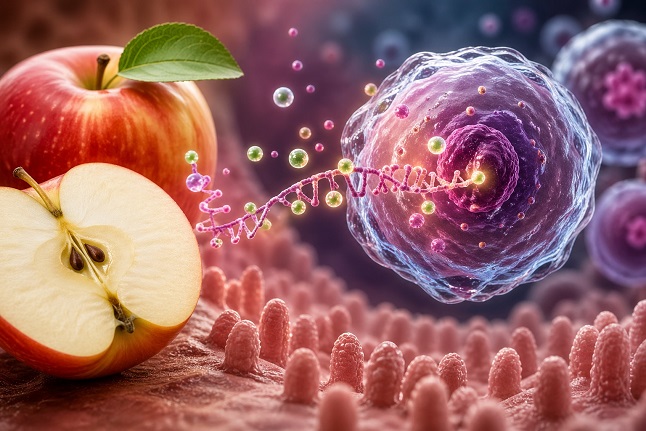 Apple molecules may help slow cancer-related cell growth at the genetic level
These molecules, known as microRNAs or miRNAs, are extremely small genetic regulators that act like switches inside cells, turning certain genes on or off. While miRNAs are naturally produced in the human body, scientists have now shown that plant-based miRNAs from apples may also interact with human cells after consumption.
Tiny Molecules with Big Impact
MicroRNAs are essential for controlling how cells grow, divide, and function. When these processes go wrong, diseases such as cancer can develop. The idea that plant miRNAs could influence human biology is known as “trans-kingdom communication,” meaning biological signals can move between completely different species such as plants and humans.
In this study, researchers focused on apples because they are one of the most widely consumed fruits globally. They identified two specific apple-derived microRNAs, called miR-482a-3p and miR-858, which appear to play a role in regulating cell growth.
How The Study Was Conducted
The research team conducted laboratory experiments using human intestinal cell lines commonly used to study colorectal cancer. These cells were exposed to synthetic versions of the apple-derived microRNAs to observe how they would respond.
The scientists involved in the study were from the Department of Interdisciplinary Medicine, University of Bari “Aldo Moro”, Bari, Italy; the INBB National Institute for Biostructure and Biosystems, Rome, Italy; the Department of Biology and Biotechnology “L. Spallanzani”, University of Pavia, Pavia, Italy; and the Department of Translational Biomedicine and Neuroscience (DiBraiN), University of Bari “Aldo Moro”, Bari, Italy.
Apple Molecules Slowed Cell Growth
The results showed that when these apple-derived microRNAs were introduced into human intestinal cells, the rate at which the cells multiplied was significantly reduced. This effect was especially strong for miR-482a-3p, which consistently slowed down cell growth over time.
This finding is important because uncontrolled cell growth is a key characteristic of cancer. By slowing this process, these natural molecules could potentially play a role in preventing or managing disease development.
Targeting A Cancer Linked Gene
To understand how this slowing effect happens, researchers examined the interaction between the apple microRNAs and human genes. They found that miR-482a-3p specifically targets a gene known as c-MYB.
The c-MYB gen
e is known to play a major role in cell growth, division, and survival. It is often found to be overactive in several types of cancer, including colorectal cancer. When the apple-derived microRNA interacted with this gene, it reduced its activity.
This reduction led to a decrease in signals that normally tell cells to grow and divide. In addition, several downstream genes associated with inflammation and tumor growth, such as CYCLIN D1, COX2, and c-MYC, were also reduced. This shows that the effect is not limited to a single gene but influences a wider network involved in disease progression.
This
Medical News report highlights how a natural dietary component can interfere with key biological pathways linked to cancer.
What This Means for Everyday Diets
The findings support the growing belief that food does more than provide energy and nutrients. Certain foods may contain biologically active molecules capable of directly influencing how human cells behave at a genetic level.
Apples, already known for their fiber and antioxidant content, may also carry genetic regulators that contribute to their health benefits. This adds a new layer of understanding to why diets rich in fruits and vegetables are associated with lower risks of chronic diseases.
Important Limitations
Despite the promising results, it is important to understand that this research was conducted in controlled laboratory conditions. The microRNAs were introduced directly into cells, which may not fully represent what happens when apples are eaten in real life.
Scientists still need to determine whether these molecules can survive digestion, enter the bloodstream, and reach target cells in sufficient amounts to have the same effects in the human body.
Conclusion
This study provides compelling evidence that apple-derived microRNAs can influence human cells by targeting genes involved in cancer growth. By reducing the activity of the c-MYB gene and its related pathways, these natural molecules demonstrate a potential role in slowing abnormal cell proliferation. While further research is needed to confirm how these effects translate in real-world dietary conditions, the findings open up exciting possibilities for future nutritional strategies aimed at disease prevention and health improvement. The idea that common fruits like apples may directly interact with human genetic systems marks an important step forward in understanding the deeper connection between diet and health.
The study findings were published in the peer reviewed journal: PLOS One.
https://journals.plos.org/plosone/article?id=10.1371/journal.pone.0347565
For the latest on plant miRNAs and colon cancer, keep on logging to Thailand
Medical News
Read Also:
https://www.thailandmedical.news/articles/cancer
https://www.thailandmedical.news/articles/herbs-and-phytochemicals




 Share
Share
 Tweet
Tweet
 Share
Share

































