Nikhil Prasad Fact checked by:Thailand Medical News Team Feb 15, 2026 6 months, 2 weeks, 1 day, 16 hours, 22 minutes ago
Medical News: Natural Citrus Molecule Shows Surprising Joint Protection
A phytochemical found in citrus fruits may hold the key to calming painful knee arthritis and protecting joint cartilage, according to new research from scientists at the Jiangxi University of Chinese Medicine in China. The phytochemical, called naringin, is commonly present in grapefruits and oranges and has long been known for its anti-inflammatory properties. However, until now, researchers did not fully understand how it worked at the molecular level to protect joints.
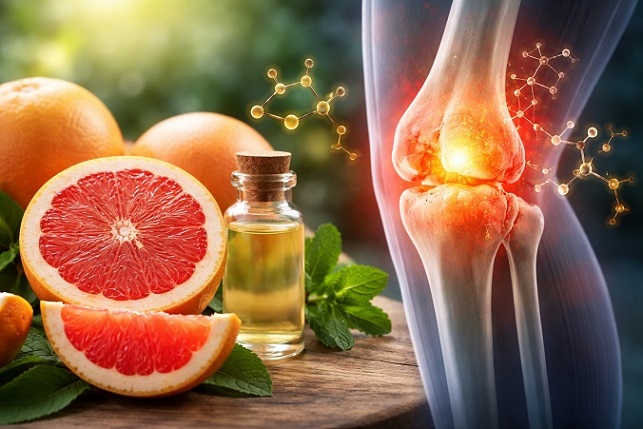 Natural citrus compound naringin blocks key inflammatory signals responsible for knee arthritis damage
This
Medical News report highlights that knee osteoarthritis, a degenerative disease affecting millions worldwide, develops largely due to inflammation that damages cartilage and reduces mobility. Current treatments mainly focus on reducing pain but do not stop disease progression. The new study provides strong evidence that the phytochemical naringin may target key inflammatory pathways and protect joint cells from damage.
How Scientists Uncovered the Mechanism
The research team used advanced tools including network pharmacology, molecular simulations, and laboratory experiments to identify how naringin interacts with inflammatory molecules. They discovered that naringin influences at least 59 key biological targets linked to osteoarthritis. Among these, two stood out as especially important: TNF-alpha and PTGS2.
These two molecules play a central role in triggering inflammation. TNF-alpha acts as a signal that amplifies inflammatory responses, while PTGS2 helps produce prostaglandins, which cause swelling, pain, and tissue breakdown. Molecular simulations revealed that naringin binds strongly and stably to both targets, suggesting it can directly block their harmful activity.
Laboratory Tests Confirm Powerful Anti-Inflammatory Effects
To confirm their findings, researchers tested naringin on human cartilage cells exposed to inflammatory stress. Normally, inflammation reduces cell survival and triggers the release of harmful molecules such as TNF-alpha, IL-6, and PGE2. However, when treated with naringin, the cells showed significant improvement.
Cell survival increased noticeably, and inflammation markers dropped dramatically. Importantly, at higher doses, naringin worked as effectively as celecoxib, a widely used anti-inflammatory drug. This suggests that naringin may offer similar benefits but potentially with fewer side effects, since it is a naturally occurring compound.
The experiments also showed that naringin reduced both gene activity and protein levels of TNF-alpha and PTGS2. This means the compound not only blocks inflammation signals but also prevents cells from producing harmful inflammatory molecules in the first place.
Why Targeting These Inflammatory Signals Matters
Inflammation is a major driver of cartilage destruction in osteoarthritis. Once inflammation begins, it creates a
cycle of damage, pain, and reduced mobility. By targeting TNF-alpha and PTGS2 directly, naringin interrupts this destructive cycle.
The researchers also found that naringin interacts with pathways linked to cell survival, immune response, and tissue repair. This suggests that its benefits go beyond reducing pain and may actually slow or prevent joint deterioration.
Conclusion
The findings provide compelling evidence that naringin could become a promising therapeutic candidate for knee osteoarthritis by targeting the underlying inflammatory mechanisms rather than merely masking symptoms. Its ability to suppress major inflammatory molecules, protect cartilage cells, and match the effectiveness of established anti-inflammatory drugs highlights its strong potential as a safer, natural alternative. While more clinical trials are needed to confirm its effectiveness in humans, the study opens the door to new treatments derived from natural compounds that may slow disease progression and improve long-term joint health.
The study findings were published in the peer reviewed International Journal of Molecular Sciences
https://www.mdpi.com/1422-0067/27/4/1812
For the latest on Arthritis, keep on logging to Thailand
Medical News.
Read Also:
https://www.thailandmedical.news/articles/arthritis
https://www.thailandmedical.news/articles/herbs-and-phytochemicals




 Share
Share
 Tweet
Tweet
 Share
Share