Nikhil Prasad Fact checked by:Thailand Medical News Team Jun 01, 2026 4 months, 3 days, 3 hours, 36 minutes ago
Medical News: Researchers have discovered that the leaves of Magnolia liliiflora, a plant long used in traditional East Asian medicine, contain powerful natural compounds that may help calm harmful inflammation in the brain. The findings raise the possibility that these often-overlooked leaves could one day be developed into functional foods or natural therapies aimed at supporting brain health and reducing the risk of neurodegenerative diseases.
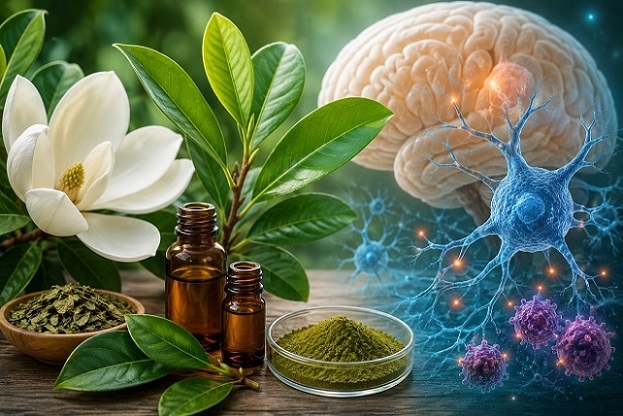 Newly discovered compounds in magnolia leaves dramatically reduced inflammation signals in brain immune cells,
offering hope for future brain-health therapies
Hidden Brain-Protective Compounds Found in Magnolia Leaves
The study was conducted by scientists from the Research Institute of Pharmaceutical Sciences, College of Pharmacy, Seoul National University, Republic of Korea, and the Department of Industrial Crop Science and Technology, College of Agriculture, Life and Environment Sciences, Chungbuk National University, Republic of Korea.
While the flowers of Magnolia liliiflora are already popular as herbal teas, the leaves have received far less scientific attention. Researchers suspected that the leaves might contain unique bioactive substances capable of reducing neuroinflammation, a process increasingly linked to diseases such as Alzheimer's disease, Parkinson's disease, multiple sclerosis, and stroke-related brain damage.
To investigate, the research team extracted compounds from magnolia leaves and analyzed them using advanced chemical profiling techniques. They identified seven lignans, a class of plant compounds known for various health-promoting effects. Remarkably, two of these compounds had never been described before and were named liliiflorin F and liliiflorin G.
Why Brain Inflammation Matters
Inflammation in the brain is largely controlled by immune cells called microglia. Under normal conditions, these cells help protect and repair brain tissue. However, when microglia become chronically activated, they release excessive amounts of inflammatory chemicals that can damage neurons and accelerate brain degeneration.
One of the key inflammatory molecules produced during this process is nitric oxide. High levels of nitric oxide are commonly associated with ongoing neuroinflammation and neuronal injury.
The researchers therefore tested whether compounds extracted from magnolia leaves could reduce nitric oxide production in activated microglial cells.
Strong Anti-Inflammatory Effects Observed
Several of the isolated compounds demonstrated impressive anti-inflammatory activity. Among the most notable was a compound called denudatone, which reduced nitric oxide production by approximately 69 percent in activated microglial cells. Another compound known as cis-burchelin achieved about 56 percent inhibition, while nectandrin B reduced nitric oxide levels by roughly 49 percent.
Even more striking was a specially enriched magnolia leaf fraction that suppressed nitric oxide production by an astonishing 97 percent, suggesting that multiple compounds may work together in a synergistic manner.
Importantly, none of the tested compounds showed detectable toxicity to the cells at the concentrations used. This indicates that the anti-inflammatory effects were genuine and not simply the result of cellular damage.
How the Compounds Work
To understand the underlying mechanism, the researchers combined laboratory experiments with computer-based molecular analysis. Their investigations pointed to a major inflammatory pathway known as NF-kB, which acts as a master switch controlling many inflammatory responses throughout the body.
This
Medical News report highlights that the newly discovered compounds appear to interfere with this pathway, effectively reducing the activation of genes that drive inflammation.
Further experiments confirmed that the compounds significantly lowered levels of two important inflammatory proteins, inducible nitric oxide synthase (iNOS) and cyclooxygenase-2 (COX-2). Both proteins are heavily involved in sustaining inflammatory damage and are commonly elevated in neurodegenerative conditions.
One of the newly identified compounds, liliiflorin F, was particularly impressive because it reduced both iNOS and COX-2 expression in a dose-dependent manner. At higher concentrations, its effects were comparable to those of dexamethasone, a powerful anti-inflammatory drug frequently used in clinical medicine.
Potential Future Functional Food
The findings suggest that magnolia leaves may represent an untapped source of brain-protective bioactive compounds. Because the leaves are abundant and generally underutilized compared to magnolia flowers and bark, they could become attractive ingredients for future functional foods, dietary supplements, or nutraceutical products.
Conclusion
The study provides compelling evidence that Magnolia liliiflora leaves contain unique natural compounds capable of suppressing key drivers of neuroinflammation. Researchers not only discovered two previously unknown lignans but also demonstrated that several magnolia-derived compounds can dramatically reduce inflammatory signaling in activated brain immune cells. By lowering nitric oxide production and blocking important inflammatory proteins such as iNOS and COX-2 through the NF-kB pathway, these compounds may offer promising new strategies for supporting brain health. Although additional animal and human studies are still needed, the research strongly suggests that magnolia leaves could emerge as a valuable natural resource in the fight against neurodegenerative diseases and chronic brain inflammation.
The study findings were published in the peer reviewed journal: Nutrients.
https://www.mdpi.com/2072-6643/18/11/1749
For the latest on preventing or treating brain inflammation, keep on logging to Thailand
Medical News.
Read Also:
https://www.thailandmedical.news/articles/herbs-and-phytochemicals




 Share
Share
 Tweet
Tweet
 Share
Share

































