Nikhil Prasad Fact checked by:Thailand Medical News Team Apr 12, 2026 4 months, 2 weeks, 6 days, 13 hours, 42 minutes ago
Medical News: New scientific insights are reshaping how we understand herpes infections, revealing that these viruses may hide in far more places in the body than previously believed. While nerve cells have long been considered the primary sanctuary for herpes viruses, emerging evidence shows that multiple non-neuronal tissues may also serve as silent reservoirs.
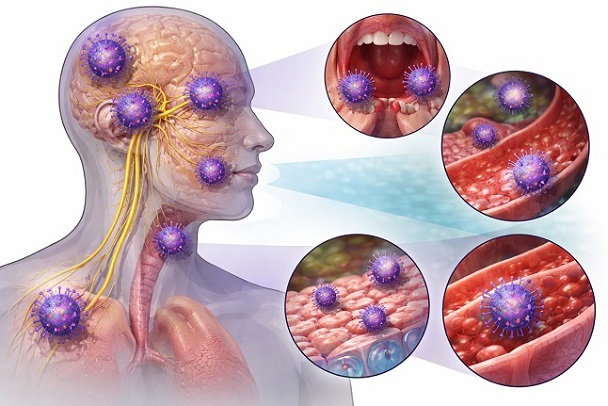 Herpes may hide across nerves, immune tissues, throat, and blood vessel linings, driving silent spread and
sudden reactivation
A Virus That Never Truly Leaves
Herpes simplex viruses (HSV-1 and HSV-2) are lifelong infections affecting billions worldwide. After the initial infection - often through the mouth, eyes, or genital areas - the virus travels along nerve pathways and becomes dormant in sensory ganglia. This state, known as latency, allows the virus to persist quietly for years.
But scientists are now uncovering a more complex picture. Viral genetic material has been detected in several non-nerve tissues, suggesting that herpes may spread and hide more widely throughout the body than once thought.
Immune System Hiding Spots
One of the most important and often overlooked findings is the role of immune tissues. Tonsils, adenoids, lymph nodes, and even circulating immune cells can carry herpes viral DNA long after the initial infection has subsided.
These tissues are especially significant because they sit at key entry and exit points of the body, such as the throat and nasal passages. Research shows that immune cells - including dendritic cells and natural killer cells - can harbor the virus in a dormant-like state. When triggered, these cells may help restart infection and contribute to viral shedding.
The Overlooked Throat and Oral Reservoir
A critical but underappreciated area is the throat region. The research highlights that herpes viruses can travel through interconnected nerve pathways and fluid drainage systems, such as the lacrimal duct, eventually reaching the tonsils and surrounding tissues.
This means that after an eye or oral infection, the virus can end up in the throat, where it may persist unnoticed. Studies in animal models have shown that infectious virus can be detected in throat-associated lymphoid tissues days after infection, and reactivation can occur from these sites under stress conditions.
This finding is extremely important because it suggests the throat may act as a hidden source of transmission, even when no visible sores are present.
Skin, Epithelial, and Endothelial Cells
Beyond immune tissues, herpes viruses can also persist in epithelial cells - the cells that line the skin and mucosal surfaces. These are the very first cells infected during exposure. In some cases, these cells retain viral DNA without producing new virus particles, creating a silent reservoir.
Keratinocytes in the skin and epithelial cells in mucosal tissues have been shown to hold viral genomes in a suppressed state. Under the right conditions, such as weakened immunity or stress, the virus can reactivate.
/>
Even more concerning is the involvement of endothelial cells, which line blood vessels. In severe cases, viral material has been detected in these cells, potentially contributing to inflammation, vascular damage, and complications such as stroke in related herpes infections.
Fibroblasts and Supporting Tissue Cells
Fibroblasts - cells that provide structural support in tissues - also play a role, although less efficiently. While they are highly permissive to active viral replication, some studies show they can retain viral DNA in a dormant-like form under certain conditions.
Although these cells are not considered primary reservoirs, their ability to harbor viral material adds another layer to the virus’s persistence strategy.
Stress and Reactivation Across Multiple Sites
Stress remains one of the most powerful triggers for herpes reactivation. Hormonal changes during stress can alter gene activity within infected cells, allowing the virus to switch from a dormant to an active state.
What is now becoming clear is that this reactivation may not be limited to nerve cells. Non-neuronal reservoirs - including immune and epithelial tissues - may also respond to stress signals, contributing to recurrent infections in different parts of the body.
Why This Changes Everything
This Medical News report underscores a crucial shift in understanding herpes biology. If the virus can persist in multiple tissue types, it becomes far more difficult to completely eliminate or control. It also explains why outbreaks can occur in unexpected locations and why transmission can happen even without visible symptoms.
Importantly, the distinction between true latency and other silent states - such as quiescent or abortive infections - is still being debated. However, many of these states share key features: the presence of viral DNA, minimal gene activity, and the potential for reactivation.
Research Gaps and the Road Ahead
Scientists emphasize that more advanced tools are needed to fully map these hidden reservoirs. Techniques like single-cell sequencing and spatial tissue analysis may help determine exactly where and how the virus persists in humans.The study was conducted by researchers from the Department of Veterinary Pathobiology, College of Veterinary Medicine, Oklahoma State University, Stillwater, Oklahoma, USA.
Conclusion
The idea that herpes viruses exist only in nerve cells is rapidly becoming outdated. Evidence now shows that immune tissues, throat-associated lymphoid structures, epithelial surfaces, endothelial linings, and even supporting tissue cells can harbor viral genomes. This widespread distribution gives the virus multiple opportunities to evade the immune system and reactivate under the right conditions.
Understanding these hidden reservoirs is essential for developing more effective treatments and preventing transmission. Future therapies may need to target the entire network of infected tissues rather than focusing solely on the nervous system, marking a major shift in how herpes infections are approached and managed.
The study findings were published in the peer reviewed Journal of Virology.
https://journals.asm.org/doi/10.1128/jvi.01723-25
For the latest research on the herpes virus, keep on logging to Thailand Medical News.
Read Also:
https://www.thailandmedical.news/articles/stds




 Share
Share
 Tweet
Tweet
 Share
Share