Nikhil Prasad Fact checked by:Thailand Medical News Team Jul 23, 2026 2 months, 1 week, 4 days, 15 hours, 51 minutes ago
Medical News: A groundbreaking new study has uncovered a hidden strategy used by SARS-CoV-2 to spread through the body, revealing that the virus can travel directly between neighboring cells using tiny bridge-like structures known as tunneling nanotubes (TNTs). The discovery not only sheds new light on how the virus spreads so efficiently but also points to an entirely new way of fighting COVID-19 by targeting the body's own cellular machinery rather than the virus itself.
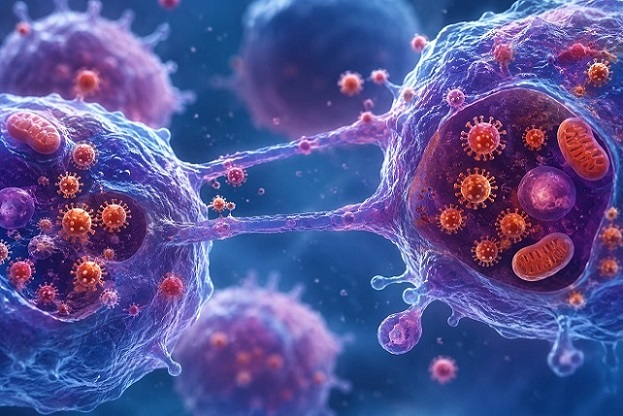 Scientists have discovered that SARS-CoV-2 uses tiny cellular tunnels to spread directly between neighboring cells,
revealing a promising new target for future COVID-19 therapies.
The research was carried out by scientists from the Centre for Virus Research, NCR Biotech Science Cluster, India; Manipal Academy of Higher Education, India; the Max von Pettenkofer Institute and Gene Centre, Munich, Germany; and Ariel University, Israel.
Hidden Cellular Tunnels Offer the Virus a Secret Route
Since the beginning of the COVID-19 pandemic, scientists have believed that SARS-CoV-2 mainly spreads by releasing virus particles from infected cells into surrounding tissues before those particles infect nearby healthy cells. However, the new study demonstrates that the virus also exploits an alternative and much more discreet pathway.
Instead of relying only on free-floating virus particles, SARS-CoV-2 creates microscopic tube-like bridges called tunneling nanotubes that physically connect one cell to another. These nanotubes are made from actin, a protein that forms part of the cell's internal framework and helps maintain its shape and movement.
This
Medical News report highlights how these tiny bridges enable the virus to move directly between cells, potentially allowing it to avoid antibodies and other immune defenses that normally attack viruses outside cells.
Some Variants Built Much Larger Networks
The researchers compared the original Wuhan-Hu-1 strain with the Delta and Omicron BA.1 variants using epithelial cells, which line the respiratory tract and are among the first cells infected after exposure to the virus.
Although all three variants produced tunneling nanotubes, the Delta variant generated substantially more of these structures. It also triggered the formation of extensive filopodia—thin finger-like projections—and highly branched TNT networks that connected multiple neighboring cells.
The larger and more complex these cellular bridges became, the easier it appeared for the virus to spread directly from one infected cell to surrounding healthy cells. The researchers believe this extensive remodeling of the cell's internal skeleton may help explain why certain variants displayed much greater transmissibility and caused more severe disease than others.
The Virus Hijacks the Cell's Internal Transport System
Using high-resolution confocal microscopy and ultrastructural imaging, the scient
ists made another remarkable discovery.
The tunneling nanotubes were transporting much more than viral material. They also carried mitochondria, the structures responsible for producing energy inside cells, and lysosomes, which are involved in waste disposal, recycling cellular materials, and regulating immune responses.
This suggests that SARS-CoV-2 is taking advantage of the cell's natural transport network to move important cellular components between infected and neighboring cells. By transferring these organelles, the virus may help infected cells generate more energy, maintain viral replication for longer periods, and improve its ability to survive within tissues.
The findings reveal that SARS-CoV-2 manipulates host cells in a far more sophisticated manner than previously appreciated.
Scientists Successfully Blocked the Cellular Bridges
The research team also investigated whether these nanotubes could be prevented from forming.
They found that blocking a cellular protein known as Cdc42, which controls actin remodeling, dramatically reduced the development of tunneling nanotubes. Likewise, inhibiting another important signaling molecule called calcium/calmodulin-dependent protein kinase II (CaMKII) with the experimental compound KN-93 also disrupted nanotube formation.
These results confirm that SARS-CoV-2 depends heavily on the host cell's cytoskeleton to construct these microscopic bridges. Because these pathways belong to human cells rather than the virus itself, they represent promising therapeutic targets.
Unlike conventional antiviral drugs that attack viral proteins and often become less effective as the virus mutates, drugs aimed at host pathways involved in TNT formation may work against multiple variants while reducing the risk of antiviral resistance.
A New Direction for Future COVID-19 Therapies
The study provides compelling evidence that tunneling nanotubes are an important but previously overlooked mechanism that SARS-CoV-2 uses to spread directly between epithelial cells. The researchers also showed that these nanotubes transport key cellular organelles that may support viral survival and replication, revealing a much deeper level of virus-host interaction than previously recognized. Most importantly, the successful disruption of TNT formation by targeting host proteins such as Cdc42 and CaMKII suggests that future therapies could slow viral spread without directly attacking the virus itself. Although additional animal studies and clinical trials will be needed, these findings open an exciting new avenue for developing broad-spectrum antiviral treatments that may remain effective even as SARS-CoV-2 continues to evolve.
The study findings were published in the peer reviewed journal: The International Journal of Biochemistry & Cell Biology.
https://www.sciencedirect.com/science/article/abs/pii/S1357272526001068
For the latest COVID-19 news, keep on logging to Thailand
Medical News.
Read Also:
https://www.thailandmedical.news/articles/coronavirus




 Share
Share
 Tweet
Tweet
 Share
Share

































