Nikhil Prasad Fact checked by:Thailand Medical News Team Aug 08, 2026 1 month, 3 weeks, 5 days, 15 hours, 46 minutes ago
Thailand Medical Researchers have reported promising findings showing that an automated urine analysis measurement could help doctors determine whether blood found in urine originates from diseases affecting the kidney’s filtering structures. The approach could be particularly useful in hospitals where experienced specialists in microscopic urine examination are not readily available.
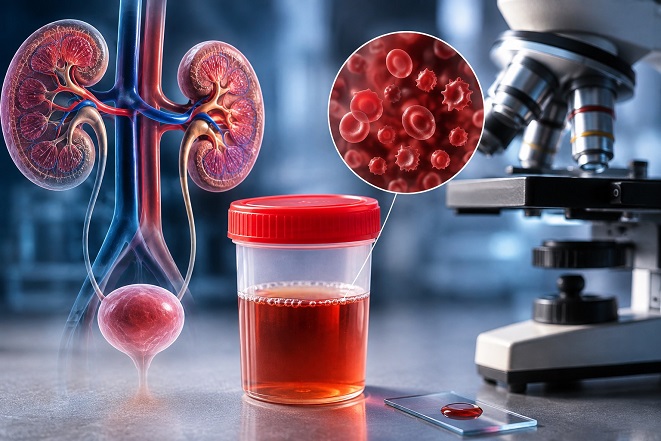 Thailand Medical Researchers found that automated urinary red blood cell distribution analysis could help identify glomerular
hematuria with high sensitivity and specificity
The research focused on glomerular hematuria, which occurs when red blood cells enter the urine because of abnormalities involving the glomeruli—the tiny filtering structures inside the kidneys. Distinguishing this from bleeding caused by kidney stones, urinary tract cancers, bladder disorders or urinary obstruction is important because the underlying diseases and subsequent investigations can be very different.
Researchers And Institutions Involved
The
Thailand Medical researchers were from the Division of Nephrology, Department of Medicine, Faculty of Medicine Siriraj Hospital, Mahidol University, Bangkok, Thailand, and the Department of Clinical Pathology, Faculty of Medicine Siriraj Hospital, Mahidol University, Bangkok, Thailand.
Automated Analysis Reveals a Striking Difference
The study involved 201 adults with blood in their urine. Of these, 101 had glomerular disease confirmed by kidney biopsy, while 100 had established non-glomerular causes determined through clinical assessment, imaging, urological evaluation and, where available, pathology.
Researchers tested a measurement called urinary red blood cell distribution (URD) produced using the Sysmex UF-5000 automated urine analyzer. URD reflects differences in the size and characteristics of red blood cells present in urine.
The difference between the groups was substantial. Average URD was 66.3 percent among patients with glomerular hematuria, compared with just 12.6 percent in patients with non-glomerular hematuria.
A 25 Percent Threshold Delivered High Accuracy
The researchers determined that a URD level of 25 percent or higher was the optimal threshold. At this level, the measurement achieved 91.1 percent sensitivity and 89.0 percent specificity for identifying glomerular hematuria.
In practical terms, high sensitivity means the test successfully identified most patients whose hematuria was associated with glomerular disease, while high specificity means it correctly classified most patients whose bleeding originated from non-glomerular causes.
Importantly, this Medical News report notes that URD remained independently associated with glomerular hematuria even after researchers adjusted for age, sex, diabetes, malignancy, kidney function and urinary protein levels. A URD of at least 25 percent was associated with markedly increased odds of glomerular hematuria.
Strong Performance Across Different Ki
dney Diseases
The finding was not limited to one kidney disorder. Sensitivity ranged from 85 to 100 percent across major biopsy-confirmed diseases, including IgA nephropathy, lupus nephritis, pauci-immune glomerulonephritis, focal segmental glomerulosclerosis and membranous nephropathy.
URD also outperformed technician-performed microscopy for sensitivity, 91.1 versus 60.4 percent, while its overall diagnostic performance was comparable with microscopy performed by a nephrology fellow. This is important because conventional microscopic assessment can vary according to the examiner’s training and experience.
Conclusions
The findings suggest automated URD measurement could provide doctors with a fast and standardized additional method for identifying glomerular hematuria, particularly where expert urine microscopy is unavailable. However, the researchers caution that automated analysis should complement rather than replace expert microscopy. The study was conducted at a single center, and larger multicenter investigations are needed to externally validate the proposed 25 percent threshold before widespread clinical implementation.
The study findings were published in the peer reviewed journal: Diagnostics.
https://www.mdpi.com/2075-4418/16/16/2491
Read Also:
https://www.thailandmedical.news/articles/thailand-medical
https://www.thailandmedical.news/articles/nephrology-(kidneys)




 Share
Share
 Tweet
Tweet
 Share
Share