Nikhil Prasad Fact checked by:Thailand Medical News Team Apr 17, 2026 4 months, 2 weeks, 1 day, 15 hours, 30 minutes ago
Medical News: A new scientific study is shedding fresh light on why some people develop life-threatening COVID-19 while others experience only mild symptoms. Researchers have discovered a dramatic imbalance in two key enzymes in the body, ACE and ACE2, that appears to worsen as the disease becomes more severe. This finding could help explain the biological mechanisms behind severe illness and even guide future treatments.
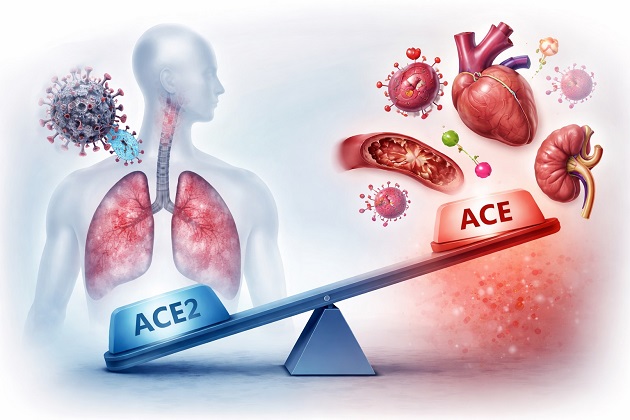 COVID severity tied to imbalance between ACE and ACE2 enzymes
The Body System Hijacked by the Virus
COVID severity tied to imbalance between ACE and ACE2 enzymes
The Body System Hijacked by the Virus
To understand the discovery, it helps to know that the human body has a system called the renin–angiotensin system (RAS), which helps regulate blood pressure, inflammation, and organ function. Two important components of this system are ACE and ACE2.
ACE promotes inflammation and constriction of blood vessels, while ACE2 has protective effects, reducing inflammation and helping blood vessels relax. In a healthy person, these two enzymes are balanced.
However, SARS-CoV-2, the virus that causes COVID-19, uses ACE2 as a doorway to enter cells. Once inside, it disrupts this balance by reducing ACE2 levels. This leaves ACE unchecked, pushing the body toward inflammation and damage.
Study Reveals Clear Pattern Across Severity Levels
The study analyzed 224 COVID-19 patients and grouped them based on disease severity, ranging from asymptomatic to critically ill. Blood samples were taken to measure ACE and ACE2 levels.
Researchers from Kuwait University, Hamad Medical Corporation in Qatar, and Qatar University found a striking pattern. As the disease became more severe, ACE2 levels dropped sharply, while ACE levels increased significantly.
Patients with mild illness still had relatively higher ACE2 levels, but those in critical condition had extremely low levels, sometimes nearly undetectable. At the same time, ACE levels rose steadily, especially in severe and ICU patients.
This imbalance created a high ACE/ACE2 ratio, which strongly correlated with worsening disease.
What Happens Inside the Body
As ACE2 levels fall, the body loses its ability to control inflammation. Meanwhile, rising ACE increases the production of angiotensin II, a molecule that promotes inflammation, blood vessel tightening, and tissue damage.
This
Medical News report highlights that this imbalance can trigger a cascade of harmful effects including lung injury, blood clotting problems, and multi-organ damage.
The study also found that severe patients had other alarming changes such as high inflammatory markers, low lymphocyte counts, kidney dysfunction, and increased clotting factors, all of which are signs of a body under extreme stress.
A Potential Biomarker for Predicting Severity
One of the most important findings was the ACE/ACE2 ratio. This ratio increased dramatically as p
atients became sicker.
For example, patients with no symptoms had very low ratios, while critically ill patients showed extremely high values. This suggests that the ratio could be used as a simple marker to predict how severe a patient’s condition might become.
Researchers believe that combining this ratio with other clinical indicators could help doctors identify high-risk patients earlier and provide more targeted care.
Why This Discovery Matters
The findings offer a deeper understanding of how COVID-19 damages the body beyond just viral infection. It shows that the virus disrupts a key regulatory system, tipping the balance toward inflammation and organ injury.
This insight could also open the door to new treatments aimed at restoring balance in the RAS system, either by boosting ACE2 activity or limiting the harmful effects of ACE.
Conclusion
This study provides compelling evidence that severe COVID-19 is not just caused by the virus itself but by a dangerous imbalance in the body’s own regulatory systems. The sharp decline in ACE2 combined with rising ACE levels creates a perfect storm of inflammation, blood vessel damage, and organ failure. The ACE/ACE2 ratio emerges as a powerful indicator of disease progression and may become a valuable tool in clinical settings. While more research is needed, these findings bring scientists one step closer to understanding - and potentially controlling - the most severe outcomes of COVID-19.
The study findings were published in the peer reviewed journal: Viruses.
https://www.mdpi.com/1999-4915/18/4/465
For the latest COVID-19 news, keep on logging to Thailand
Medical News.
Read Also:
https://www.thailandmedical.news/articles/coronavirus




 Share
Share
 Tweet
Tweet
 Share
Share

































