Nikhil Prasad Fact checked by:Thailand Medical News Team Dec 07, 2025 9 months, 4 weeks, 5 hours, 32 minutes ago
Medical News: A major new study by researchers from Celcuity Inc., Minneapolis USA is offering fresh hope for men battling advanced prostate cancer that no longer responds to hormone-blocking treatments. Their work shows that combining two drugs—gedatolisib, which targets the PI3K/AKT/mTOR cell-survival pathway, and darolutamide, a well-known androgen-blocking therapy—can work together to stop cancer cells from growing even after they have already developed resistance. This
Medical News report highlights what the scientists found and why it matters for future treatments.
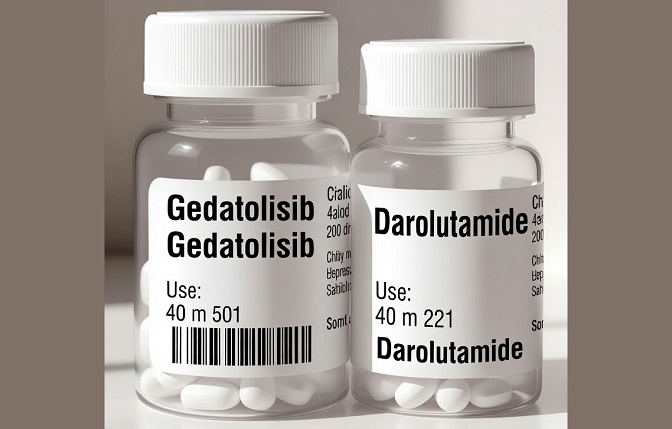 New research shows a two-drug combination can overcome resistance in advanced prostate cancer
Why Prostate Cancer Becomes Resistant
New research shows a two-drug combination can overcome resistance in advanced prostate cancer
Why Prostate Cancer Becomes Resistant
Prostate cancer depends heavily on male hormones called androgens. Drugs like darolutamide normally block this hormonal signal, slowing tumor growth. However, many cancers eventually adapt, finding new ways to grow even without androgens. One common escape route is the PAM pathway, a powerful survival and metabolism system inside the cell. When this pathway becomes overactive—often due to loss of a gene called PTEN—cancer cells become harder to kill.
A Dual Approach That Hits Cancer from Two Sides
The research team found that combining gedatolisib and darolutamide stopped the growth of multiple prostate cancer cell types, including those with and without PTEN mutations. In many laboratory models, the combination acted far more strongly than either drug alone. The two drugs together shut down both the androgen receptor pathway and the PAM pathway at the same time—something the cancer cells could not easily overcome.
Key Study Findings
The scientists discovered several important effects when both drugs were used simultaneously:
• Cancer cells were pushed into a “shutdown mode,” unable to progress through the cell cycle.
• The combination triggered apoptosis, a form of programmed cell death, much more strongly than either drug alone.
• Cancer metabolism was disrupted as the drugs reduced glycolysis, lactate production, and lipid synthesis—cutting off the fuel supply tumors rely on.
• The most striking result was seen in cancer cells already adapted to long-term darolutamide treatment. Even those resistant cells became sensitive again when gedatolisib was added, demonstrating potential use in hard-to-treat cases.
What These Results Suggest
These findings indicate that blocking both androgen signaling and the PAM pathway together could offer a more durable treatment option for castration-resistant prostate cancer. The study also suggests that the combination may work regardless of PTEN status, meaning a broader group of patients could benefit. The conclusion is that this dual-drug strategy may overcome several forms of resistance at once and could become a promis
ing addition to future clinical practice.
The study findings were published in the peer reviewed International Journal of Molecular Sciences.
https://www.mdpi.com/1422-0067/26/24/11810
For the latest on Prostate Cancer, keep on logging to Thailand
Medical News.
Read Also:
https://www.thailandmedical.news/articles/cancer




 Share
Share
 Tweet
Tweet
 Share
Share

































