Nikhil Prasad Fact checked by:Thailand Medical News Team Jul 18, 2026 1 month, 2 weeks, 1 day, 9 hours, 1 minute ago
Medical News: Long COVID continues to puzzle scientists as millions of people worldwide struggle with lingering symptoms months after recovering from COVID-19. Now, researchers have uncovered compelling evidence that the condition may involve damage to nerve fibers supplying the stomach, providing a possible explanation for persistent digestive problems, fatigue, dizziness, and other symptoms linked to autonomic dysfunction.
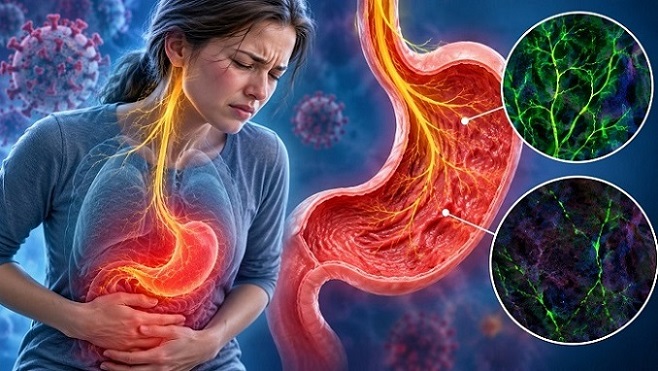 Researchers uncover hidden damage to vagal nerve fibers supplying the stomach lining, offering new clues to the
persistent symptoms of Long COVID
The study was conducted by researchers from the Department of Internal Medicine at San Francesco Hospital, Telese Terme; the Department of Neurosciences, Reproductive Sciences and Odontostomatology and the Department of Translational Medical Sciences at the University of Naples Federico II; the Neurology Department and Skin Biopsy Laboratory at Istituti Clinici Scientifici Maugeri IRCCS, Telese Terme; the Vascular and Interventional Radiology Unit at the University of Salerno; and the Unit of Geriatrics at Policlinico Universitario Campus Bio-Medico di Roma, Italy.
Researchers Discover Hidden Nerve Damage
The vagus nerve is one of the body's most important nerves, helping regulate digestion, heart rate, immune responses, and communication between the brain and internal organs. Although previous research suggested reduced vagal activity in Long COVID patients, direct structural evidence of damage had been lacking.
To investigate, the researchers studied 12 people diagnosed with Long COVID and compared them with eight individuals who had never been infected with SARS-CoV-2. During routine gastroscopy, tissue samples were collected from two regions of the stomach—the fundus and antrum. Using advanced immunohistochemical techniques, the team measured the density of total nerve fibers and cholinergic nerve fibers, which largely reflect vagal parasympathetic innervation of the stomach lining. Heart rate variability testing was also performed to assess autonomic nervous system function.
Dramatic Loss of Nerve Fibers in the Stomach Lining
The results revealed a substantial reduction in nerve fibers within the stomach lining of Long COVID patients.
Overall nerve density in the fundus fell from 3.9 to 2.1 nm/µm³, while nerve density in the antrum dropped from 3.9 to 1.9 nm/µm³ compared to healthy controls. Even more striking was the marked reduction in cholinergic nerve fibers, indicating significant impairment of the vagal nerve supply to the stomach.
Microscopic examination showed that healthy stomach tissue contained an extensive network of nerve fibers extending through the gastric mucosa. In contrast, tissue from Long COVID patients displayed sparse, fragmented nerve fibers, with many failing to extend into the upper layers of the stomach lining. Importantly, the stomach appeared normal during endoscopic examination, meaning this hidden nerve damage could only be detected through specialized laboratory analysis.
This
nt-size:16px">Medical News report highlights the first in vivo structural evidence that Long COVID is associated with damage affecting vagal cholinergic nerve fibers supplying the stomach lining.
Damage Closely Linked to Autonomic Dysfunction
The structural changes were closely linked to abnormalities in autonomic nervous system function.
Patients with greater nerve fiber loss also showed significantly impaired heart rate variability, reflecting reduced parasympathetic activity and an imbalance between sympathetic and parasympathetic nervous system control. The damaged nerve supply also correlated with higher blood levels of NT-proBNP, a marker of cardiac stress, and elevated D-dimer levels, which are associated with abnormal blood clotting.
Many of the participants experienced symptoms consistent with autonomic dysfunction, including orthostatic intolerance, gastrointestinal complaints, excessive sweating, and persistent fatigue. Interestingly, skin biopsies showed no significant loss of sensory nerve fibers, suggesting that Long COVID may selectively target autonomic nerve pathways supplying internal organs rather than causing generalized nerve damage throughout the body.
New Clues About Long COVID
The researchers believe the findings support the theory that SARS-CoV-2 may injure vagal nerve pathways that normally regulate the body's cholinergic anti-inflammatory response. Loss of this protective nerve signaling could allow chronic inflammation to persist, contributing to many of the long-lasting symptoms experienced by Long COVID patients.
The discovery also raises the possibility that treatments designed to restore vagal function, including vagus nerve stimulation or therapies that enhance cholinergic signaling, could eventually become new treatment options, although larger clinical studies will be needed before such approaches can be recommended.
Conclusion
This study provides the strongest evidence to date that Long COVID is associated with structural damage to vagal cholinergic nerve fibers supplying the stomach lining, rather than merely causing functional disturbances. The close relationship between nerve fiber loss, impaired autonomic regulation, cardiovascular stress markers, and persistent symptoms suggests that vagal nerve injury may be a central mechanism driving Long COVID in at least a subset of patients. Larger studies will now be essential to confirm these findings and determine whether therapies aimed at restoring vagal function can improve long-term outcomes.
The study findings were published in the peer reviewed International Journal of Infectious Diseases.
https://www.ijidonline.com/article/S1201-9712(26)00608-9/fulltext
For the latest on Long COVID, keep on logging to Thailand
Medical News.
Read Also:
https://www.thailandmedical.news/articles/long-covid
https://www.thailandmedical.news/articles/coronavirus




 Share
Share
 Tweet
Tweet
 Share
Share