German Study in Frontiers Journal Warns That Aging and Long COVID Awakens Dormant Viruses and Fuels Chronic Inflammation
Nikhil Prasad Fact checked by:Thailand Medical News Team Aug 07, 2026 1 month, 4 weeks, 4 hours, 36 minutes ago
Researchers are proposing a new way of understanding why aging and long COVID may trigger persistent health problems, suggesting that dormant viruses hiding inside the body could become active again when the body's natural defense systems begin to weaken. The new review introduces an interconnected biological model that may explain why chronic inflammation, immune dysfunction, and viral reactivation often appear together in older adults and in people living with long COVID.
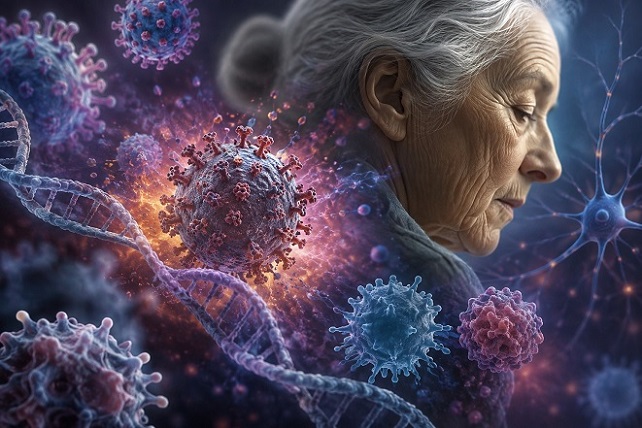 Scientists propose that weakening body resilience during aging and long COVID may reactivate dormant viruses,
creating a self-perpetuating cycle of chronic inflammation
The research was conducted by scientists Ludmila Müller, Svetlana Di Benedetto, and Viktor Müller from the Max Planck Institute for Human Development, Center for Lifespan Psychology, Berlin, Germany.
A New View of Viral Dormancy
Most people carry cytomegalovirus (CMV), a member of the herpesvirus family, for life. Normally, the immune system keeps the virus inactive. However, the researchers argue that this balance depends on a much broader network than previously believed. They describe these interconnected systems as "host-virus resilience networks," which include the immune system, metabolism, mitochondria, stress-response pathways, epigenetic regulation, and tissue barriers.
When these systems remain healthy, CMV stays dormant. But as people age or develop long COVID, these protective networks may gradually lose efficiency. Instead of seeing viral reactivation as a simple infection problem, the researchers suggest it may be a sign that the body's overall resilience has started to fail.
Chronic Inflammation Creates a Dangerous Cycle
The review also introduces the concept of "viral inflammaging circuits." According to this model, chronic low-grade inflammation weakens the body's ability to suppress dormant viruses. Once viruses such as CMV reactivate, they further stimulate inflammation, creating a vicious cycle that becomes increasingly difficult to stop.
This Thailand
Medical News report highlights that the researchers believe CMV should be viewed not only as a marker of immune aging but also as a possible contributor to it. Lifelong viral persistence continually stimulates immune cells, forcing the immune system to remain active for decades. Over time, this may exhaust immune cells, reduce their flexibility, and increase inflammatory activity throughout the body.
Why Long COVID May Be Part of the Same Process
The scientists note that long COVID shares many biological features with aging, including persistent immune activation, mitochondrial dysfunction, endothelial damage, metabolic disturbances, and chronic inflammation. These overlapping changes may weaken the body's resilience networks and make dormant viruses more likely to reactivate.
The review also discusses evidence linking long COVID with the reactivation of lat
ent herpesviruses, including CMV and Epstein-Barr virus. While researchers stress that more studies are needed to prove cause and effect, they suggest that viral reactivation may reflect widespread biological stress rather than isolated viral events.
Effects May Extend Throughout the Body
The proposed model suggests these self-reinforcing inflammatory circuits could affect multiple organs. In the brain, they may contribute to neuroinflammation and cognitive decline. In blood vessels, they may worsen endothelial dysfunction and cardiovascular disease. Similar processes may promote tissue degeneration, impaired regeneration, metabolic dysfunction, gut barrier disruption, and possibly contribute to autoimmune diseases and cancer-promoting environments through prolonged inflammation.
The review emphasizes that mitochondria, stress-response systems, epigenetic regulation, and tissue barriers all play important roles in preventing viral reactivation. Once these protective mechanisms deteriorate, chronic inflammatory diseases may become increasingly difficult to control.
Looking Toward Future Treatments
Rather than targeting only viruses, the researchers believe future therapies may need to restore the body's overall resilience by reducing chronic inflammation, improving metabolism, strengthening immune regulation, and preventing repeated viral reactivation. They also call for advanced multi-omics studies and systems biology approaches to identify early warning signs of resilience failure and develop therapies that interrupt these damaging biological feedback loops.
Conclusion
The review presents an innovative systems-level hypothesis that connects aging, long COVID, dormant viral infections, and chronic inflammation into one unified biological framework. Although many elements are supported by existing evidence, the proposed resilience networks and viral inflammaging circuits remain conceptual models that require further validation. If confirmed, they could fundamentally reshape how scientists understand aging-related diseases and long COVID while opening new avenues for prevention and treatment.
The study findings were published in the peer reviewed journal: Frontiers in Cellular and Infection Microbiology.
https://www.frontiersin.org/journals/cellular-and-infection-microbiology/articles/10.3389/fcimb.2026.1896480/full
Read Also:
https://www.thailandmedical.news/articles/long-covid




 Share
Share
 Tweet
Tweet
 Share
Share

































