Nikhil Prasad Fact checked by:Thailand Medical News Team Jul 05, 2026 2 months, 4 weeks, 1 day, 16 hours, 54 minutes ago
Medical News: People living with chronic kidney disease (CKD) may face a much greater risk of brain damage than previously recognized, according to a new study that uncovers an important biological connection between the kidneys, the gut, and the brain. Researchers found that harmful toxins produced by gut bacteria can accumulate when the kidneys fail, potentially damaging tiny blood vessels in the brain and contributing to memory and behavioral problems.
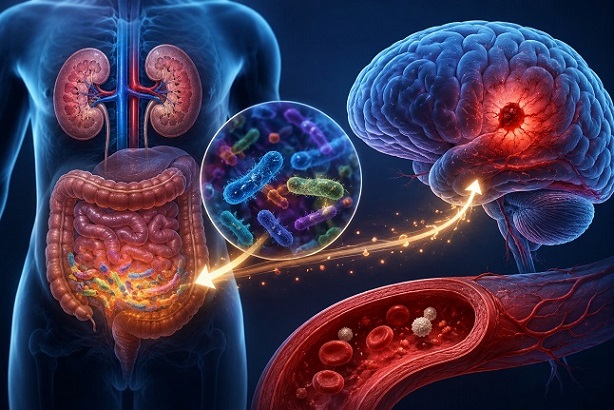 New research shows that gut-derived toxins accumulating in chronic kidney disease may contribute to brain
microbleeds and memory impairment
The study was conducted by researchers from the University of California, Irvine, Dong-A University in South Korea, the David Geffen School of Medicine at the University of California Los Angeles (UCLA), the Lundquist Institute for Biomedical Innovation at Harbor-UCLA Medical Center, and the Beckman Laser Institute and Medical Clinic.
A New Look at the Kidney-Gut-Brain Connection
The kidneys are responsible for filtering waste products from the bloodstream. As kidney function declines in CKD, waste substances that would normally be removed begin to accumulate throughout the body. Scientists have increasingly suspected that some of the most harmful of these compounds are actually produced by bacteria living in the gut.
In this study, researchers focused on three gut-derived toxins—indoxyl sulfate, p-cresyl sulfate, and trimethylamine N-oxide (TMAO). These chemicals are created when intestinal bacteria break down certain nutrients found in food. Previous studies have linked these toxins to inflammation and blood vessel damage, but their exact role in brain injury has remained unclear.
To investigate this, the research team studied mice with chronic kidney disease and also analyzed blood samples and brain scans from patients undergoing hemodialysis.
Brain Microbleeds Increased Dramatically
One of the most important discoveries was that mice with chronic kidney disease developed approximately 2.5 times more brain microhemorrhages than healthy animals.
Brain microhemorrhages, also called cerebral microbleeds, are tiny areas of bleeding caused by damage to very small blood vessels in the brain. Although these bleeds are microscopic, they have become increasingly recognized as important warning signs for cognitive decline, memory impairment, stroke, and dementia.
The researchers also found that the CKD mice became significantly less active, suggesting that kidney disease was affecting normal brain function in addition to causing physical illness.
Gut Bacteria Were the Main Source of Dangerous Toxins
To determine whether gut bacteria were responsible for producing these toxins, some mice received broad-spectrum antibiotics designed to suppress intestinal microbes.
The results clearly showed that levels of indoxyl sulfate, p-cresyl sulfate, and TMAO fell dramatically after gut bacteria were reduced. This confirmed that the gut microbiome is the major source of these circulating toxins in chronic kidney disease.
&
amp;nbsp;
The scientists also observed that male mice treated with antibiotics performed better on memory testing. Their working memory improved despite having chronic kidney disease, suggesting that reducing toxin production may help preserve certain brain functions.
This
Medical News report highlights growing evidence that protecting the gut microbiome could eventually become an important strategy for reducing neurological complications in patients with chronic kidney disease.
Diet Influenced Toxin Levels but Kidney Disease Was the Main Driver
Researchers also tested whether feeding mice a diet rich in amino acids would increase production of gut-derived toxins.
The special diet significantly increased blood levels of TMAO, although it had much smaller effects on indoxyl sulfate and p-cresyl sulfate. Despite this increase, the severity of kidney disease itself remained the strongest predictor of brain injury.
This suggests that while diet can influence toxin production, declining kidney function plays the dominant role by allowing these harmful compounds to accumulate in the bloodstream.
Gut Microbiome Changes May Be Part of the Problem
The study also revealed important changes in the gut microbiome. CKD animals showed increased levels of Lactobacillus and Ileibacterium, while antibiotic treatment dramatically altered the bacterial populations. Researchers also observed sex-specific differences in how gut bacteria responded to both diet and antibiotics.
These findings indicate that kidney disease reshapes the intestinal microbial community, which may further increase production of toxins capable of damaging blood vessels throughout the body, including those supplying the brain.
Men and Women Showed Different Risk Patterns
Another important finding involved differences between males and females. Among male mice, higher TMAO levels were strongly associated with more brain microhemorrhages and poorer movement. In female mice, however, higher levels of p-cresyl sulfate were more closely linked to brain bleeding.
These sex-specific findings suggest that different biological mechanisms may contribute to brain injury in males and females, an area the researchers believe deserves much deeper investigation.
Human Study Supports the Animal Findings
To determine whether similar processes occur in people, the researchers analyzed stored blood samples and brain MRI scans from 30 long-term hemodialysis patients.
Patients with higher TMAO levels were significantly more likely to have lobar brain microbleeds, mirroring the observations seen in the male mice. Although one unexpected finding showed an inverse relationship between indoxyl sulfate and certain microbleeds, the researchers emphasized that the relatively small patient group means additional studies involving much larger populations will be necessary before definitive conclusions can be reached.
Conclusion
This study provides strong new evidence that chronic kidney disease affects far more than the kidneys alone. It demonstrates that changes in the gut microbiome can generate harmful toxins that accumulate in the bloodstream when kidney function declines, potentially damaging delicate brain blood vessels and contributing to cognitive decline. The findings also suggest that therapies aimed at modifying gut bacteria, lowering toxin production, or reducing their harmful effects could eventually become promising approaches for protecting brain health in CKD patients. While larger clinical studies are still required, the research substantially advances understanding of the kidney-gut-brain axis and offers an important new direction for preventing neurological complications associated with chronic kidney disease.
The study findings were published in the peer reviewed International Journal of Molecular Sciences.
https://www.mdpi.com/1422-0067/27/13/6020
For the latest on chronic kidney disease and brain issues, keep on logging to Thailand
Medical News.
Read Also:
https://www.thailandmedical.news/articles/nephrology-(kidneys)




 Share
Share
 Tweet
Tweet
 Share
Share

































