Brazilian Scientists Uncover Multifaceted Role of TMPRSS2 in Viral Infections and Its Potential as a Drug Target
Nikhil Prasad Fact checked by:Thailand Medical News Team Jan 08, 2025 1 year, 8 months, 3 weeks, 5 days, 20 hours, 16 minutes ago
Medical News: The enzyme TMPRSS2 (Transmembrane Protease Serine 2) has emerged as a critical player in understanding how certain viruses, including influenza and coronaviruses, infect human cells. This
Medical News report highlights findings from researchers at the Universidade Federal do ABC (UFABC) in São Paulo, Brazil, who conducted an extensive review to examine TMPRSS2's multifaceted role in viral infections and other diseases.
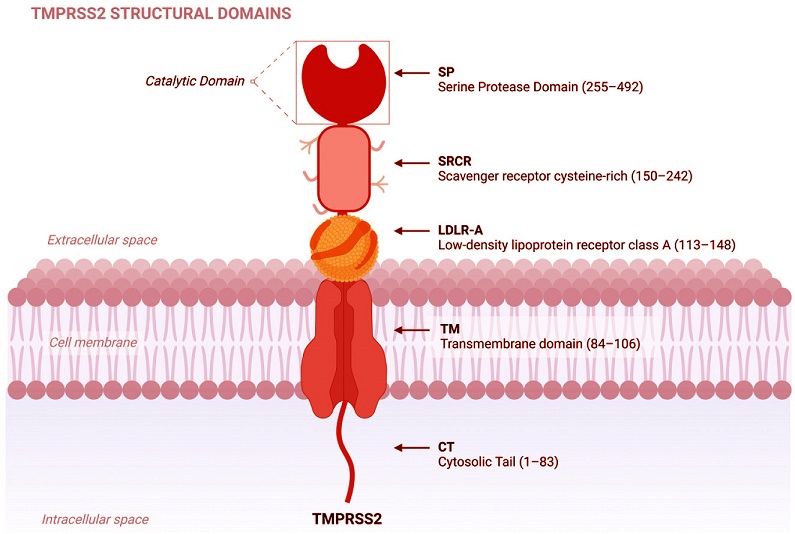 Brazilian Scientists Uncover Multifaceted Role of TMPRSS2 in Viral Infections and Its Potential as a Drug Target
TMPRSS2 structural domains: cytosolic tail, and transmembrane domain. Low-density lipoprotein receptor class A, scavenger receptor cysteine-rich, and the serine protease domain
Brazilian Scientists Uncover Multifaceted Role of TMPRSS2 in Viral Infections and Its Potential as a Drug Target
TMPRSS2 structural domains: cytosolic tail, and transmembrane domain. Low-density lipoprotein receptor class A, scavenger receptor cysteine-rich, and the serine protease domain
TMPRSS2 is primarily known for facilitating the entry of viruses into human cells. It does so by activating viral proteins, such as the spike protein in SARS-CoV-2, enabling the virus to fuse with host cell membranes.
How TMPRSS2 Contributes to Viral Infections
The TMPRSS2 enzyme activates viral proteins by cleaving them, a process essential for many viruses to infect human cells. In influenza viruses, TMPRSS2 is responsible for cleaving hemagglutinin, a protein that enables the virus to attach to and invade host cells. Similarly, TMPRSS2 activates the spike protein of SARS-CoV-2, the virus responsible for COVID-19, facilitating its entry into human respiratory cells.
Research highlights that TMPRSS2 is predominantly expressed in tissues such as the lungs, prostate, intestines, and heart. Its expression can be regulated by androgenic hormones, which may partly explain why COVID-19 affects men more severely than women. Genetic variations in TMPRSS2 among different populations may also influence susceptibility to viral infections, underscoring the need for diverse and inclusive research.
TMPRSS2 and Other Health Conditions
Beyond viral infections, TMPRSS2 has been linked to other health issues, including cancer. For instance, its role in prostate cancer is well-documented, and elevated levels of TMPRSS2 have been observed in certain types of cancerous tissues, such as those in the lungs and liver. This enzyme’s involvement in such a broad spectrum of diseases makes it a compelling target for drug development.
Targeting TMPRSS2 for Therapies
The study reviewed multiple TMPRSS2 inhibitors currently being developed or tested. These inhibitors are designed to block the enzyme’s activity, potentially stopping viruses from entering human cells. Drugs like camostat mesylate and nafamostat mesylate have shown promise in laboratory studies and clinical trials. Camostat mesylate, originally developed to treat pancreatitis, has demonstrated potential in reducing the severity of COVID-19 symptoms, though its ability to lower viral load remains inconclusive.
<
strong>Key Findings from the Study
The researchers identified that TMPRSS2 plays a pivotal role in facilitating the replication of influenza viruses and SARS-CoV-2. Studies using genetically modified animal models showed that removing TMPRSS2 significantly reduced viral replication and disease severity. For example:
-TMPRSS2-deficient mice infected with influenza viruses showed reduced viral spread and minimal symptoms.
Similar experiments with SARS-CoV-2 demonstrated lower viral loads and less lung damage in TMPRSS2-deficient animals.
The researchers also examined genetic variations of TMPRSS2 across populations. Certain gene mutations, such as the rs12329760 variant, have been associated with different outcomes in COVID-19 patients, ranging from mild symptoms to severe disease. This highlights the enzyme's potential role as a genetic marker for assessing disease risk.
Future Implications
The insights into TMPRSS2’s functions and its inhibitors open up possibilities for developing targeted therapies. By blocking TMPRSS2, researchers aim to prevent viruses from hijacking human cells. This approach is particularly promising because it targets the host rather than the virus, reducing the chances of drug resistance.
However, challenges remain. Not all viruses depend on TMPRSS2 to the same extent, and its inhibition might have unintended effects on other biological processes. Therefore, further research is needed to fine-tune these therapies and ensure their safety and effectiveness.
Conclusions
The study by UFABC researchers underscores TMPRSS2’s significance as a therapeutic target for viral infections, particularly influenza and COVID-19. Their findings reveal that targeting this enzyme can significantly reduce the severity of these diseases. Moreover, the enzyme’s involvement in other health conditions, including cancer, adds to its potential as a broader therapeutic target.
Developing inhibitors for TMPRSS2 is a promising avenue for addressing not only the current pandemic but also future viral outbreaks. By understanding and targeting TMPRSS2, researchers hope to pave the way for innovative treatments that can save lives and mitigate the impact of viral diseases.
The study findings were published in the peer-reviewed journal: Biomolecules.
https://www.mdpi.com/2218-273X/15/1/75
For the latest Research on Viruses, keep on logging to Thailand
Medical News.
Read Also:
https://www.thailandmedical.news/news/covid-19-news-taiwanese-study-finds-that-phytochemicals-from-anisomeles-indica-suppress-the-protein-expression-of-ace2-and-tmprss2
https://www.thailandmedical.news/news/breaking-research-reveals-that-tmprss2,-an-endothelial-cell-surface-protein-that-is-involved-in-sars-cov-2-cell-entry,-is-also-a-tumor-suppressor
https://www.thailandmedical.news/news/covid-19-research-john-hopkins-study-shows-that-obesity-upregulates-ace2-and-tmprss2-expression
https://www.thailandmedical.news/news/japanese-study-reveals-that-omicron-variants-prefer-endosomal-cathepsin-l-for-viral-entry-over-tmprss2
https://www.thailandmedical.news/news/quercetin-is-able-to-reduce-expression-of-ace2-and-tmprss2-but-does-not-prevent-sars-cov-2-from-entering-lung-cells




 Share
Share
 Tweet
Tweet
 Share
Share

































