Polish Study Finds That Insulin Resistance in the Brain May Drive Alzheimer’s Disease
Nikhil Prasad Fact checked by:Thailand Medical News Team Jan 28, 2026 8 months, 1 week, 2 hours, 44 minutes ago
Medical News: Insulin is commonly linked with diabetes and blood sugar control, but growing scientific evidence now shows that this hormone also plays a vital role inside the human brain. New research is revealing that when insulin signaling in the brain becomes impaired, it may contribute directly to the development and progression of Alzheimer’s disease, a condition affecting millions worldwide. This
Medical News report highlights findings from researchers who explored how disrupted insulin activity in the brain may accelerate memory loss and brain degeneration.
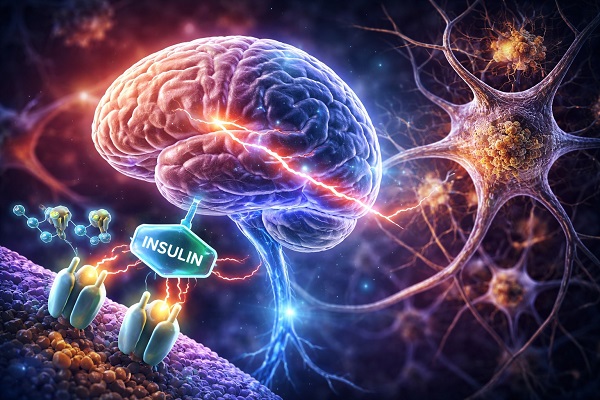 Disrupted insulin signaling in the brain may fuel memory loss and toxic protein buildup linked to Alzheimer’s disease
Researchers and Institutions Involved
Disrupted insulin signaling in the brain may fuel memory loss and toxic protein buildup linked to Alzheimer’s disease
Researchers and Institutions Involved
The study was conducted by scientists from the Chair and Department of General Biology and Parasitology at the Medical University of Warsaw in Warsaw Poland. The research team included Monika Pliszka and Professor Leszek Szablewski, both experts in molecular biology and metabolic disorders.
Why Insulin Matters Inside the Brain
For decades, the brain was mistakenly believed to be insensitive to insulin. However, modern research has shown that insulin receptors are widely present in brain regions responsible for learning, memory, and decision making, including the hippocampus and cerebral cortex. Insulin helps brain cells use glucose efficiently, supports communication between neurons, and protects nerve cells from damage. It also plays a role in clearing toxic proteins that accumulate with age.
What Happens When Brain Insulin Resistance Develops
Brain insulin resistance occurs when nerve cells no longer respond properly to insulin signals. The study explains that this condition reduces the brain’s ability to use glucose for energy, leading to weakened synapses, impaired memory formation, and slower thinking. Over time, insulin resistance disrupts critical signaling pathways such as PI3K AKT and MAPK, both essential for neuron survival and memory processing.
Connection to Amyloid Plaques and Tau Tangles
One of the most striking findings discussed is how insulin resistance promotes hallmark Alzheimer’s pathology. Impaired insulin signaling reduces the breakdown of beta amyloid proteins, allowing them to accumulate into plaques. At the same time, insulin resistance activates enzymes like GSK 3 beta that cause excessive phosphorylation of tau protein, leading to neurofibrillary tangles. Together, these changes accelerate neuron loss and cognitive decline.
Alzheimer’s as a Brain Specific Diabetes
The researchers highlight mounting evidence that Alzheimer’s disease may represent a form of diabetes that primarily affects the brain, sometimes referred to as Type 3 diabetes. Brain insulin resistance appears years before memory symptoms emerge, suggesting it could be an early driver rather than a consequence of the disease.
/>
Implications for Treatment and Prevention
The study also reviews emerging treatment strategies. Lifestyle measures such as physical activity and diets that improve insulin sensitivity may help protect brain function. Experimental therapies including intranasal insulin, metformin, and GLP 1 receptor drugs show promise in improving memory and reducing toxic protein buildup, though larger clinical trials are still needed.
Conclusions
The findings strongly suggest that impaired insulin signaling plays a central role in Alzheimer’s disease development. By disrupting energy metabolism, increasing toxic protein accumulation, and damaging synaptic communication, brain insulin resistance accelerates cognitive decline. Targeting insulin pathways early may offer new hope for slowing or preventing Alzheimer’s progression and could reshape how the disease is diagnosed and treated in the future.
The study findings were published in the peer reviewed International Journal of Molecular Sciences.
https://www.mdpi.com/1422-0067/27/3/1222
For the latest on Alzheimer’s Disease, keep on logging to Thailand
Medical News.
Read Also:
https://www.thailandmedical.news/articles/alzheimer,-dementia-
https://www.thailandmedical.news/articles/diabetes




 Share
Share
 Tweet
Tweet
 Share
Share