Nikhil Prasad Fact checked by:Thailand Medical News Team Mar 18, 2026 6 months, 2 weeks, 2 days, 23 hours, 27 minutes ago
Medical News: A new scientific investigation has uncovered a surprising genetic driver behind liver damage, while also pointing to a natural compound found in everyday foods as a possible future therapy.
The research offers fresh insight into how aging-related genes inside the liver may quietly influence disease progression long before noticeable symptoms appear.
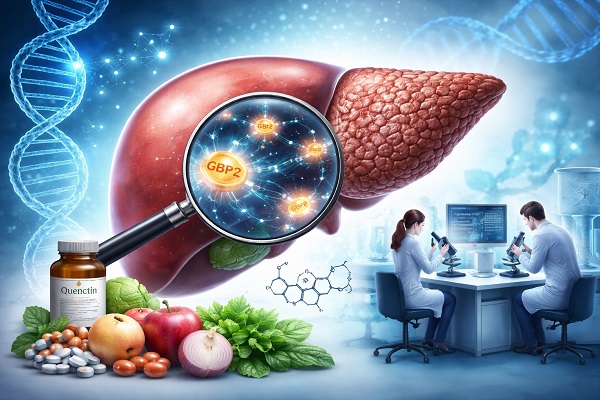 Key gene discovery reveals new pathway driving liver scarring and potential natural treatment
Scientists Pinpoint a Powerful Gene
Key gene discovery reveals new pathway driving liver scarring and potential natural treatment
Scientists Pinpoint a Powerful Gene
Researchers from the School of Pharmacy at Chengdu University in China and the Institute for Technology-Inspired Regenerative Medicine at Maastricht University in the Netherlands examined a group of genes connected to liver aging. Their aim was to determine whether these genes actually cause liver disease or simply appear after damage has already begun.
Their analysis highlighted one standout gene called GBP2. Higher levels of this gene were strongly linked to an increased risk of liver fibrosis, a condition where scar tissue builds up in the liver and disrupts its normal function.
This finding suggests that GBP2 is not just present during disease but may actively drive it forward.
A Complex Role Inside the Body
What makes GBP2 particularly interesting is that it does not behave the same way in all conditions.
While it increases the risk of fibrosis and cirrhosis, it appears to reduce the likelihood of a specific type of liver cancer known as cholangiocarcinoma. This contrast shows that the gene’s role depends heavily on the disease environment and stage.
Such dual behavior helps explain why liver diseases can progress in unpredictable ways and why treatments often produce mixed results.
Immune System Connections
The researchers also explored how GBP2 interacts with the immune system, revealing important insights into how liver damage develops.
In fibrosis, higher GBP2 levels were linked to reduced activity of macrophages, which are immune cells responsible for clearing damaged tissue and preventing excessive scarring. When these cells are less active, scar tissue can accumulate more rapidly.
However, in cancer cases, GBP2 showed the opposite effect. It was associated with increased activity of T cells and natural killer cells, which play a critical role in attacking abnormal or cancerous cells.
This shift suggests that GBP2 can reshape immune responses in different ways, either promoting disease progression or helping to limit it.
Natural Compound Offers Hope
Another important part of the study focused on quercetin, a natural compound found in fruits, vegetables, and traditional herbal remedies.
Using advanced computer modeling, the researchers discovered that quercetin may influence GBP2 indirectly through another protein called IRF1.
By affecting this pathway, quercetin could help reduce liver aging and slow the development of fibrosis.
r />
This Medical News report highlights how natural compounds with multiple biological effects may offer promising alternatives or additions to current treatments, which often come with limitations and side effects.
No Reverse Effect Found
The study also confirmed that liver disease does not appear to trigger changes in GBP2 levels.
Instead, GBP2 seems to act as a driving force behind disease progression, strengthening its potential as a target for early intervention and treatment strategies.
Conclusion
Overall, the findings reveal that liver aging is not just a passive process but is actively controlled by specific genes such as GBP2. This gene appears to influence both scarring and immune responses, making it a central player in liver disease progression. The discovery that quercetin may regulate this pathway indirectly adds an exciting layer of potential treatment options. While further clinical research is needed, these insights bring scientists closer to developing more targeted and effective therapies that could slow or even prevent serious liver conditions.
The study findings were published in the peer reviewed journal: Biomedicines.
https://www.mdpi.com/2227-9059/14/3/701
For the latest on Liver Fibrosis, keep on logging to Thailand Medical News.
Read Also:
https://www.thailandmedical.news/articles/gastroenterology
https://www.thailandmedical.news/articles/coronavirus




 Share
Share
 Tweet
Tweet
 Share
Share

































