Nikhil Prasad Fact checked by:Thailand Medical News Team Feb 22, 2026 7 months, 1 week, 2 days, 23 hours, 38 minutes ago
Medical News: Scientists Uncover a New Weakness in SARS-CoV-2
Researchers have discovered that SARS-CoV-2 may rely heavily on a human enzyme called PAD4 to help it replicate and trigger damaging inflammation. The study, conducted by scientists from the University of Turin Medical School, University of Padua, University of Milan, University of Eastern Piedmont, Veneto Institute of Oncology IOV-IRCCS, UMass Medical School in the United States, and Padua University Hospital, suggests that blocking this enzyme could significantly weaken the virus while also calming harmful immune responses.
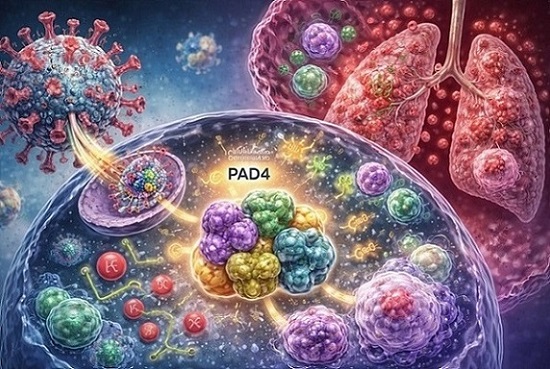 Blocking PAD4 shows promise in reducing COVID-19 replication and inflammation in new research
COVID-19 continues to cause serious health problems worldwide, not only during acute infection but also through lingering complications. Scientists have been searching for treatment approaches that can both suppress viral growth and reduce excessive inflammation, and this
Medical News report highlights a discovery that may offer exactly that dual benefit.
How PAD4 helps the virus
PAD4 belongs to a family of enzymes responsible for a process called citrullination, which changes proteins after they are produced. Under normal conditions, this process helps regulate immune activity and cellular functions. However, the researchers found that SARS-CoV-2 infection sharply increases PAD4 levels, causing widespread protein changes that appear to favor viral replication.
The virus seems to use this pathway to create an environment that supports its survival. Hundreds of proteins were altered during infection, affecting cell structure, metabolism, and immune signaling. At the same time, inflammatory molecules increased, which may explain why severe COVID-19 often involves uncontrolled immune reactions.
Blocking PAD4 shows strong antiviral effects
Scientists tested several compounds designed to block PAD enzymes, especially a PAD4-specific inhibitor known as GSK199. In laboratory experiments using human cells, the treatment dramatically reduced viral replication across multiple variants, including Delta and Omicron.
Interestingly, the inhibitor did not stop the virus from entering cells. Instead, it disrupted later stages of the viral life cycle, including genome replication and viral protein production. This is important because therapies that target host processes rather than the virus itself may remain effective even as new variants emerge.
Animal studies confirm protective benefits
The team also tested the treatment in infected mice. Animals receiving PAD4 inhibition showed far lower viral loads in the lungs and reduced tissue damage compared to untreated animals. The treatment also reduced inflammatory markers, suggesting that it helped prevent the immune system from becoming dangerously overactive.
Researchers observed additional benefits in brain tissues, where viral spread appeared lower in treated animals. These findings raise the possibility that PAD4 inhibition could
help limit both respiratory and neurological complications linked to COVID-19.
Why this discovery matters
Most existing COVID-19 treatments focus either on directly attacking the virus or controlling inflammation. The new findings suggest that targeting PAD4 may achieve both goals at once. By reducing viral replication and restoring healthier protein balance, this strategy could potentially reduce severe disease and maybe even long-term complications associated with persistent inflammation.
Scientists believe the abnormal protein changes driven by PAD4 may also contribute to post-viral symptoms, meaning future therapies based on this pathway might have benefits beyond the acute phase of infection.
Conclusion
The study provides strong evidence that PAD4 plays a central role in SARS-CoV-2 infection by helping the virus replicate while amplifying inflammation. Blocking this enzyme reduced viral levels, improved tissue health, and restored more normal immune signaling in experimental models. While human trials are still needed, the results suggest that PAD4 inhibitors could become an important next-generation strategy against COVID-19, especially as the virus continues to evolve. If confirmed in clinical studies, this approach may offer a safer and more durable way to manage both infection and inflammation, giving doctors a valuable new tool in future outbreaks.
The study findings were published in the peer reviewed journal: iScience.
https://www.sciencedirect.com/science/article/pii/S258900422600413X
For the latest COVID-19 news, keep on logging to Thailand
Medical News.
Read Also:
https://www.thailandmedical.news/articles/coronavirus




 Share
Share
 Tweet
Tweet
 Share
Share

































